
There is a growing interest in the marketing industry to apply, utilise and capitalise on the insights behavioural economics offers to consumer purchasing behaviour and brand perception.
While it is true that strategies to influence consumer decision making and behavioural concepts are not new to seasoned marketers, the categorisation and validation that behavioural economics offers provides a fresh perspective to an industry that is increasingly challenged to be ahead of the curve. The following article introduces a way of categorising and repositioning brand perception through the lense of behavioural economics and the NeuroPower™ Framework.
When faced with a difficult decision, the pathway to a conclusion typically includes a myriad of little, at time unconscious, judgements that are influenced by heuristics and cognitive biases. Consider the last time you made a significant purchase. Perhaps it was a car. How did you decide on the make and model? Did you choose to simplify the decision making process by going with a make that you are familiar with? Perhaps you were unsure whether to buy a brand new or used car, so you visited various car sales and carmaker’s websites. The decision-making continues when you consider buying car insurance, the brand of car insurance, the level of cover, and the list of decisions to continues on and on.
The new wave of Behavioural Economics
The brain is inherently lazy, it attempts to conserve energy and expend the least amount of effort wherever possible. When faced with a difficult decision, the brain will spend precious engergy to understand the complexity surround the situation before it can come to a conclusion. As such, the brain will prefer to rely on information that is either readily available (e.g. working memory/past experience) or it will short cut to a conclusion that can be easily self-justified (e.g. heuristics/cognitive bias). Therefore, even with rational, objective information available to us, our brains will choose the path of least resistance, resulting in our ‘rational’ decisions heavily influenced by emotional biases or heuristics.
Through integrating economics, psychology and neuroscience, behavioural economics explores how social, cognitive and emotional factors influence decision making and behaviour.This insight can help us understand the implicit processes that drive human decisions making and provides us with a framework to analyse these processes through the lens of emotion versus rational thinking.
This idea of two systems of thinking was first proposed by Daniel Kahneman and Amos Tversky in the 1970s, which describes emotional and rational thinking as adual-system theoretical framework, known as System 1 and System 2. System 2 consists of slow, concentrated processing, whereas, System 1 is the automatic and fast processing system of the brain. Decisions influenced by System 2 are controlled, well-deliberated and rationally analysed.
Alternatively, judgements made through the lens of System 1 are automatic, reactive and without little sense of voluntary control. These reactive judgements can stem from habituated response, unsubstantiated intuitions or emotional triggers. As these judgements are made automatically, and feel rational at the time the decision is made, it can lead to outcomes that are not in our own best interests.
Core Beliefs
Judgements made through the lens of System 1 are influenced by heuristics (cognitive shortcuts) and cognitive biases (systematic deviations in judgement), which lead to automatic emotional ideals that are deeply rooted through years of experience.
These emotional ideals are consistent across nationality, age and gender and, as research suggests, can be grouped together into nine profiles of the limbic (emotional) brain, as shown in the table below.
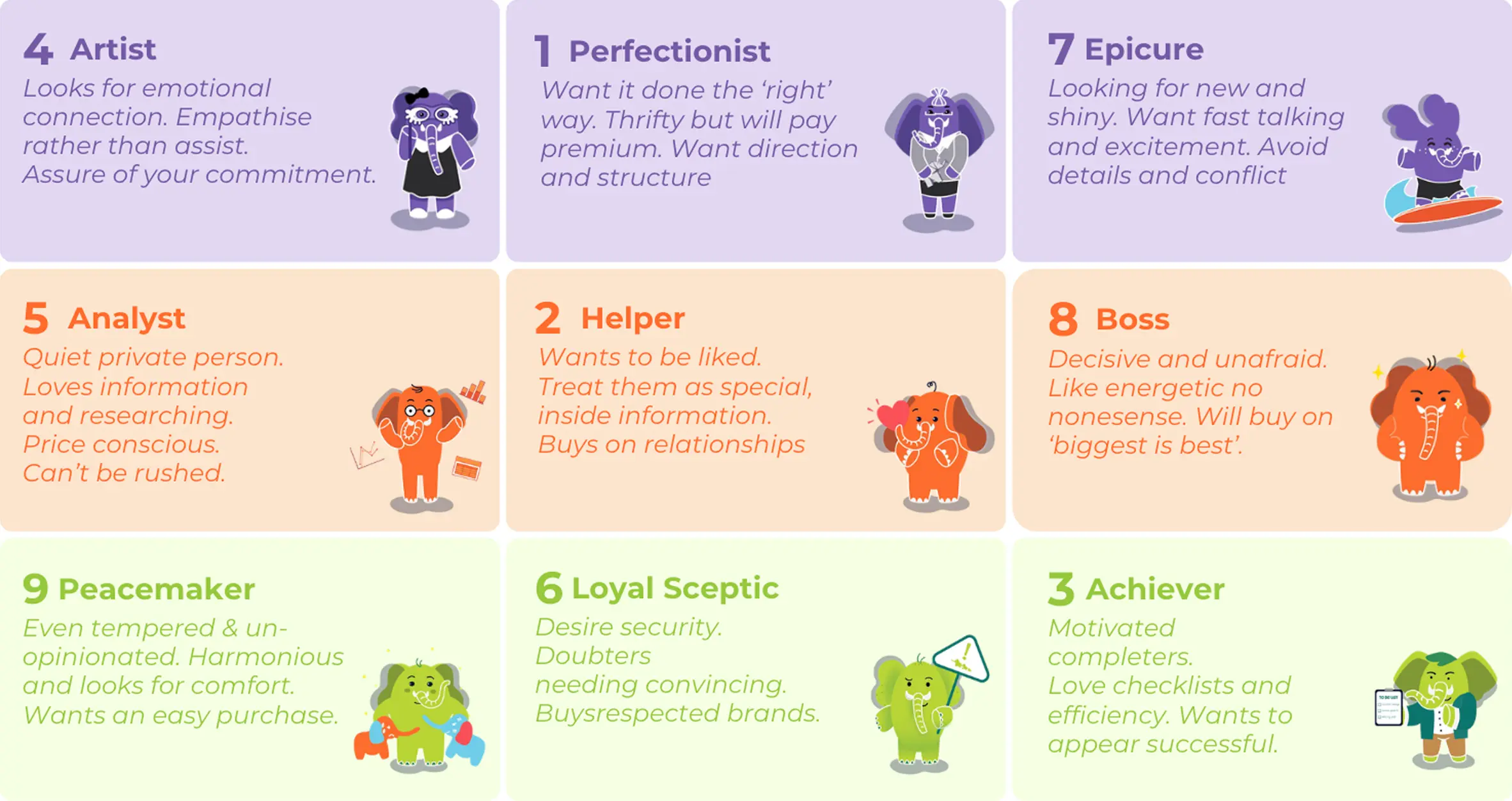
The Brand Canvas
The brand canvas provides a visual representation of a brand’s unique business value and positions the brand on an industry wide customer base map. The brand canvas, in conjunction with the NeuroPower framework, can help you identify whether your brand aligns with its value proposition and connects with the ideal customer segment.
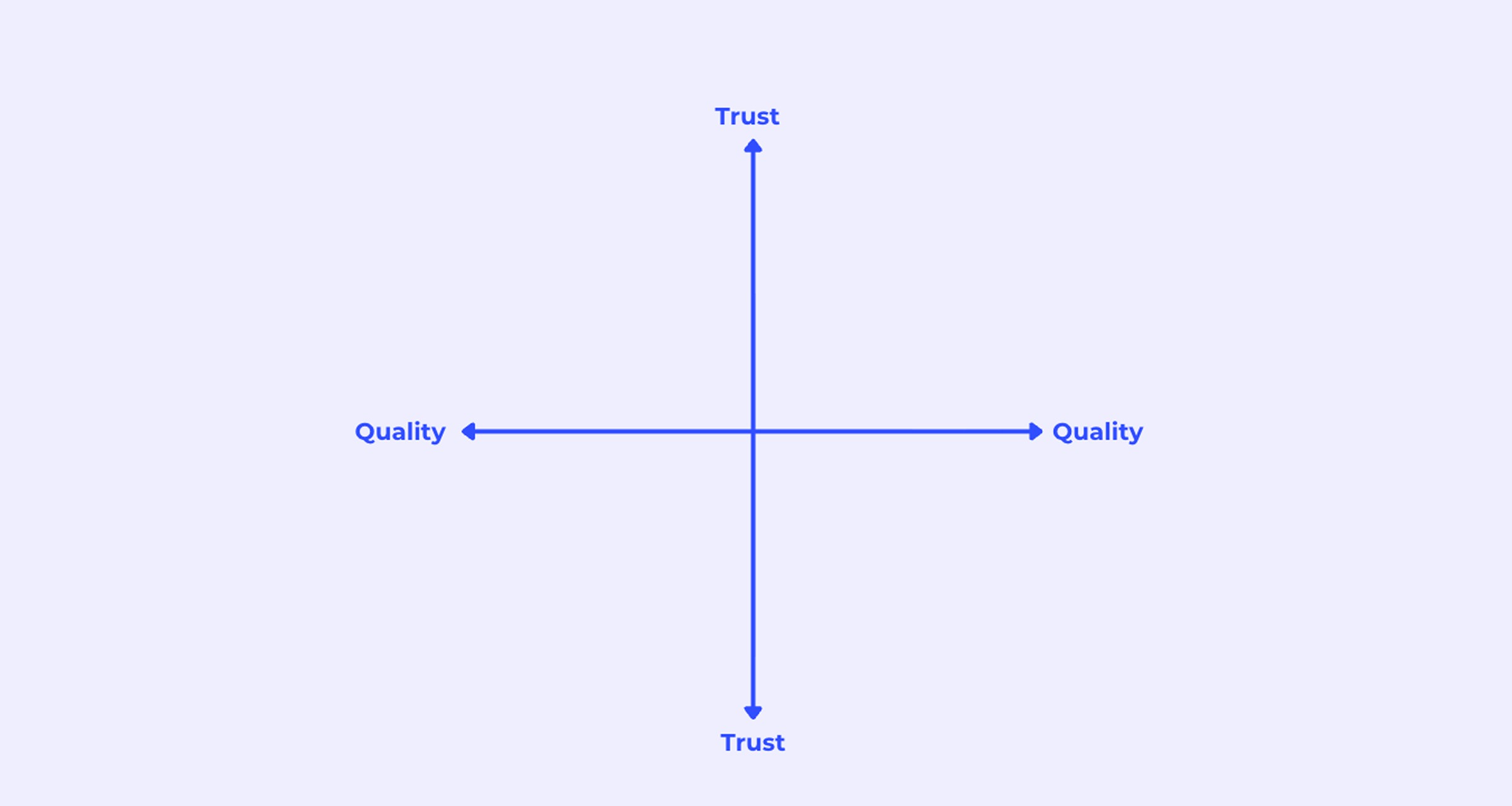
The brand canvas is a four-quadrant matrix where each axis represents a fundamental element to your brand’s unique business value. Perhaps your brand’s core values are to deliver a high quality product/service while maintaining consumer trust. As such, the brand canvas could include a quality continuum and a trust continuum.
How to draw your own Brand Canvas
Identify your brand’s value proposition
Ask yourself, what two primary values do we want our brand to offer to the market? These two primary values will become the X- and Y- axes of your Brand Canvas. Having a clear understanding of your brand’s value proposition and distilling them down to two primary values, will establish the type of footprint you want your brand to have on the market.
Your brand’s position
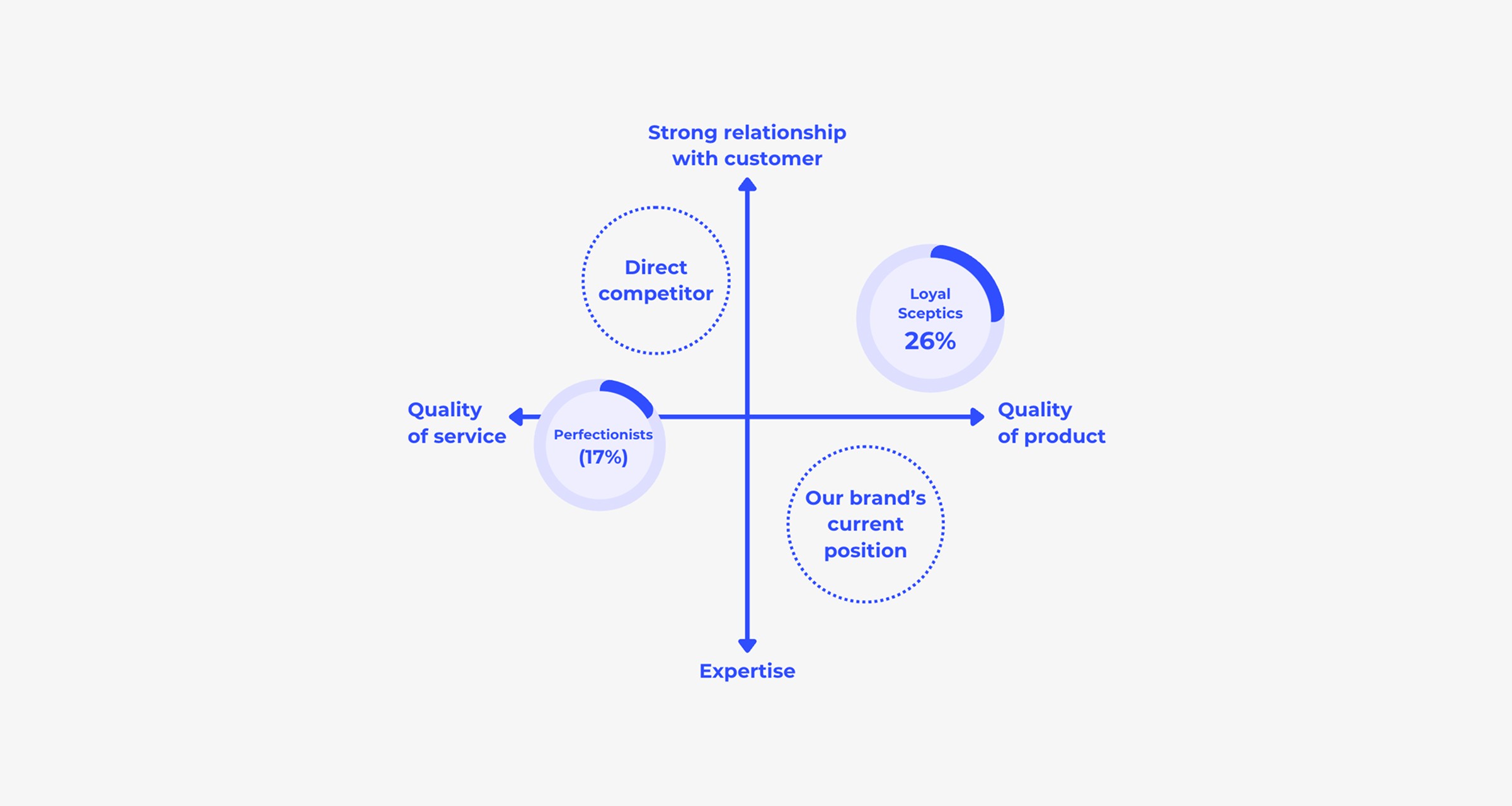
Consider the scale to which your brand meets your two primary values, and plot this position on the brand canvas. Continuing with the Quality and Trust example, is your brand currently delivering a high quality product/service while maintaining a high level of trust from your customer base?
If yes, your brand is positioned in the top right quadrant of the brand canvas and is fulfilling the purpose you defined. If no, there may be misalignment between consumer perception and your brand’s ideal position in the market.
Define your primary values
Consider each axis as a continuum. How would you, and your customers, define each extreme? Continuing with Quality and Trust as an example, customers could define the quality of the product as one extreme and the quality of the customer service provided as the other extreme.
The trust continuum could be defined as brand expertise in the market and the strong relationship the brand builds with the customer base. Clarifying the extremes of each continuum will help your brand identify the space you currently own in the market and whether there is a need to shift to a more desirable position.
Profile the customer base
The next step is to understand your customer base. Using the NeuroPower™ Framework, the position of the nine Core Belief profiles on your brand canvas depends on the scale to which each profile appeals to both of your two primary values.
Using quality and trust as an example, the Loyal Sceptics (CBP 6) sit neatly in the top right quadrant as they appeal to brands whose product/service consistently deliver and the brand instills confidence in the product through a welldeveloped relationship.
Alternatively, the Perfectionists (CBP 1) value a brand’s association with industry standards and is less influenced by the strength of relationship but rather the confidence in the brand’s expertise.
Repositioning your brand
Once you have identified your values and the CBPs that are implicitly drawn to those qualities, you can then use this insight to shift your current position along both continuums towards your ideal customer base. Directing this shift can be achieved through a number of ways, for example:
Evaluate your current brand perception in the market against the relevant customer core belief profiles through focus groups or individual interviews.
Develop marketing campaigns that speak to the implicit desires of the relevant Core Belief Profiles that lead to a positive perception of your brand.
Assess how your current offering meets the needs of the ideal customer core belief profiles and use the feedback to revise and update your offering.
Develop new products targeted towards your ideal customer core belief profiles.
The insights from the brand canvas provides a fresh perspective to help develop strategies that target the desirable customer Core Belief Profiles. From this, you can begin to differentiate from the competition, shift towards the ideal client base and align with the core values of the business.

Through the lens of behavioural economics, the brand canvas is a useful tool to reposition your brand and improve its current market perception. The brand canvas also challenges you to think about your customers from a System 1 perspective, uncovering the drivers behind each profile’s decision making process that influence how they perceive your brand and purchase your product.
The brand canvas provides behavioural insight for you to develop strategies that focus your offering towards customers who are already implicitly drawn to your brand’s core values, which ensures alignment between market perception and the value proposition of your offering.