Complex strategic decisions involving judgement, interpretation and complex trade-offs are at the centre of effective teamwork at senior levels of organisations. Yet leadership teams find it difficult to get it right.
Perhaps this is because our brains have developed problem-solving processes that rely heavily on past experiences which significantly bias today’s preferences.
In a study conducted by McKinsey of more than 1000 major investments, it emerged that when leadership teams understand how to mediate their biases in decision-making they achieved returns of up to seven percentage points higher. (For more on this study, see The Case for Behavioural Strategy, McKinsey Quarterly, March 2010.) Cognitive bias is real and alive in most leadership teams. In this chapter I will outline the top 19 decision-making biases that derail executive teams, how to detect which of these most impact your team and how to minimise their effect.
How cognitive bias and group-think undermine judgement
We all like to think that we make decisions logically and objectively. Neuroscientists working with economists are discovering, however, that our decision-making isn’t as rational as we believe. In fact, the way our brains function means that we all have blindspots and biases that influence the choices we make. By learning how to spot the most common blindspots, both in yourself and in your team you can increase the effectiveness of your decisions.
Decision-making is one of the most important responsibilities of a leadership team. It’s also often the hardest and riskiest part of the job. Poor decisions can damage the business and careers – sometimes permanently. A now-classic example of this is the Deepwater Horizon oil spill crisis in the US in 2010, the largest accidental marine oil spill in the history of the petroleum industry that resulted in the disappearance of 11 people and devastated the marine and wildlife habitats (and associated fishing and tourism industries) in both the Gulf of Mexico and further afield.
When we first started using this as an example of biased decision-making, within a year of the initial explosion, the underlying causes of the disaster were unknown. Our discussions were, therefore, necessarily limited to theory or conjecture – was the accident simply bad luck, or a matter of bad decision-making? We mused that, even from the limited information available at the time, it seemed possible that BP CEO, Tony Hayward, presided over an organisational culture that permitted risk-taking, ignored expert advice, disregarded warnings about safety issues and hid facts. What if BP’s failure to respond to the disaster itself with sufficient speed and attention was also a direct consequence of this flawed culture?
Since then, numerous investigations have explored the causes of both the initial explosion of the oil rig and the record-setting spill. In 2011, a White House commission found that cost-cutting efforts on the part of BP and its partners, combined with insufficient safety systems and culture were triggered as significant contributors.
Almost six years after the incident, BP has plead guilty to federal criminal charges (including a felony count of lying to Congress), submitted to monitoring of its safety practices and ethics, been temporarily banned from new contracts with the US and has paid more than $60 billion in criminal and civil settlements, payments to trust funds and fines. This included the largest corporate settlement in US history ($18.7 billion), after BP was ruled to be primarily responsible for the oil spill due to gross negligence and reckless conduct.
Even as the early stages of events unfolded, the tenor of the public discussion was revealing. CEO Tony Hayward’s seeming inability to understand the public reaction (including reaction to his comments) made him appear at best, defensive and out of touch with the reality of the situation and, at worst, weak, petty and selfish. But how could someone so senior with a team of top advisors be so (apparently) blind? To find out, we need to look at the role blindspots play in how decisions are made.
The way our brain works can sabotage our decisions
As leaders, we are constantly called upon to deal with complexity. Faced with the need to process vast amounts of information in order to make decisions, we resort to unconscious routines. These mental shortcuts (also known as heuristics, or decision rules which are simple for the brain to compute) enable us to make decisions and avoid both ‘information overload’ and ‘analysis-paralysis’. In general, heuristics are very useful when making most routine decisions or when time is of the essence, but they can also lead to severe and systematic errors in judgement.
Researchers at INSEAD, Harvard, Oxford and Stanford Universities have identified a whole series of such flaws in the way we think when making decisions (besides heuristics, others include ‘motivational factors’ and ‘social influence’). Of course, what makes these blindspots so dangerous is their invisibility. Because they are biases that are hardwired into our brains, we fail to recognise them and repeatedly make the same mistakes. These blindspots effectively create holes in our reasoning ability which, over time, produces recurring patterns of erroneous decision-making. In a group, the combined, overlapping biases of the individuals in the team reinforce and amplify biases. This can result in disastrous decisions.
While no one can entirely rid their mind of these ingrained patterns, it is possible to learn strategies to compensate for some of these biases. Awareness is key and the first step is to understand how these blindspots are formed. Executives who familiarise themselves with the
se blindspots and the diverse forms they take can consciously adapt their decision-making processes to ensure that the decisions they make are sound.
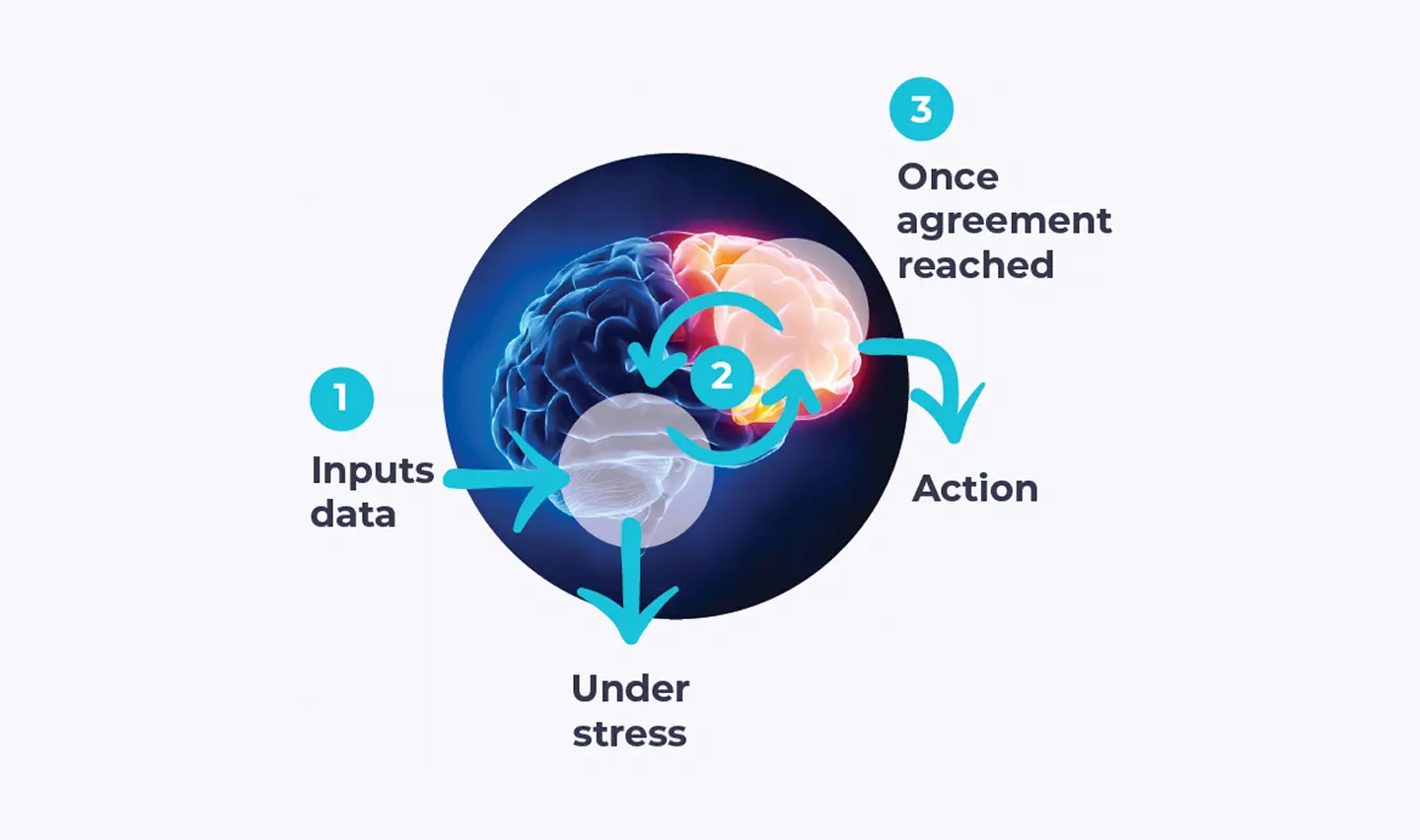
Figure 1. How the brain makes decisions: System 1 and System 2
Input enters the brain and the limbic system reacts emotionally, based on existing Core Beliefs – System 1.
If the situation is not ‘out of the ordinary’ (or ‘novel’), an habitual response is invoked and translates into immediate behaviour.
If the situation is novel, then the information moves to System 2. Here it is assessed and matched against the individual’s conscious worldview and analytical style to reach a decision.
The trial decision from System 2 is checked by the limbic system:
If it lines up with past experience (i.e. a similar decision has been made previously and the outcome is familiar) the individual will feel ‘comfortable’ with the trial decision, which will be embraced and translated into action.
If no similar decision has been made previously and the anticipated outcome is unfamiliar, a feeling of discomfort will arise and the trial decision will then be sent back to System 2 for further thought.
This moving between the two systems will continue until a balance is reached and both systems are comfortable with the trial decision. Only then will it be translated into behaviour.
How emotions colour our thinking – our core beliefs at work
While neuroscientists continue to grapple with the complex ways that emotions interact with and influence the cognitive skills involved in decision-making, one thing is clear: emotions play a crucial role. In fact, we actually can’t make decisions without them. By informing our desires, preferences and aversions, emotions shape our rational calculations. This is useful and necessary, because if we didn’t have an emotional response to something (one way or another) we wouldn’t be motivated to make a decision about it. Complete apathy leads to total lack of interest – we ‘tune out’.
Problems develop, however, because our emotional responses can inform our rational decision-making in a way that perpetuates our own personal philosophy on life (our unique worldview). Neuroeconomics describes people who decide different things in identical situations as different ‘types’. These types are described as having different decision rules or different core beliefs.
Core beliefs are deep-seated perceptions that everyone has about the world around them. Over the course of our lives, each of us has developed a complex matrix of core beliefs that we believe will keep us ‘safe’ in the world. These beliefs have evolved over millennia to help us respond quickly and unthinkingly to dangerous situations; they act as our survival strategies and are embedded in the most primitive parts of our brain.
System 1 and System 2 – your emotional and rational brain
The interaction of our emotion-based core beliefs and our rational brain is illustrated in Figure 1 – How the brain makes decisions. It shows how the two cognitive systems in our brain interact to make decisions and ultimately produce behaviour.
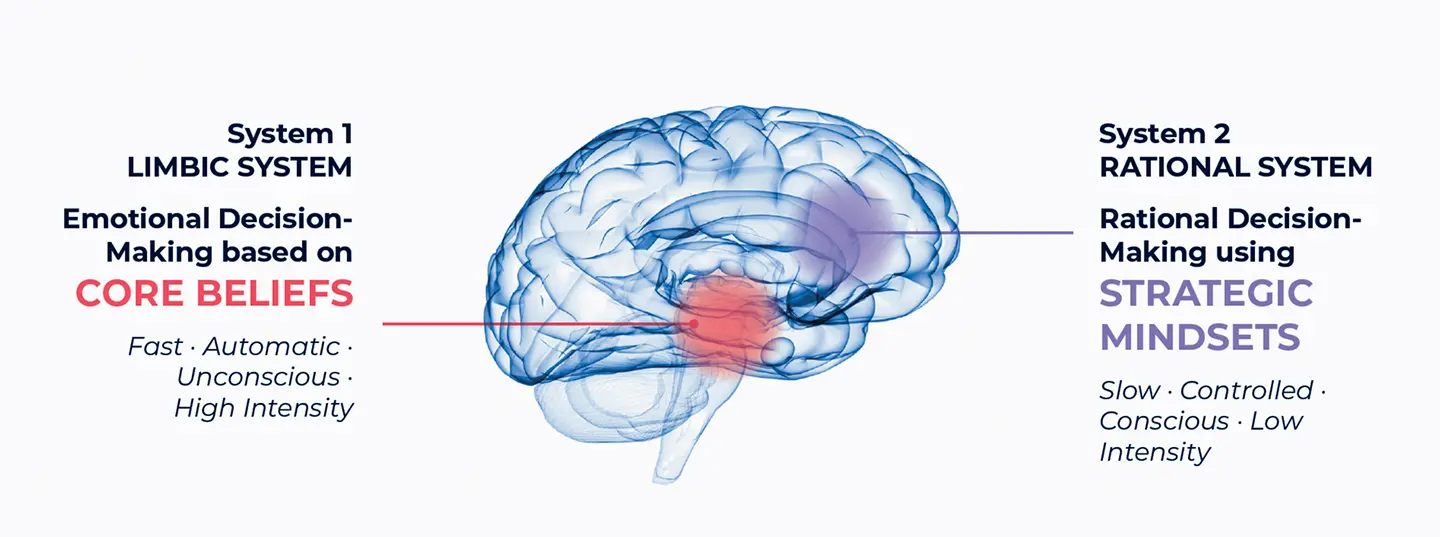
As Daniel Kahneman (who won a Nobel prize for his work in the area of neuroeconomics) explains, these two systems differ in speed, flexibility and operation.
The operations of System 1 (our emotional and most primitive brain – where our core beliefs live) are typically fast, automatic, effortless, associative, implicit (not available to introspection) and often emotionally charged; they are also governed by habit and therefore difficult to control or modify. The operations of System 2 (our rational, more evolved and modern brain) are slower, serial, effortful, more likely to be consciously monitored and deliberately controlled; they are also relatively flexible.
Both System 1 and System 2 influence our judgements and choices – meaning that how we feel about something is as important as what our reasoning tells us about it. While this may conflict with our view of our own decision-making as highly rational, it often lines up with our experience of other people (who we see as occasionally irrational and emotional when we are arguing with them).
What makes this process particularly hard to track in ourselves is our tendency to rely on our primitive brain with its relatively simple (emotionally-charged core belief) evaluations to arrive at our decisions. We do this because it’s so much easier and requires far less effort than using our rational brain. We then retrospectively justify (or post-rationalise) our core belief-based decisions using our rational brain and see them as rational choices.
In this way, each core belief’s (or different type’s) survival strategy filters out important data. This produces blindspots in System 1’s emotional responses that influence what otherwise seem to be System 2’s rational decisions. They are, therefore, linked to the many forms of what psychologists call ‘cognitive bias’, including a tendency to draw incorrect conclusions in certain circumstances based on partial evidence.
An understanding of your own core beliefs is a great asset for any current or aspiring leader because it enables you to predict and, therefore, circumvent likely cognitive biases (i.e. your personal bias), thereby increasing the effectiveness of your decision-making.
In the same way, insights about core beliefs and how they drive our decision-making can also be applied in a team context; by understanding the core belief profiles of the team, it becomes possible to predict the most likely cumulative and amplified cognitive biases that the team will experience in group decision-making processes.
Furthermore, because emotion is so central to our decision-making, the impact of our core belief-driven survival strategies vary according to our level of stress.
The core beliefs continuum from best to worst
Under low stress, we're at our best: we can harness our motivation and manage cognitive bias effectively. This is our sweet spot.
As stress increases, we enter the Danger Zone, a "pinch" state where our reactions become harder to control. At this stage, it's still possible to settle ourselves down through self-management.
If we don't, we reach the Crunch: full high-stress meltdown. We lose control, damage relationships, and make very poor decisions.
At best, when everything is proceeding as ‘business-as-usual’ and we are experiencing healthy levels of stress, our core beliefs help us make timely decisions. While these decisions may be correct, they are inherently biased. With awareness, we can learn to manage many of these personal biases using our rational brain.
As we become slightly stressed, our core beliefs encode the sorts of things that are likely to trigger us emotionally (based on whatever it is that we learnt to associate with survival when we were young). As the stress intensifies, we can get to an emotional tipping point, when we get triggered because we subjectively perceive (usually inaccurately) that our survival is being threatened. This explains why you might find something frustrating, annoying or infuriating, while others seem blissfully unaware it even happened – you simply have different core belief survival strategies that are wired to see different things as potential threats.
When something triggers you emotionally, you reach this emotional tipping point. This is also known as experiencing an emotional ‘pinfch’. Unfortunately, as your stress levels increase further, usually because the issue isn’t addressed, the pinch can progress further to a second, much more dramatic tipping point called a ‘crunch’. This highly emotional state often causes damage to relationships, both personal and professional, and leads to very poor decisions.
The rest of this article will be focusing on the cognitive bias aspect of this continuum rather than the pinch or crunch tipping points.
While it assumes at least a basic understanding of the Core Belief Profiles in making the links to different cognitive biases, that’s certainly not necessary to grasp the key concepts we’ll be discussing.
As an introduction, Figure 3 provides a brief overview of the nine Core Belief types. If you’re interested, you can find out more information about the Core Beliefs – and start the process of identifying your own and those of your team – by reading the book, Core Beliefs: Harnessing the Power (Burow, 2012).
The Nine Core Belief Types Each of us has three of these core beliefs:
Core Belief Profile 1 – Perfectionists · Focus: Integrity/Clarity
Driven by the belief that you must be good and right to be worthy. Consequently, are conscientious, responsible, improvement-oriented and self-controlled, but also can be critical, resentful and self-judging.
Core Belief Profile 2 – Helpers · Focus: Influence
Driven by the belief that you must give fully to others to be loved. Consequently, are caring, helpful, supportive and relationship-oriented, but also can be prideful, overly intrusive and demanding.
Core Belief Profile 3 – Achievers · Focus: Achieving Results
Driven by the belief that you must accomplish and succeed to be loved. Consequently, are industrious, fast-paced, goal-focused and efficiency-oriented, but also can be inattentive to feelings, impatient and image-driven.
Core Belief Profile 4 – Artists · Focus: Elite Standards
Driven by the belief that you must obtain the longed-for ideal relationship or situation to be loved. Consequently, are idealistic, deeply feeling, empathetic and authentic to self, but also dramatic, moody and sometimes self-absorbed
Core Belief Profile 5 – Analysts · Focus: Analysis/Depth of Technical Knowledge
Driven by the belief that you must protect yourself from a world that demands too much and gives too little to assure life. Consequently, are self-sufficiency seeking, non-demanding, analytical/thoughtful and unobtrusive, but also can be withholding, detached and overly private.
Core Belief Profile 6 – Loyal Sceptics · Focus: Loyalty/Scepticism
Driven by the belief that you must gain protection and security in a hazardous world you just can’t trust. Consequently, are themselves trustworthy, inquisitive, good friends and questioning, but also can be overly doubtful, accusatory and fearful.
Core Belief Profile 7 – Epicures · Focus: New Opportunities
Driven by the belief that you must keep life up and open to assure a good life. Consequently, are optimistic, upbeat, possibility – and pleasure-seeking and adventurous, but also can be pain-avoidant, uncommitted and self-serving.
Core Belief Profile 8 – The Boss · Focus: All or Nothing
Driven by the belief that you must be strong and powerful to assure protection and regard in a tough world. Consequently, are justice-seeking, direct, strong and action-oriented, but also overly impactful, excessive and sometimes impulsive.
Core Belief Profile 9 – Peacemakers · Focus: Minimising Conflict
Driven by the belief that to be loved and valued you must blend in and go along to get along. Consequently, are self-forgetting, harmony-seeking, comfortable and steady, but also conflict avoidant and sometimes stubborn
Understanding cognitive bias
While there are more than 200 different cognitive biases, there are almost 20 that can have particularly profound impacts on individual and collective decision-making, and benefit from being tracked and measured in teams. (N.B. This does not include biases caused by an inability to understand and work with numbers – also known as innumeracy biases).
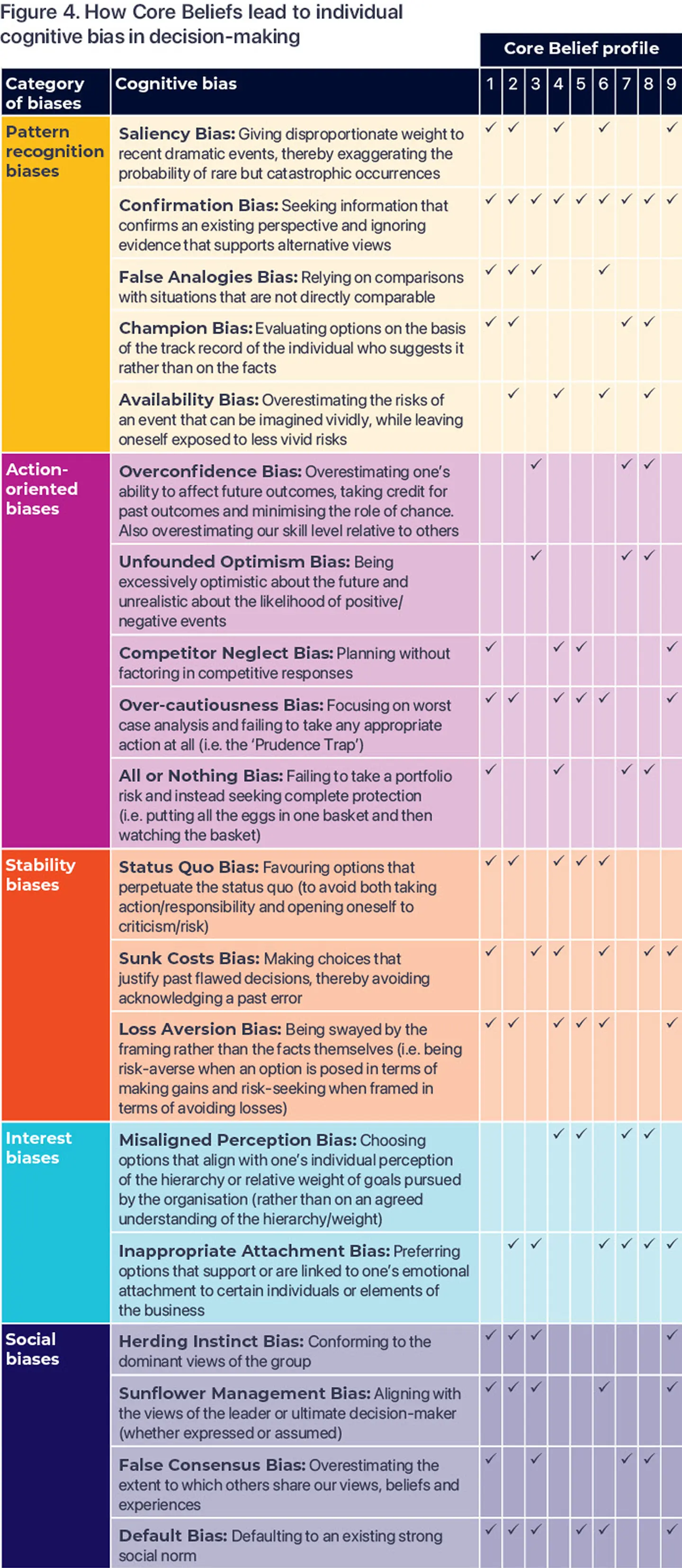
As shown in Figure 4, these 19 biases can be grouped into five main categories:
Pattern recognition biases: Misinterpreting conceptual relationships or identifying patterns where there are none;
Action-orientated biases: The drive to take action too quickly;
Stability biases: The tendency toward inertia in the presence of uncertainty;
Interest biases: Arising in the presence of conflicting incentives (including non-monetary and even purely emotional ones);
Social biases: The preference for harmony over conflict.
Cognitive bias in action: poor decision-making at BP
Returning to the BP situation, even the initial information suggested there were elements of underestimating risk, ignoring advice, disregarding warnings about safety issues and post-rationalising. These are all classic markers of Confirmation Bias.
This suggests that BP’s decision-making may have been biased towards confirming existing beliefs by seeking only information that confirmed preconceptions and by ignoring evidence in support of other viewpoints. Unchecked, Confirmation Bias results in ill-informed, narrow and partial decisions most commonly seen in situations of ‘Groupthink’.
Groups with this bias often exhibit a degree of ‘we’re right, you’re wrong’ certainty that is often unwarranted. In the BP case, this may help explain the wildly inaccurate early estimates regarding the environmental impact of the disaster.
Without having undertaken a detailed and direct cultural and cognitive bias analysis, BP’s actions also showed signs of three other biases: Unfounded Optimism Bias (being excessively optimistic about the future and unrealistic about the likelihood of positive/ negative events), Overconfidence Bias (overestimating their ability to affect future outcomes in the cleanup process) and False Consensus Bias (overestimating the extent to which others shared BP’s perspective on the disaster and instead assuming that everyone else thinks the same way they do).
Each of these biases is common to the Core Belief Profile 3 (described in Figure 3). Perhaps the team had too many Core Belief Profile 3s in its composition, or perhaps they had a number of Core Belief Profile 3 advisors. Or the BP culture may reflect the legacies of Core Belief Profile 3s in the past.
While we can hypothesise about the decision-making factors that contributed to the accident, it’s important to note that BP is not alone in experiencing biased decision-making.
When we work with Australian leadership teams and boards that are facing highly stressful situations (e.g. shareholder outrage at poor performance), they can often track back the seeds of the situation they are facing to a long line of poor decisions that reflect the primary biases of the team. Unchecked, cognitive bias leads to poor commercial performance, because the crucial decisions from the top are flawed.
Highly complex and important decisions are the most prone to distortion by cognitive bias because they tend to involve the most assumptions, the most estimates, and the most inputs from the greatest number of people. And, of course, the higher the stakes, the higher the risk of falling prey to one or more psychological biases because we are stressed and by nature therefore more emotional.
Even if teams can’t eradicate the distortions ingrained in the way their members’ minds work, they can build tests and discipline into their decision-making process that can uncover errors in thinking before they become errors in judgement and lead to disastrous decisions.
Cognitively balancing cognitive bias
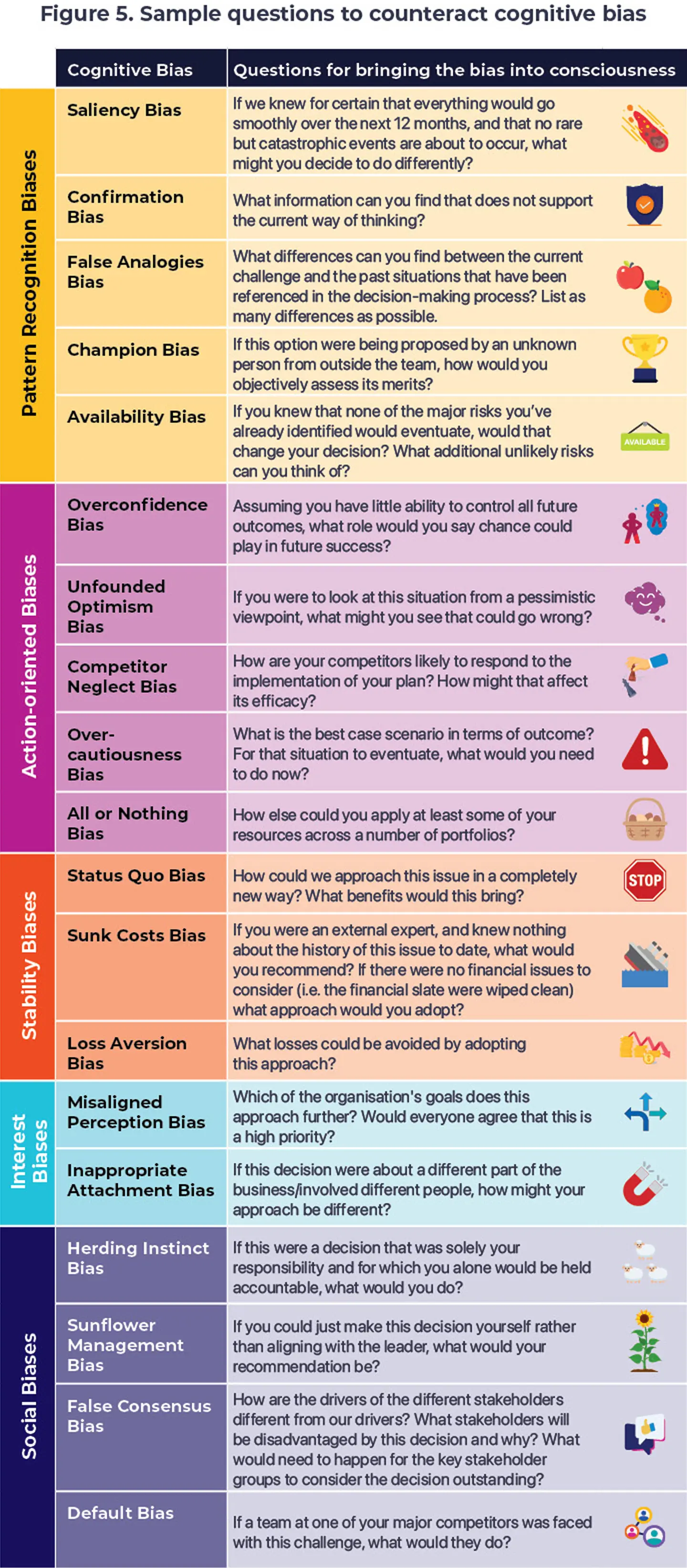
In a team context, the most effective way to minimise the impact of certain cognitive biases on group decisions is to create awareness of the team’s collective bias and to use key questions to balance the bias.
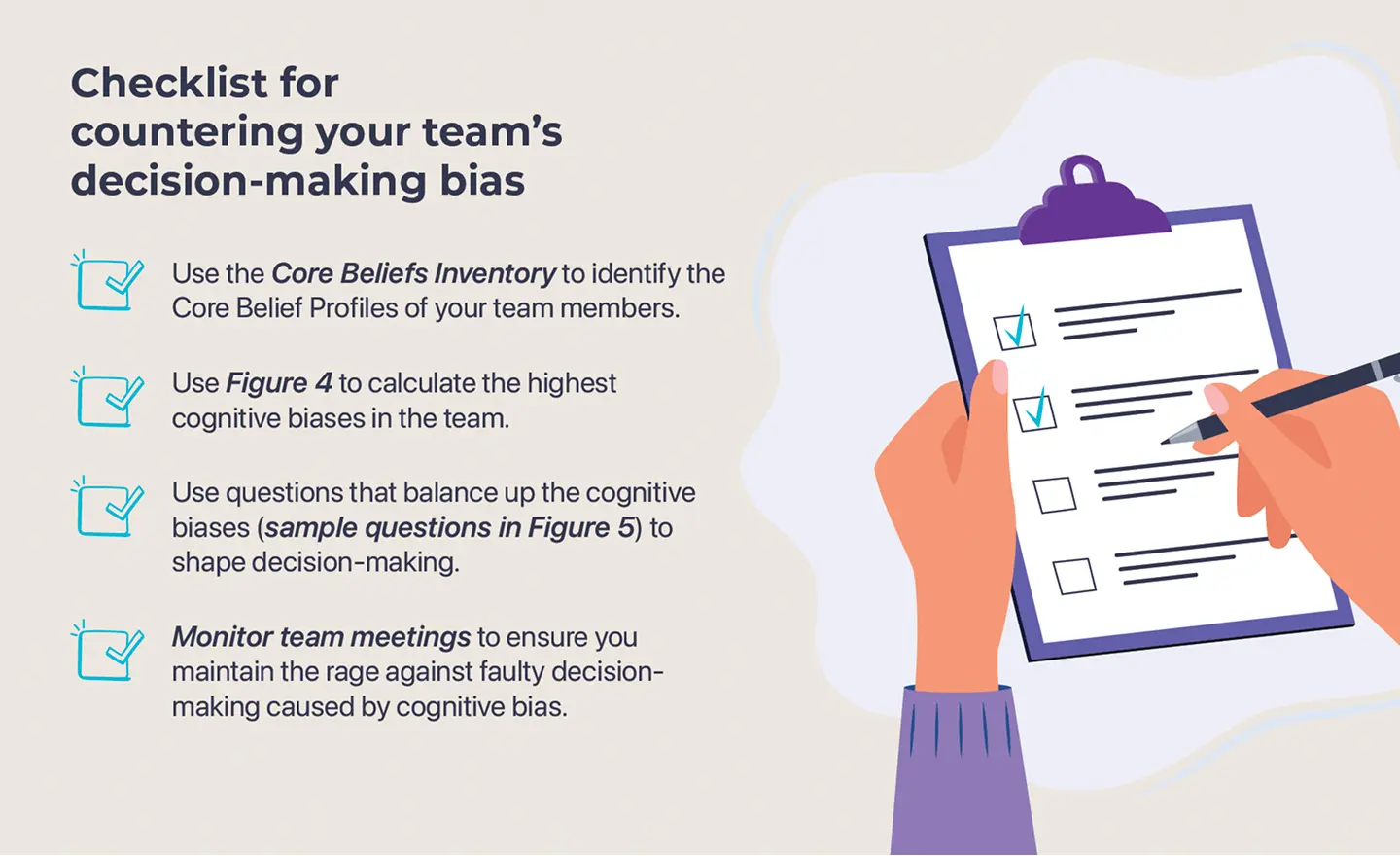
When we work with leadership teams, we enhance and sharpen the focus of this awareness by identifying the exact Core Belief Profiles in the team using a tool called the Core Beliefs Inventory and then cross tabulate this with the 19 biases (see Figure 4). With this information, it is possible to tally which of the 19 cognitive biases will have the greatest influence over the team.
The questions outlined in Figure 5 can be used to counteract the team’s biases and drive more effective decision-making. Calculate key high priority biases within your team and then workshop the relevant questions.
Decision-making, either as a leader or as part of a team, is never an easy process. Unfortunately, as the stakes increase, so too does the likelihood that the outcome will be driven by cognitive bias, rather than the reality of the situation. The good news is that with awareness and questioning, you can significantly reduce cognitive bias. And, once done, the effectiveness of your decisions will increase – to the benefit of both you and your team.
Awareness is the key to counteracting bias and overcoming decision-making blindspots