
In every industry, there is a ‘maturity journey’ that tracks the ability of an organisation to work effectively in ever more complex environments in an ever more dynamic and efficient way.
This maturity model tracks the way human societies develop, from primitive, competing tribes that ‘muddle-through’ each new challenge, all the way through to highly sophisticated, integrated, collaborative, fluid organisations that have the ability to synthesise complexity rapidly, anticipate challenges and focus their effort in a way that fosters innovation and delivers new levels of customer, service, product or industry excellence.
As each organisation works to move from reactive service delivery towards an integrated, forward-thinking system that anticipates future challenges and leverages from the best of its people, an understanding of the People Capability Maturity Model (PCMM) outlined in this article provides a structure for organisations to recognise their current state, but also define the steps that will enable organisational maturity, growth and effectiveness.
Many organisations would no doubt assume that they operate in the advanced stages of this model, however, in our experience, this is often only the case in certain pockets throughout the organisation. In fact, very few organisations have achieved true excellence in information management, performance systems and leadership.
The result is that while innovation, collaboration and highly sophisticated service does exist within work functions or units – or in the passion of individual employees – very rarely is this same mindset captured within the broader organisation, its structures or its systems.
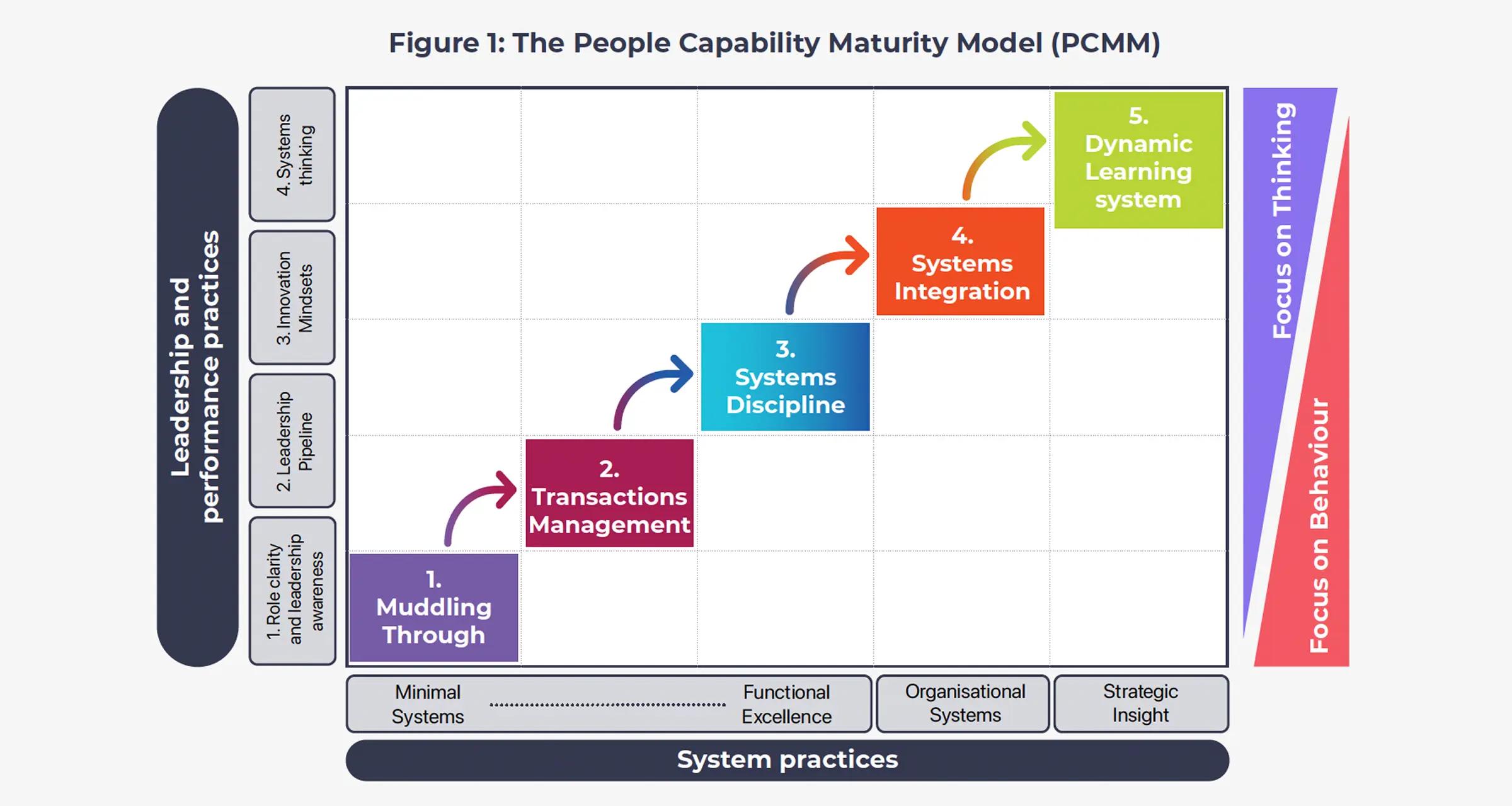
Defining the journey: People Capability Maturity Model (PCMM)
Figure 1 outlines three basic concepts:
Maturity Phases
Five stages which rise diagonally from the bottom left-hand corner of the model to the top right. Every organisation must pass through these phases if it is to reach ‘maturity’ and this entails introducing practices in two areas defined by the horizontal and vertical axes.
Systems Practices
These are the horizontal axis practices that an organisation needs to implement in order to transition to the next stage of maturity.
Leadership and Performance Practices
The vertical axis maps the practices that an organisation needs to implement in order to transition to the next stage of maturity.

Note that the corresponding Systems and Leadership/Performance practices axes both generally need to happen in order for the organisation to progress to the next growth phase. This article explores each of these three concepts.
The Maturity Phases of Clinical Organisations
The Growth Phases, originally identified by Bill Curtis in his People Capability Maturity Model, show how organisations develop more sophisticated and effective systems as they respond to external and internal pressures:
Muddling Through
Transaction Management
Systems Discipline
Systems Integration
Dynamic Learning System
Each of these stages is reached as the organisation.
1. Muddling Through
Many organisations know too well the challenges of working in a turbulent environment. Indeed, many organisations may spend the majority of their operations in such turbulent times, or in some cases start-ups, small businesses, family-owned companies or independent entrepreneurs may operate in this space on a more continual basis.
For example, a small start-up with only the founder and one other member may initially have the necessary practices or processes absent or under-developed. The employees ‘make do’ and do what is needed for the business to deliver the best service possible, while keeping most of the information in their own heads.
However, as activity increases, or service demand escalates, employees may no longer be able to keep up with product/customer demands and therefore may no longer be able to meet the required level of service and start to feel ‘out of control’ and stressed from the workload.
Larger organisations in developing nations, however, can also experience this state of operation, typically after a large organisational change that has disrupted systems and processes, or – particularly in public environments – when the volume and complexity of services required by the community exceeds the organisation’s resources and ability to plan either temporarily or longer-term.
In public health services this could mean bed blockages, ambulance ramping, care being delivered in corridors and ‘heroic’ clinicians and support teams struggling to provide care in the face of adverse systems, poor technology and insufficient resources.
For corporate services this could mean campaigning for work, putting in for tenders or winning projects and coming to performing the tasks with little scope on how to proceed – it’s more of a figure it out as you go approach.
In the reactive, ‘fire-fighting’ state of this phase, the environment can seem overwhelming, where the focus is on the organisation surviving each day, with little opportunity to set direction, plan resources or operate in an efficient way.
Examples: Start-ups; small family businesses and small professional services firms.
2. Transaction Management
In response to challenges experienced in the previous phase, organisations take the next logical step, where they seek first to establish order through systems, processes and standards. Very basic system tools are introduced and the organisation implements processes to ensure that interactions (with partners, clients or with other services) are managed in a controlled way.
Daily operations are defined and foundational governance practices introduced, including potential specific work functions, units or departments. Staff or contractors may be hired to handle support processes, and the founders or small group of initial employees no longer need to handle everything.
During this phase some standards of work and values to guide practice may also be defined; but consistency is lacking and many of the practices may be slow, inefficient or reflect older operating models.
Organisational processes (e.g. equipment purchasing; human resources management; rostering; information technology) may enable a more consistent focus on product development or service delivery and even some forward planning.
However, with little development of the organisation overall or focus on its particular corporate ‘brand’, the approach to market growth or capitalisation is unpredictable and driven by personal views that are idiosyncratic to the founder, team or employee hub.
Examples: Second-generation family businesses; mid tier service firms; average performing corporations
3. Systems Discipline
At this stage in an organisation the systems that were introduced in Phase 2 become more developed and start to provide the control and reporting mechanisms that leaders need for managing organisational efficiency.
Training and induction procedures become more established allowing new employees to understand and follow the procedures and practices of the organisation. Reporting processes are established to manage budgets against stricter planning cycles and corporate governance practices strengthen to ensure a high standard of product or service delivery can be maintained.
In an environment of relative stability, centres of excellence emerge as key leaders shift their focus from establishing a ‘baseline’ to an increasing focus on client/customer experience and future planning.
Commercial organisations may also begin to focus on their internal ways of working, and take a more nuanced approach to their external ‘brand’.
At this stage of development functional areas (defined either by function, business unit or department) start to differentiate and further define their own way of working focused on delivering service excellence, providing superior products or becoming market differentiators.
While this increases the organisations ability to maintain standards of service, it also increases interactions amongst employees and teams as they begin to strengthen their identity with work. However, differences between separate functions or departments become more apparent and this will drive predictable conflict.
Team members build trust and collaboration with other members of their immediate team, but have little awareness or regard for colleagues in other units/functions of the organisation. Importantly, these predictable, consistently emerging features of specialist organisations impact directly on product/service delivery.
Stakeholders, clients or customers who fall within a particular service or product need will enjoy the benefits of more streamlined delivery (e.g. for a sales company it may be superior technical expertise or product information); however, customers or clients who interact with multiple areas of the organisation may have challenging experiences created by silos in the organisation’s systems and processes (e.g. troubleshooting or customer complaints may have to go through multiple channels, meaning the customer needs to relay their experience multiple times).
Within each area, strong leadership and processes have enabled small-scale efficiencies but the organisation overall is operating in silos, so productivity is not reaching full potential.
Examples: Microsoft; General Motors; Mercedes Benz; BHP
4. Systems Integration
In recognition of the challenges faced by the organisation at systems discipline, the next stage emerges when the organisation shifts its focus to improving whole-of-service issues, both horizontally (between different functional areas) and vertically (between different layers of leadership). This is where the use of technology (through organisation-wide databases, integrated technical equipment and unified financial tracking) provides integration across the organisation’s different departments, connecting many processes and enabling a whole-of-service view on current performance and whole-of-service demand/market patterns.
Leaders become increasingly aware of challenges at the interface between different functional areas and their impact on product/service delivery and begin to focus on ways to build relationships and smoother interactions between departments; however in the face of robust siloed governance and accountabilities, decisions are often still made in disjointed ways.
Examples: Disney; Citibank
5. Dynamic Learning System
Consistent organisational growth and performance excellence emerges as systems and processes are fully integrated so that directors and managers have good, accurate oversight on what the organisation is doing on a daily basis and can plan and prepare for the future. This is supported by leadership mindsets that enable the organisation to make complex trade-off decisions based on robust data. This combination of leadership and systems processes enables other leaders and employees at all levels of the organisation to make more effective trade-off decisions about resource allocation to maximise service delivery.
Senior leaders have more of their time freed up for service planning and anticipating future needs and the organisation looks years down the track to anticipate and plan for changing market needs and expectations.
With strong collaboration and integration horizontally across the organisation and vertically between layers of leadership, channels of communication and information flow smoothly. This enables ongoing improvement of products and/or services. Externally, the organisation is able to collect new evidence and conduct real-time tracking of service effectiveness, while internally, the organisation can simultaneously enable a culture of open enquiry and innovation.
Across all sectors, only the largest and most successful organisations in the world have reached this stage – the likes of Google and Apple.
Examples: Google; Apple; GE; Proctor & Gamble
The Five Stages of Organisational Maturity Summarised
Stage 1 - Muddling Through
At this stage practice processes are absent or under-developed, and the responsible owner keeps critical information in their own head. The implication for product or service delivery is that quality is reliant on individuals. In times of peak demand, customers and clients don't get the required level of service, and leaders feel stressed from excessive workload.
Stage 2 - Transactions Management
Basic system tools are introduced to help manage transactions more efficiently, and staff are hired. In terms of service delivery, there is responsiveness in times of great need or urgency, but consistency is lacking. Many practices are slow, some inefficient practices may feel outdated, and there is little development of customer experience.
Stage 3 - Systems Discipline
Systems become more developed and start to provide the control and reporting mechanisms the owner needs for managing data more efficiently. For service delivery, high levels of specialisation provide excellent products and services in highly defined areas, but a lack of integration and communication between different functions or departments leads to disjointed customer experiences. Some processes remain clumsy and labour-intensive, and productivity is not maximised.
Stage 4 - Systems Integration
Technology provides integration across departments, connecting many processes and providing a whole-of-service view of consumer demands and performance. The focus on collaboration and the customer journey helps resolve pain points in the customer experience through more effective integration between business functions and departments. Integrated systems enable leaders at all layers to anticipate customer needs and track performance.
Stage 5 - Dynamic Learning System
Systems and processes are fully integrated so directors and managers have accurate oversight on what the business is doing daily and can plan and prepare for the future. Senior leaders have time freed up for strategic planning for future service provision, with access to robust data to make trade-off decisions about how to deliver maximum service levels with available resources.
How long it takes a organisation to move from one stage to the next depends on many factors. Below we look closer at the Systems Practices that need to happen for an organisation to progress.
Systems Practices (Horizontal Axis)
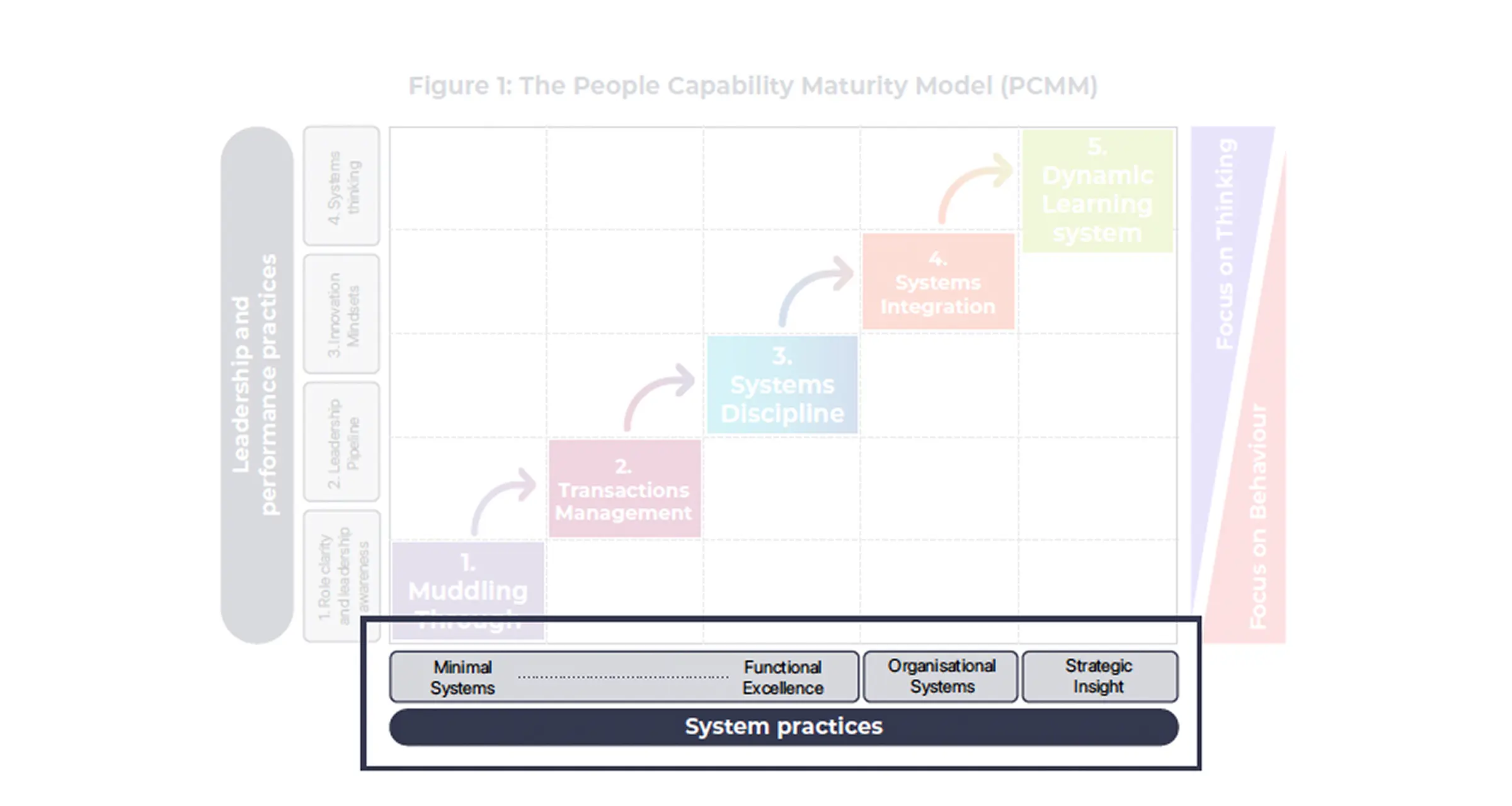
In order to develop maturity, an organisation needs to progress through a series of four systems practices that, in conjunction with the leadership and performance practices (vertical axis), drive the desired ‘end state’ of full maturity.
Systems practices outline the phases of work that need to be undertaken in order to effectively structure an organisation horizontally or functionally across the business.
These stages of development on the horizontal axis are:
1. Minimal Systems
This is where an organisation hasn’t segmented work into horizontal functions, but instead uses an ‘all hands on deck’ approach. It is this ‘muddling through’ mindset that keeps the business firmly in Stage 1 of maturity.
2. Functional Excellence
An organisation reaches Stage 2 when work functions have been broken up and siloed horizontally into different specialist areas (e.g. clear demarcations between specialties, well-established professional cohorts with independent leadership, well-define corporate support functions including operations, finance, HR etc.) This creates areas of responsibility and efficiency and a critical mass of expertise that develops its own momentum and community of practice.
Methodologies like Kaizen, Total Quality Management and, more recently, LEAN are often implemented at this stage to re-examine clinical processes, embed systems thinking and practice and replace tactical fire-fighting cultures with cultures that encourage functional excellence.
3. Organisational Systems
Stage 3 is achieved when the organisation has systems in place that run across all functions and bring the whole organisation together as one system.
Often integrated software systems developed with an emphasis on integration of service planning, delivery and tracking are introduced to help manage flow of work between functions by creating shared platforms that minimise administrative data entry and maximise timely patient and organisational data.
4. Strategic Insight
The final stage is one of strategic insight, where organisational systems provide up-to-date information and insight that allows for crucial strategic decisions to be made in real time and executed across the organisation. Data is effectively captured and used to monitor work flows throughout the organisation and enable investment decisions to be made.
Essentially any organisation starts off relatively unstructured and one-dimensional but, as it develops, builds functional excellence through systems that help manage the work flow across all departments, leading it eventually to ‘maturity.’
Leadership and Performance Practices (Vertical Axis)
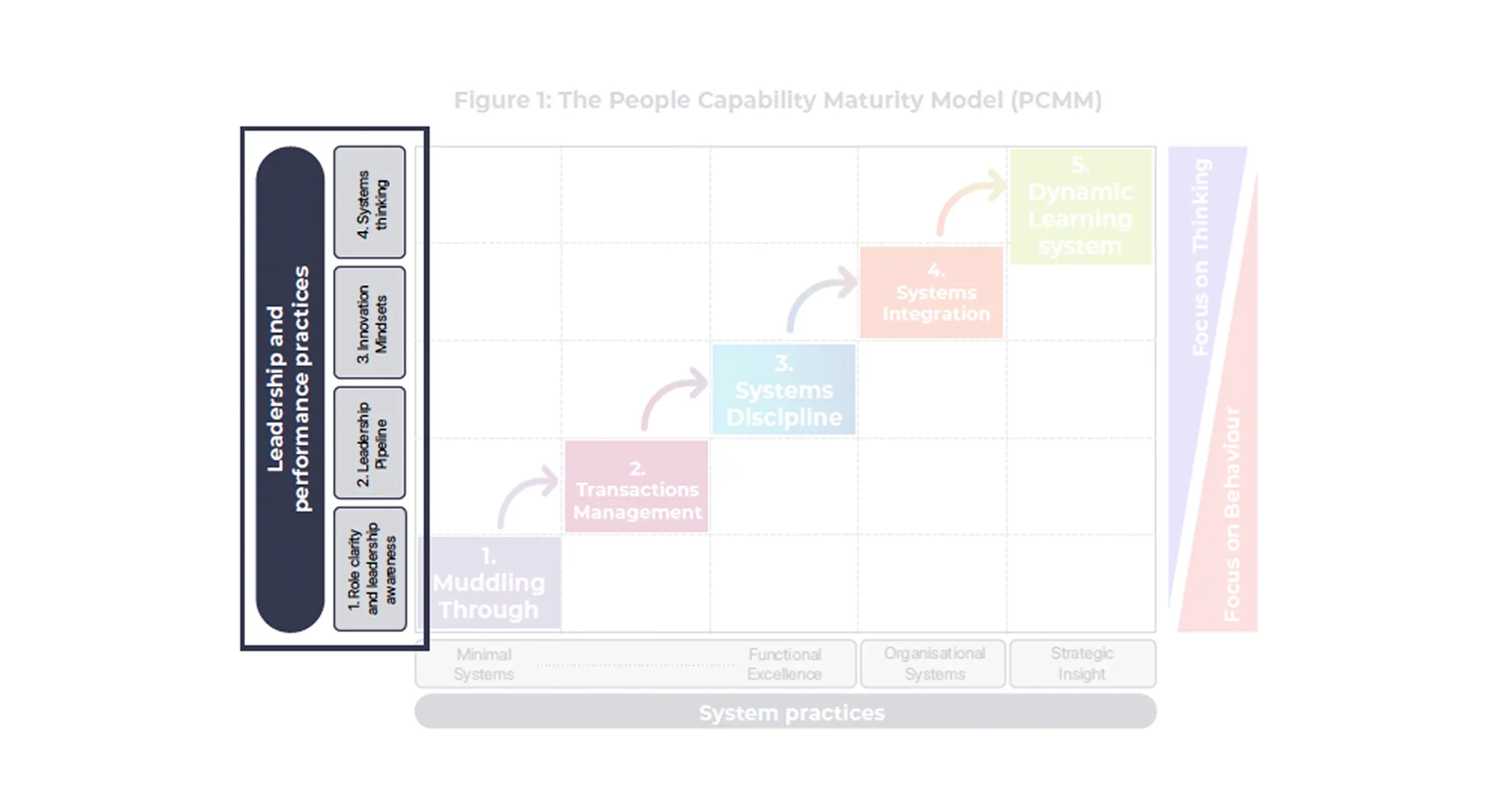
The vertical axis describes how an organisation needs to develop from the angle of vertical or hierarchical performance, showing what progress needs to be made alongside the systems advances, in order for it to move towards maturity.
There are four key transitions the organisation needs to make:
Role clarity
Leadership pipeline and performance standards
Strategic mindsets
Systems thinking
Contribution #1: Introducing Role Clarity and Leadership Awareness
When the organisation is muddling through, roles are not clearly defined in terms of authority, responsibility or delivery. No plan exists for people to grow vertically through the organisation and the organisation has a very ‘flat’ structure with very little segmenting of work. Often one person will therefore fill multiple roles.
The move from Muddling Through to Transaction Management requires roles to be clarified both in terms of responsibility and deliverables. This removes confusion and duplication and provides a clear line of sight between the contributions made by each individual and the objectives of the organisation.
Contribution #2: Introducing Leadership Pipeline and Performance Standards
The next transition – from Transaction Management to Systems Discipline – is achieved when a Leadership Pipeline is in place, which outlines how each layer of the organisation undertakes different leadership work and adds value in a different way. This enables authority and decision-making responsibilities to be defined at all levels of the organisation and provides paths for career development and progression.
The Leadership Pipeline was introduced by Ram Charan, Steve Drotter and Jim L. Noel. They outline six ‘passages’ in a ‘pipeline’ that any leader must take if they are to deliver on their responsibilities as a leader.
For leaders, the internal work at this phase is two-fold. Firstly, they develop good understanding of how to mentor and grow ‘in-house’ talent. This means not only understanding the value the new leader plays at that layer, but also the psychological steps this new leader will need to make the change.
The MEALER method (developed by Peter Burow and documented in Chapter 10 of the The Performance Pipeline) outlines six phases new leaders pass through to make the transition. When done well, the new leader takes up their role adding the right value for that layer in the organisation. When done badly, the new leader simply doesn’t make the transition and begins competing with and controlling the very people they are supposed to be leading and empowering.
If this lack of ability to help new leaders transition is widespread throughout the organisation, over time it drags senior leadership down to focusing on middle management tasks and middle managers down to supervisors, leaving vital leadership work throughout the organisation undone.
Systems Discipline requires the introduction of clear performance standards. Whereas the Leadership Pipeline divides leadership work across the layers of leadership within an organisation, the Performance Standards (also the work of Steve Drotter) outline what work determines performance and how this is delivered at each level of an organisation i.e. what do leaders do at a certain ‘layer’ to deliver the desired outcomes.
After the initial gains in productivity that come from implementing the Leadership Pipeline (resulting from increased strategic alignment and reduced duplication of work) have been realised, organisations sometimes find that an intensified focus on succession planning and leadership development delivers less and less return on investment.
This is often because their leadership development is focusing on the wrong area. The key is to focus on what each role needs to achieve and the leadership work to be done by each layer to enable the layer below to deliver exceptional results.
Reaching Systems Integration (The First Three Leadership Contributions on the Vertical Axis)
Contribution #1 - Role Clarity
Clear roles are introduced to define authority, responsibility and delivery. Professional plans exist for people to grow vertically through the organisation's flat structure, but with very little segmenting of work. Role clarity is established around responsibility and deliverables, but each individual fulfils multiple roles.
Contribution #2 - Introducing Leadership and Performance Pipeline Principles and Performance Management
Manager of Enterprise perpetuates the Enterprise Strategic Framework. The key focus question is: what should this enterprise look like in 20 to 50 years, and how will we get the resources we need? The growth mindset at this layer is Directed Performance, the control mindset is Building an Enterprise Immune System, and the leadership cognition is Sustainable Value.
Manager of Group focuses on the right portfolio and strategic differentiation for investment, including Business General Manager succession. The key question is: do we have the right collection of businesses, what should be added or removed, and are we developing people to run them? The leadership cognition at this layer is Non-Linear Interdependencies.
Manager of Business is responsible for profit, both long and short-term, and strategy including products, markets and customers. The focus question is: do our services add appropriate value for our patients, stakeholders and employees, and how should our strategy change to fit the community's major needs? The growth mindset is Agile Delivery, the control mindset is Tracking Progress, and the leadership cognition is Strategic Integration.
Manager of Function focuses on competitive advantage and functional excellence. The key question is: how can we do this better, and do we have the right functional capability? The leadership cognition is Diversity and Empowerment.
Manager of Managers is focused on productivity, integration and focus. The question to answer is: do I have the right leaders and the best processes, and are they working together? The growth mindset is Creative Collaboration, the control mindset is Planned Execution, and the leadership cognition is Amplification of Success.
Manager of Others enables delivery through assignment clarity and coaching. The focus is: are my people trained and motivated to add value for patients, and do I have the right mix of talent? The leadership cognition is Accountability and Compliance.
Individual Contributor focuses on delivery and patient satisfaction. The guiding question is: am I doing my best to deliver the right service, and am I being a good corporate citizen? The growth mindset is Problem Solving, the control mindset is Alignment and Capability, and the leadership cognition is Self-Expression and Application.
Contribution #3 - Introducing Innovation Mindsets
Innovation mindsets are embedded across all layers through the Growth Mindset, Control Mindset and Leadership Cognition columns described above for each pipeline layer.
Surprisingly few organisations make the transition to Systems Integration. It is only achieved when an organisation matches its advanced information management systems and strategic insight (described in the horizontal axis of the PCMM) with an advanced ‘innovation mindset’ (the third transition on the vertical axis.)
Once the organisation’s Leadership Pipeline and Performance Standards are in place, this final level of performance can only be achieved when leaders throughout the organisation are ‘thinking’ in the right way and at the right level of complexity. This means they are identifying the right problems to be solved at their layer and are resolving them in the right way.
This process can be fast-tracked using Peter Burow’s NeuroPower model, which draws on the latest insights from neuroscience and explores:
3. Strategic mindsets
4. Systems thinking
Embedding this model in an organisation means a breakthrough commercial mindset at all levels of leadership. These are outlined in Table 3 on the next page.
Strategic Mindsets (Contribution #3)
Manager of Enterprise
The growth mindset at this layer is Directed Performance - a top-down strategy directing access to valuable resources that determines how to generate the most value for the organisation. The control mindset is Building an Enterprise Immune System, where Finance and Human Resource staff are used by the Enterprise Manager as an extension down to the bottom of the organisation to address enterprise viruses - for example by stopping inappropriate behaviours on the spot, stalling inappropriate hiring decisions, removing false or erroneous information and releasing critical information. The leadership cognition is Sustainable Value, which is purpose-driven and concerned for the planet as well as things that help or harm it. At this level the leader becomes aware that the world is one big system, sees life as interlinked cause and effect and sees everything at once. The organisation is seen as a boundary-less community that has the flexibility to shift as internal and external changes take place. Anyone who can help achieve its purpose is an employee or potential employee.
Manager of Group
The leadership cognition at this layer is Non-Linear Interdependencies - revealing the simplicity beneath the complexity, where interdependencies inform the strategy. The leader becomes aware of how all the different roles or parts of the economic community work together as a system that ebbs and flows. This involves consciousness of supply chain interdependencies, money flows, economic movements and the impact of government legislation on the business.
Manager of Business
The growth mindset is Agile Delivery, which brings a revolutionary vision to life with innovative and ambitious vision that can't be achieved by conventional means. Teams with diverse skills are hand-selected by leaders to bring the vision to life, usually involving meeting key deadlines and milestones mapped to deliberate work cycles. The control mindset is Tracking Progress, which establishes and maintains accurate systems that measure the degree to which the strategic direction driving best practice clinical excellence, individual competence and organisational competence are on track and in alignment. It tracks the financial impact of decisions, builds deep knowledge of each function and focuses on return on investment rather than functional capability, showing the ability to make hard, data-driven decisions and the courage to stay on course. The leadership cognition is Strategic Integration, which uses a strategic portfolio approach to determine trade-offs between competing influences to drive the medium-term growth of the business. The leader becomes aware of the internal interdependencies that affect the performance of the business, including all functions, culture, resource allocation and employee engagement.
Manager of Function
The leadership cognition is Diversity and Empowerment - encouraging diversity and focusing on process rather than data to foster functional performance. The leader becomes aware of the value that each different area brings to the function and focuses on finding the themes that unify those with apparently competing interests. They see the threats and opportunities in the external environment and advance interpersonal engagement and communication skills in the management of stakeholders, both internal and external.
Manager of Managers
The growth mindset is Creative Collaboration - freedom to create and reach natural potential. The leader is highly charismatic and assembles a team of highly skilled, inventive collaborators. They guide the process and the creative team creates an open culture of collaboration, using frequent meetings and interactions to develop new and innovative ideas, working effectively with unlimited budgets and no fixed time constraints. The control mindset is Planned Execution, a traditional command and control approach where the leader provides strong, top-down authoritarian directives and establishes a strong, structured hierarchy. Employees focus on clearly defined and scripted tasks, are held accountable by chain of command and are motivated by advancing up the hierarchy. The leadership cognition is Amplification of Success - finding and duplicating the success of teams throughout the organisation. The leader becomes aware that success comes from finding and duplicating what works, using the frontal lobe to settle down the limbic system and focus on opportunities rather than on problem-solving and risk management. It also requires the use of advanced Theory of Mind to coach and assist others in gathering management skills.
Manager of Others
The leadership cognition is Accountability and Compliance - self-discipline and team before self. The leader becomes aware that commitment to the organisation's performance requires them to prioritise the needs of the team over their individual wants or desires. This involves using the frontal lobe to self-manage and direct the emotional activity of their limbic system in a constructive way that unifies the team behind the team's role or purpose.
Individual Contributor
The growth mindset is Problem Solving - bottom-up involvement and contribution based on autonomous, independent decision-making. Individual contributors create opportunities to voice opinions and contribute practically, with direct power minimised and a focus on engaging employees by gaining trust, promoting a strong brand and understanding individual motivations. The control mindset is Alignment and Capability, aligning personal autonomy with a shared sense of community responsibility. It focuses on strategic decision-making, but the direction of the business mainly emerges via consultation, idea generation and collaboration, while also focusing on building technical skills and influencing competencies. The leadership cognition is Self-Expression - learning to fuse work and self. The leader becomes aware that their self-concept can find expression through work and doesn't need to be compartmentalised to non-working time. This involves harnessing the energy of their emotional system and using the frontal lobe to link it with the skills required in their role.
Leadership cognition
As a leader moves through the Leadership Pipeline not only must they adopt a different mindset but they must also increase their ability to deal with complexity.
Complexity refers to an individual’s ability to deal with three cognitive challenges: high data volume, ambiguity and uncertainty.
When an individual first performs a task or skill, significant amounts of conscious focus and energy are required by the ‘thinking’ parts of the brain to sustain the activity. This reflects the fact that the brain is building a new neural pathway for that particular task or skill.
With repetition, the neural pathway is strengthened and shifts to being automatic and unconscious. This frees the conscious, thinking parts of the brain to focus on new challenges or problems in innovative ways.
In leadership terms this means that, as the ability to think at the appropriate level (in terms of skills, making trade-off decisions, applying the right time horizon and innovating) become habitual, the leader is able to manage issues of increasing cognitive complexity. It also means that if an individual’s leadership cognition is further down the hierarchy than is required at their layer, they will be unable to perform the thinking required for their role.
An individual’s level of leadership cognition is reflected in their focus of attention and their ability to deal with ambiguity and uncertainty. The more senior the role, the more ambiguity and uncertainty there is. This informs the questions they ask and the contributions they prioritise. When these shift to reflect the leadership cognition of the next layer up, the individual is in line to be considered for a promotion.
Contribution #4: Systems Thinking
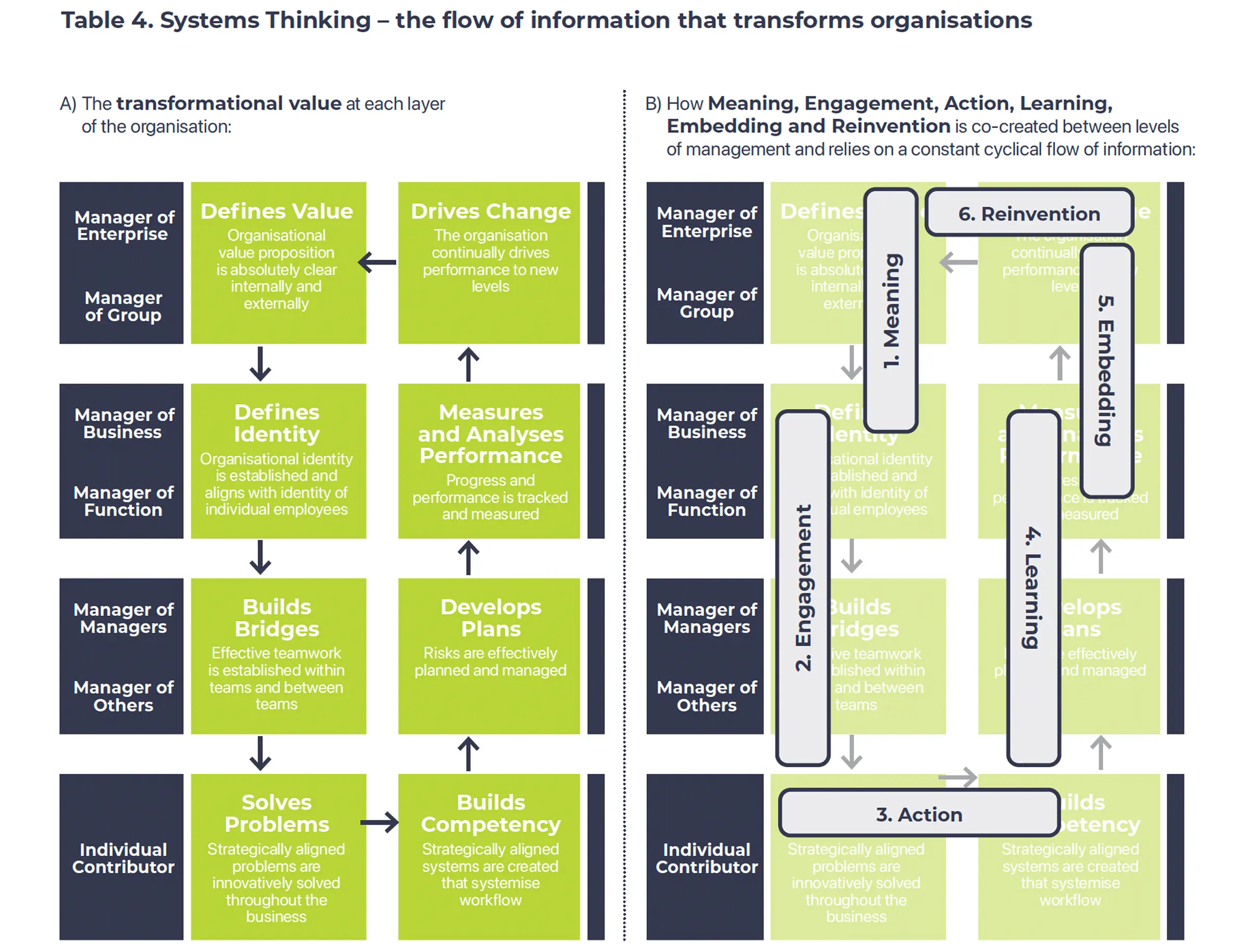
The final transition is by far the least well applied in most organisations, because it requires all levels of leadership in an organisation to not only be acting and thinking correctly, but also applying a systems-thinking approach to the way information is shared. When this is done well, ongoing strategic reinvention becomes a reality.
In practice, this occurs when a circular flow of information is established, which runs from the Enterprise Manager down through the six layers of the organisation to the Individual Contributor and back up again. For this to work, it is critical that each layer is focusing on the right transformational leadership work, as outlined in Table 4 on the previous page.
Once this is established and teamwork between the layers is flowing effectively, derivative messages start emerging that form the strategic messaging necessary for organisation-wide reinvention and innovation.
For example, a clear understanding of the organisation’s value proposition for its different stakeholders when combined with a powerful shared identity creates organisational meaning i.e. what it means to work for this organisation. This codifying of corporate meaning is the critical role that the top four layers from Enterprise Manager down to Function Manager must work on together to deliver. It is this shared meaning that, when cascaded, becomes the lifeblood of every employee within the enterprise.
When identity, bridge-building and problem-solving (from the Business Manager down to the Manager of Others) takes place in a strategically aligned way it fosters aligned employee engagement that drives the behaviour required to deliver on the organisational strategy.
The whole process is outlined in Table 4, which diagrammatically shows the six steps as a cycle. The left-hand flow downwards from the CEO to Manager of Self requires the leaders to adopt a growth mindset, while the information travelling up the page on the right-hand side requires the leaders to adopt a control mindset.
While the final phase of reinvention happens at senior management, the upward flow of knowledge and insight about what is ‘really happening’ at the front line ensures that strategic initiatives are informed, client-relevant and builds on the learnings from all layers throughout the organisation.
Summary
In this paper we have presented five stages through which health organisations move as they mature from a start-up to a major enterprise able to deliver excellence and reinvent their operating models to match emerging market demands and streamline organisational growth and performance. We have described the two drivers of this maturity model as 1) systems practices, and 2) leadership and performance practices.
The authors propose that, although historically overlooked, these phases provide actionable insight for developing product/service excellence through cultural development and organisational performance.
As the organisation grows, they often hit a seemingly impenetrable glass ceiling. We propose that the main cause of the ceiling is related to a lack of leadership clarity about how their leaders need to perform, insight into how to grow their leaders from within the organisation (by understanding how they move from one layer to another) and lack of clarity about exactly how they need to think at each layer.
Finally, we have proposed a method for driving innovation and reinvention that requires a systems thinking approach for understanding how information pulses through an organisation from top to bottom and back again, and we have codified the work to be done at each layer to make sure this information is not bottle-necked or distorted.
Organisations are now requiring leaders to expand their thinking to encompass broader organisational challenges beyond the consulting room and to translate them back at their layer. The People Capability Maturity Model (PCMM) provides a useful framework for organisations to continue a conversation about how they can move to the next phase of maturity and provides useful, practical and tangible steps to achieve it.