
Political, business and social leaders are being asked not only to work and think differently themselves but also encourage and inspire the same in their employees. If, in this process, leaders can’t rise to the necessary reshuffle of business-as-usual practices, we could be facing the collapse of certain companies and ways of life.
Major organisational transformation is often difficult at the best of times, but on the back of a global pandemic, it adds an extra layer of complexity.
In times of change and transformation, carefully chosen narratives provide the meaning-making ingredient people unconsciously crave. For organisations, these narratives often embed messages of trust, hope and/or optimism about a better future.
However, to be uniting connecting, narratives need to do more than just focus on the aspirational or inspirational messages.
In general, Baby Boomers are often compelled through inspirational/aspirational messaging and abstract ideas, whereas Millennials are grounded in practical and functional aspects of the messaging. For example, where a Baby Boomer may ask “What’s the future going to look like?”, Millennials may be asking “What’s being done to achieve that future?”.
While having multiple generations working together adds enormous value for organisations, for the current workforce, it also creates challenges for leaders developing unifying narratives, particularly during times of change, transformation and/or restructure.
During the pandemic in 2020, Queen Elizabeth II broadcasted a heartfelt and positive message to the world regarding COVID-19.
With what was intended to be an inspirational and meaningful message, in reality, it only hit that mark with certain British populations.
For younger Britons, in particular, the message was met with indifference and described by many as ‘irrelevant’, ‘far-removed from the facts’ and ‘unrelatable’.
In our experience, for narratives to be truly uplifting, they need to target not just the problem but the logical level in which that problem makes the most sense to people – including integration of both abstract and practical elements. Through our years of working with senior leaders on a political stage (including four state premiers), in financial industries, in health and in other high-stakes industries, we’ve narrowed down our insights into five tips for creating a unifying and connecting change narrative.
RFI International. Queen Elizabeth’s speech fails to reassure all Britons (Published 06 April 2020)
Creating a unifying and connecting change narrative (summary)
Beginning - Summarise the problem to be solved
1. Refining the problem to be solved
Start by clearly stating the core problem in simple terms. Useful prompts include: "The problem is simply...", "Our customers have expressed concern that...", or "Our people are worried about...". In written form this should be 1-2 sentences of 12-35 words, and spoken it takes around 10 seconds.
2. Build solution credibility
Establish that the solution has been properly considered and is fit for purpose. Useful prompts include: "Having spoken to (a), (b) and (c)...", "We all agree that ideally we want a solution that enables...", or "The solution is cost effective and...". In written form this runs to 75-150 words, and spoken it takes around 1 minute.
Middle - State the solution you've found to the problem
3. Signpost simple solutions
Clearly signal that a solution exists and what direction it takes. Useful prompts include: "I'm pleased to be able to say...", or "Based on this we will..." (see other examples in the text). In written form this is 24-40 words, and spoken it takes around 15 seconds.
4. Anchor your solution with an example
Make the solution concrete and relatable with a real example. Useful prompts include: "For example, if you are experiencing...", "As the plan rolls out next week, you'll be able to...", or "The benefit of this is...". In written form this is 150-300 words, and spoken it takes 1-2 minutes.
End - State what the next steps are
5. End with a call to action
Close with a clear and direct next step. Useful prompts include: "You can contact me on...", "For your further interest and reading...", or "Visit our...". In written form this is 12 words or less, and spoken it takes around 10 seconds.
TIP 1: Reframe the problem into a solvable one
When creating a narrative, the moment you describe a problem that is experienced by your selected target market (which often isn’t what you immediately thought), you’re able to grab the attention of that segment in a sound bite.
Much like Joseph Campbell’s Hero’s Journey (where a hero receives a call to adventure), a compelling narrative must start with a problem to be solved, a challenge to overcome or a barrier to break down. However, it’s often the case that while the initial problem cannot be solved,
a reframed or redefined element of the problem can.
For example, in 2006 a small earthquake caused the Beaconsfield gold mine in Tasmania to collapse unexpectedly. In the early stages of the disaster, the media focused on trying to solve whose ‘fault’ it was that the mine collapsed. Unfortunately, this is not a problem you want people to be focused on (that’s a matter for the courts).

If the problem can’t be solved within the frame it was conceived, the solution lies in reframing the problem. — Brian McGreevy (Author)
There is no way you could solve that problem simply and easily in a short narrative. But from the audience’s perspective, the problem that focused on them could have been framed as ‘friends, family and the wider community feel they are in an information vacuum and want to know where they can go to get the very latest, valid information’.
With a plethora of problems emerging during major change initiatives, such as restructures, one pressing question that continues to remain a key challenge from an employee’s perspective is “Why me?”. Immediately, you’ll notice that this is a loaded question and not easily resolved in a short narrative. What is solvable, however, is “Why is the restructure happening and how will I be supported?”.
What we’ve done is taken a potentially unsolvable problem, identified a solvable symptom and reframed
the symptom as a problem to be solved. In a way, this is almost achieved by conducting a reverse six sigma analysis approach.
In an ideal world you would be able to solve the root problem, but by reframing symptoms into solvable scenarios, it helps create certainty, reassurance, hope and/or optimism by weaving in the practical element of ‘solvability’ while still appealing to the abstract nature of the initial problem.
See Box 1 for questions that will help to tease out a solvable problem.
Box 1: Refining your problem
What’s a solution that you can actively roll out or communicate in the current environment? What problem does this solve?
What’s the problem you’re trying to solve or have been asked to solve that you can do something about?
How can I make this problem more tangible?
What are some symptoms of this problem that might be more tangible and more successfully addressed?
What do/does the symptom(s) look like from your target market’s perspective?
What solution(s) spring to mind?
What symptoms of the problem do/does your solution(s) target?
TIP 2: Focus on the credibility of your solution before the solution itself
If a leader, being interviewed, were to tell you that they’d cured cancer but weren’t medically trained – what would you think? What questions would you have? Chances are you’d be asking: what is their credibility?; who have they worked with?; how did they develop it?; who was involved? etc.
In building credibility for your proposed solution, it’s
absolutely critical that you outline what a successful strategy looks like and articulate to your target market that you’ve spoken to people relevant to them to develop a solution with them in mind.
Extraordinary claims require extraordinary proof. — Carl Sagan (Astronomer)
Why? In essence, we often have no way of knowing whether people are being truthful or not simply by evaluating the content of the statement. Instead, they revert to analysing the credibility of who you’re involved with – or who is in ‘your corner’? For the above ‘cancer cure’ scenario, if the person had mentioned consulting with local, state and federal medical research facilities, having big name university backing or having well-known authorities on the subject supporting their cure, the chances of you believing them are much higher.
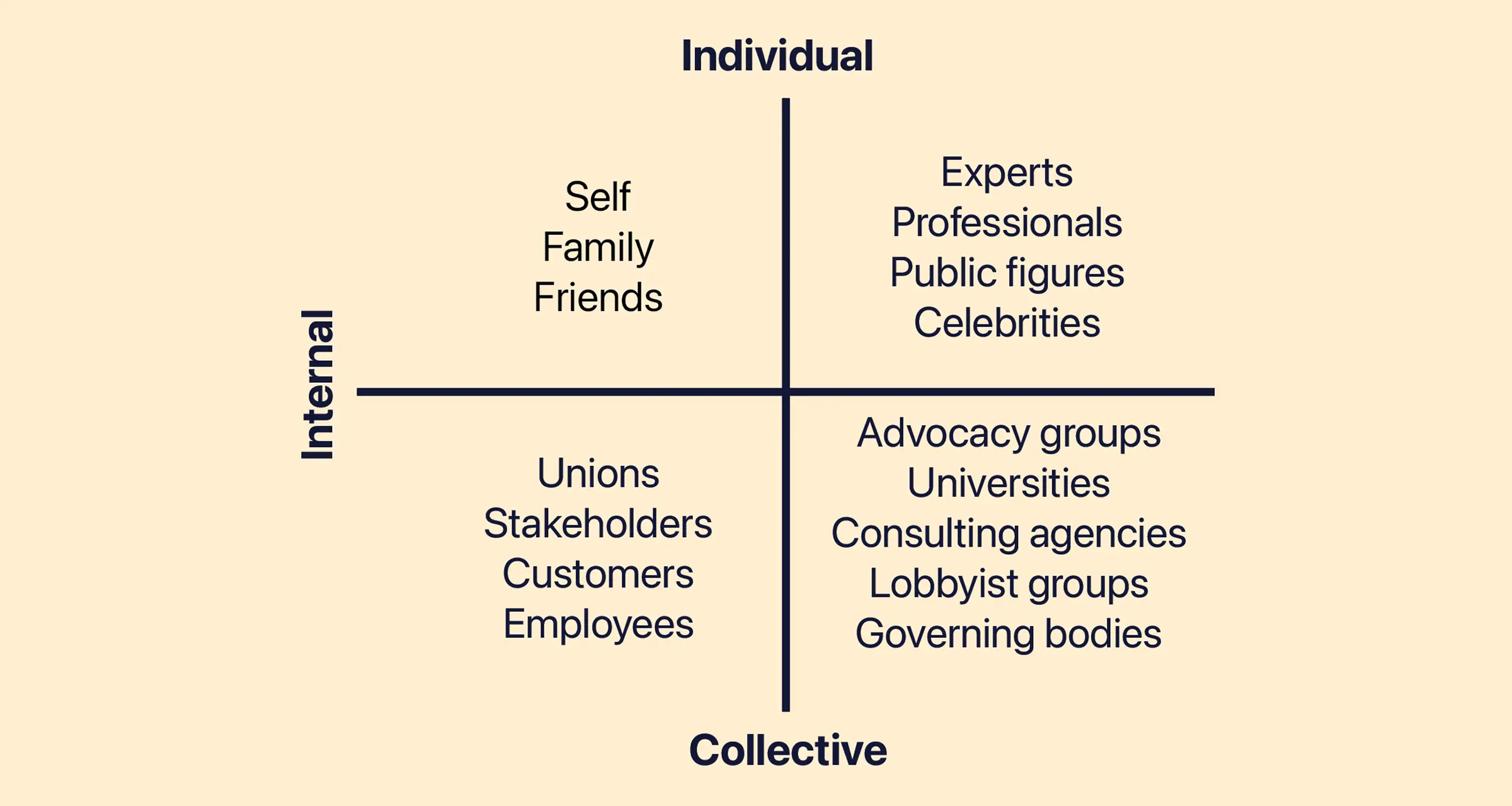
When articulating a solution to your reframed problem, you need to be able to plot where it sits on the ‘believability’ quadrant and subsequently ensure that you have the right people, organisations or groups in your corner to meet that believability requirement.
Box 2: Source believability quadrant
It’s important to choose sources and references that are seen as credible for the specific issues that you are trying to address.
N.B. This quadrant is based on Integral Theory (by Ken Wilber). It suggests that we expand our thinking by considering individual and group perspectives from an internal and external worldview (this gives rise to subjective and objective integration)
A rule of thumb: the more widespread and global your solution claims to be, the more credibility you need. Aim to mention at least three sources that align with your audience to show that the solution you’re proposing has weight behind it.
For example, if the problem you’re trying to solve is “Why is the restructure happening and how will I be supported?” on the quadrant (Box 2), you could pose this problem as an internal, collective issue. Meaning that to build credibility for your proposed solution you’ll need to show that your solution has taken into consideration information or feedback received from employees, unions, stakeholders and/or customers.
This approach embeds into the narrative practical elements of your proposed solution (it’s for the people, developed by the people) but also helps to build certainty and confidence during a time where stability is key.
Here’s some other helpful criteria you may also like to consider:
Discuss the process you took in developing your solution
Speak to the level/range of involvement in developing the solution (and its quality)
Speak to the relationship between the solution and the reframed problem
TIP 3: Solutions need to be signposted, simple and aligned with your stated criteria for a good solution
By this stage, if you’ve nailed the first two components (by successfully framing/reframing the problem to be solved and built sufficient credibility for your approach), your audience is now ready and waiting to hear your proposed solution.
We find that when solutions fall flat, it’s because leaders have jumped ahead and either pitched the solution before building sufficient credibility or linking it back to the reframed problem (i.e. the solution they’ve pitched doesn’t actually solve the reframed problem).
For example, in the redefined problem of “Why is this happening and how will I be supported?”, if your narrative includes the solution of ‘continuing to monitor the situation’ or ‘develop contingencies as the plan evolves’ – you’ve missed the mark. In this case, your solution is appealing to the abstract nature of the ‘un-reframed’ problem (and even then it wouldn’t land).
We’ve found that leaders often neglect to link the solution back to the problem – or ‘signpost’ it in other words. While it’s helpful to consider whether your solution is practical, fair, workable and/or financially acceptable, there are also some simple phrases that leaders can use to bookend their proposed solution and elevate that sense of unity and stability.
Box 3: Tried and tested solution phrases
Because of *state problem* we’ve decided to/that…
This solution addresses *state problem* on two levels...
After considering the impact of *state problem*, we’re keen to…
After working through other possible solutions with *state credibility sources*, we propose *state solution* as a means of achieving the best outcome for *state problem*
Given that *state problem*, it’s clear we need to...
TIP 4: Anchor your solution with a ‘For example…’
Think back to any moving story or narrative that you’ve come across in your life – what about the narrative itself amplified how it made you feel? Chances are you’re thinking ‘well it inspired me, it taught me something, it reminded me of better times or made me feel a certain way’. And you’d be right.
Narratives take people on a journey and this element in developing a narrative is where we project the abstract notions of hope and optimism through practical stories of success, triumph or achievement.
Crises refine life and in them you discover who you are — Allan K Chalmers (Author)
Box 4: Considerations inyour example
How will key stakeholders experience the situation?
How will they feel?
How will the mechanics actually work?
Where has this been tried and what were the results?
Ultimately, people want to feel stable and supported and, while you may have wonderfully reframed your problem, built valuable credibility and articulated your well-aligned solution, that sense of stability comes from relatable concrete experience.
To cement the solution, use real life example/s from your audience – if you have more than one audience use one example from the top three. You could use examples of people who have been impacted by the change, where they go for help and/or how they will be supported (see box 4 for more suggestions).
For organisations, leaders tie the solution into legacy, enduring company qualities, other crises/disasters and/or changes the company has forged through previously.
We find that in times of hardship our true nature is revealed and that’s the essence we need to capture in the narrative – unity, connection and stability.
TIP 5: End with a call to action
This element of the narrative further solidifies the practicality of the solution and is designed to provide the target market with options for further information. If you were to bookend your narrative with the success stories or the aspirational/inspirational messages of the previous element, your narrative would lose appeal (particularly to younger generations – remember they want practical and functional).
Creating this element in the narrative doesn’t need to be lengthy or long-winded and can simply be a statement in terms of how people can contact you further, where they can find additional information or how they can contribute to the evolving process (e.g. feedback, comments, thoughts).
Some key action elements you might consider including in your narrative are:
Particular information pages on the company website
Other websites with helpful information
Social media links or initiatives
Links to additional readings or key information on credibile sources
Contact details for yourself or another member of staff managing the process
Final thoughts
While this process may seem simplified, it helps to create a narrative that is easily digestible, practical and that will appeal to multiple generations using both traditional and non-traditional media. These tips will help to better connect leaders with their people by acknowledging their core concerns during a time of uncertainty, change and transformation, while articulating those concerns in a way that practically solves symptoms of a problem, helps them feel supported and compels them through a sense of hope and optimism for the future.
We hope that in applying these tips you’ll find that:
Your audience feels satisfied with a succinct narrative that eases their concerns, proposes practical solutions and creates hope during uncertainty.
Your narrative is no longer a generic response but a well articulated solution that is both practical, inspiring, connecting and unifying.
You can adapt the narrative to be meaningful across traditional and non-traditional media e.g. online domains, face-to-face, social media posts, media briefings and feature interviews.
The narrative you form is human-centred, people-focused and stakeholder-centric so that your people know that you’re going to be there and work with them to help resolve their concerns during challenging times.