
COVID-19 has elevated the topic of wellbeing in all our minds, and there’s never been a more important time for Boards to align their thinking.
Why wellbeing belongs on your Board agenda
As we all know, the pandemic has intensified mental health pressures, but with an interesting by-product – a massive shift in our understanding of what health and wellbeing really means. For most of us, the notion of ‘health’ has historically been defined by the absence of disease or infirmity. But now – thanks to COVID-19 – we’ve gained an understanding of wellbeing as a much more complex, community issue¹.
With a more holistic view of mental, physical and social wellbeing as equally important ingredients of what it takes for us to ‘thrive’, the responsibility for wellbeing is moving beyond the individual and into our collective hands – at the same time as other big changes are impacting our working world. Key developments in science and technology are driving future of work developments, while also delivering higher quality, real-time insight about how we’re faring in the midst of ongoing change (both individually and collectively). Differences in generational expectations are also being amplified, with strong emphasis on the role work plays in our lives and the cultural value proposition organisations can offer. In a tight labour market, sought after, talented individuals are making career decisions based on the extent to which they feel supported by organisations and see tangible evidence of the ingredients they need to thrive.
All of this is focusing attention on how organisations are fostering the health and wellbeing of their networks – workforce, customers, wider communities and other stakeholders.
Furthermore, the challenges of the past few years (and the impacts on everything from supply chains to frontline delivery) have helped us appreciate the fundamental truth that, for most organisations, their most precious asset is their people.
Commercial (or practical) success relies in large part on the ability of its people to contribute meaningfully and consistently – both of which depend on people being in good shape (if not at their best). So health and wellbeing isn’t simply a ‘nice to have’ for organisations – it’s central to your ability to deliver.
The price of isolation
Arguably, there’s never been a more important time for this to be an area of focus.
From March 2020 onwards, the prevalence of anxiety and depression in OECD countries increased, and in some countries even doubled². The struggle is real.
Another 2020 report pointed to the impact of loneliness and isolation on our risk of premature death from any cause — as much as or more than smoking or a lack of physical activity do — as well as increasing the likelihood of heart disease and stroke³.
The statistics are stark. Not least given a report commissioned by Heads Up and PwC found that while 90% of senior managers say that they recognise the importance of mentally healthy workplaces, only 56% of employees really believe that their mental health is truly valued⁴. That perception isn’t entirely unexpected, when mental health has historically been viewed as the absence of a condition, rather than a continuum.
³https://www.nytimes.com/2021/08/18/magazine/isolation-loneliness-health.html
Nurturing the ‘moderately well’
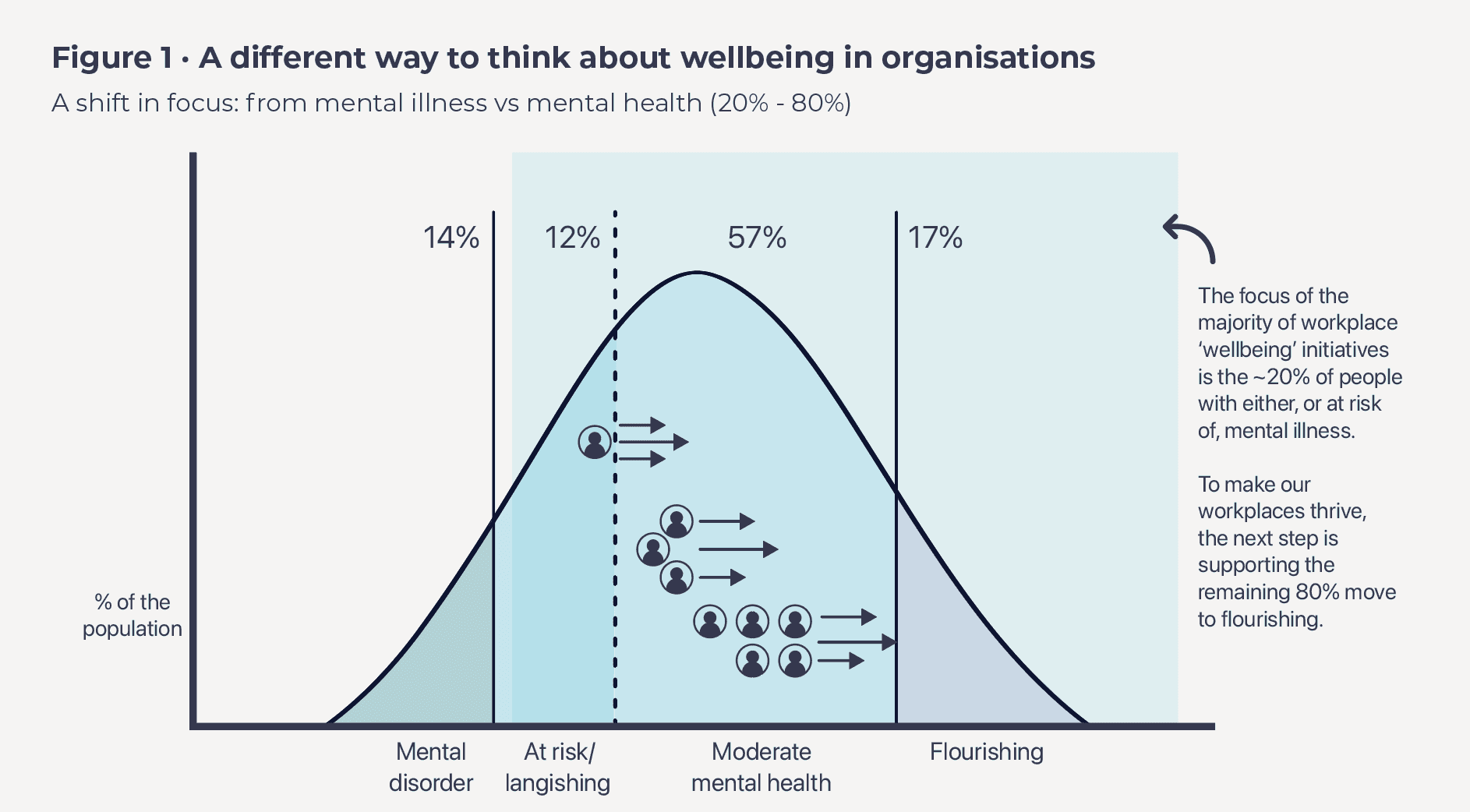
Rather than a binary view, wellbeing is better understood as a bell curve (see Figure 1); from those who are experiencing acute mental health challenges through to those (at the opposite end of the curve) who are flourishing even in the midst of challenge and adversity.
The majority of people, clustered in the middle, have historically tended to be overlooked. Now, thanks to COVID-19, we’re realising that those in the ‘languishing’ or ‘moderately well’ space need their wellbeing nurtured proactively. This investment yields great results, both in avoiding the challenges of sick leave or turnover associated with illness (including the risk of sliding further down the curve), as well as the potential for greater performance through flourishing.
Studies show that flourishing individuals miss fewer days at work, have clear goals and high resilience, the lowest risk of cardiovascular disease, the fewest health limitations and more. All this helps when there’s important work to be done.
Fortunately, wellbeing is no longer a black box; there’s a growing body of evidence that suggests there are key things we can do to set up individuals, groups, organisations and even entire communities, to truly thrive.
A new working world
Society is changing. New generations see health and wellbeing as a work ‘right’, rather than a ‘nice to have’. While the World Economic Forum has identified that many are actually working fewer hours than ever before5, the intensity of how we’re working, and the quality of our interactions with each other, is impacting the way we experience our day-to-day work (a reality that has been further amplified by the new world of hybrid working).
This is catalysing important discussions around what organisations need to provide (whether public, private or not-for-profit, small, medium or large) to have strong appeal in the market. In a tight labour market, there are growing expectations that the best organisations have a clearly articulated approach (and demonstrated success) for fostering the health and wellbeing of their team and partners. This will rapidly move from a characteristic that differentiates organisations to one that becomes a baseline expectation, with employees happy to switch if they find it lacking (even without an alternative position confirmed).
In short, profit no longer gets you there. There are growing expectations around the kind of organisation you are, what you’re offering for people who are interacting and working with you, and to what extent you’re actually fostering the health and wellbeing of your team and partners.
The blueprint for human thriving
Fortunately, recent breakthroughs in social cognitive neuroscience and other fields have furnished us with rich insights into the drivers behind human behaviour and what cultivates our ability both to perform and to experience a sense of thriving (rather than just surviving). Distilled from more than 30 years of brain-based studies (and integrating more than 50 models of human behaviour dating back thousands of years), the RELISH model highlights the six universal social needs of all human brains (once our basic physiological needs are met). Developed by Peter Burow and the team at Neuro Group, it provides a practical, unifying blueprint for designing work environments, interactions and dynamics that give our brains what they need for each of us to show up at our best.
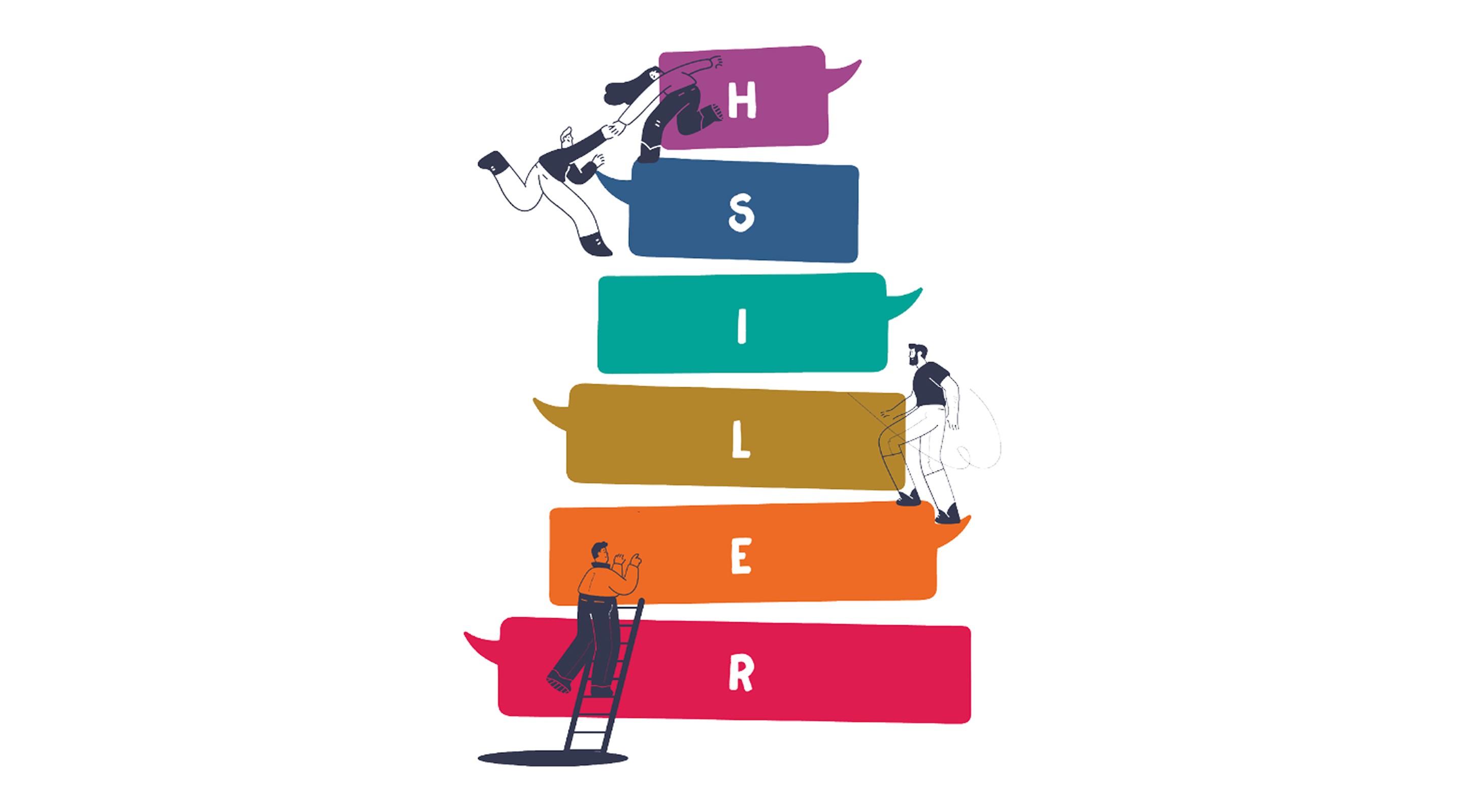
When these needs aren’t satisfied, the brain is more likely to move into a stress-driven reaction (driven by the survival-focused limbic system and associated with high levels of cortisol). In contrast, when the six RELISH needs are successfully met, individuals and teams are not only able to be constructive, adaptive and solution-focused in the face of challenges, they also feel fulfilled and sustained while doing so. This reflects healthy levels of key neurochemicals (like serotonin, dopamine and oxytocin) being stimulated by our working environment and interactions. The right balance in this neurochemical cocktail is vital to our sense of wellbeing and ability to operate effectively.
Part of the value of the RELISH model lies in its universality – all humans share these needs, which remain consistent no matter what we’re doing, where or with whom.
It’s a powerful tool for thinking about how to maximise both the experience of your people, as well as their ability to contribute and perform.
The RELISH Model - Six Social Cognitive Needs
Relatedness - To belong
Links to: psychological safety, sense of community, feeling valued as part of the group, and purpose, role and values.
Neurochemical: Serotonin - the brain's natural mood stabiliser that determines mood, levels of anxiety and general sense of wellbeing.
Expression - To express
Links to: openness about emotions, perspectives and ideas, sense of fun and joy, feeling respected, and creativity and constructive friction.
Neurochemical: Dopamine - the brain's happy chemical, linked with movement, memory and focus, as well as mood and happiness.
Leading the Pack - To achieve
Links to: focus and energy, sense of drive and momentum, feeling motivated and a sense of autonomy, and shared goals and celebrating success.
Neurochemicals: Adrenaline and testosterone. Endorphins - which induce a sense of euphoria, boost self-esteem and create an overall sense of wellbeing.
Interpersonal Connection - To connect and feel supported
Links to: empathy and relationships, sense of being supported and cared for, feeling understood and appreciated, and active listening, collaboration and leveraging strengths.
Neurochemical: Oxytocin - associated with empathy, love, relationship-building and forgiveness.
Seeing the Facts - To learn and see progress
Links to: learning and seeing evidence of being on track, sense of progress, feeling curious and wanting to grow, and KPIs and learning culture.
Neurochemicals: Acetylcholine - which plays a role in alertness, attention, learning, memory and neuroplasticity. Noradrenaline - which plays a role in alertness and impacts ability to concentrate.
Hope for the Future - To feel hopeful
Links to: longer-term horizon, sense of how the story is likely to end, feeling optimistic, and future-thinking, horizon planning and bigger paradigm shifts.
Neurochemical: Theta state (3.5 - 7.5 Hz) - associated with daydreaming and imagining new possibilities.
The role of Boards
So, when it comes to health and wellbeing, where can Boards focus?
As a start, it helps to recognise that health and wellbeing is just as important for you and your brain as it is for the organisation.
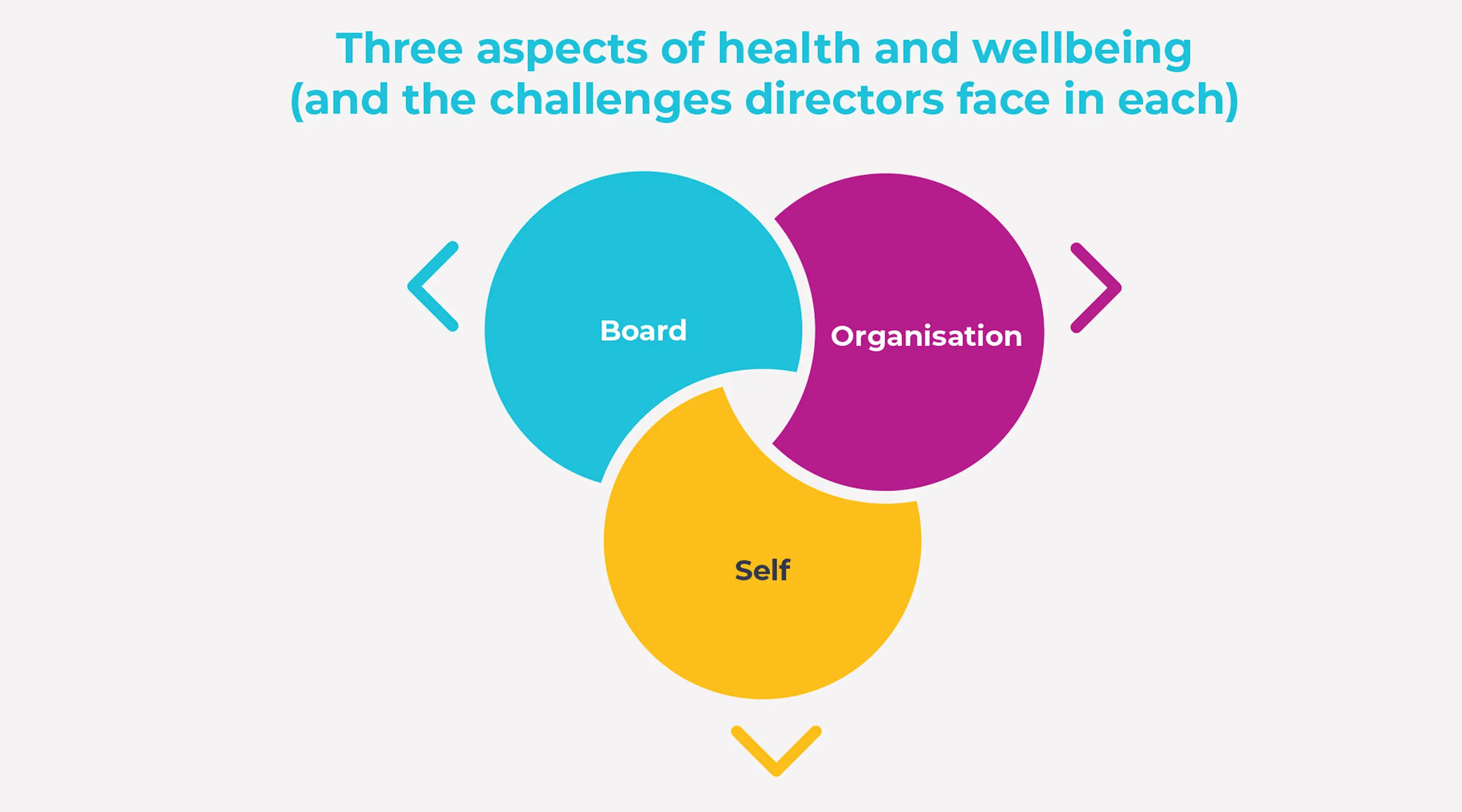
The three aspects of Self (i.e. you as a Director), Board and Organisation are important to consider – as are the challenges that directors face
in each (see right).
As you start focusing on the organisational lens, it’s key to understanding wellbeing as an indicator of how your organisation is performing – rather than just an area of risk.
Board
Old attitudes/mindset that wellbeing is a private or personal issue not a corporate issue
Overcrowded Board agendas can mean important issues get missed/glossed over
Limited shared language for talking proactively about personal health and wellbeing until it's become an issue
Online meetings can be a barrier to human connection
Impact of power and politics
Focus on being a 'functioning board' leads us to be 'functional'
Self
Running constantly
Finding the space to stop automatic pilot
Easy for distractions/the treadmill to get in the way of what we know is needed
Myth of the 'strong leader/director' and the 'infallible expert' discourage expressions of vulnerability
Don't feel you can bring your whole self (vulnerability)
Organisation
Helicopter view vs. what's actually happening on the ground
Relevant data may be lacking or not making its way to the Board
Stigma regarding mental health issues
Cultural issues (e.g. hard-driving cultures that take a linear view of performance)
Executive and middle managers not well equipped to identify/manage issues or lead through a wellbeing lens
Challenges with increased flexibility/remote working
From curative to preventative
One of the main challenges can be the traditional view that wellbeing is a private, personal thing for people to deal with by themselves – that it’s not actually a corporate matter. There can also be cultural issues, where financially-driven organisations have difficulty acknowledging wellbeing as a measure of performance. Both may be reflected in either topics or papers brought to the board by executive, or in the perspectives shared by individual directors around the table.
Furthermore, while the stigma that exists around mental health and mental wellbeing is less than it perhaps was in the past, it still exists. So does the suspicion that disclosures about wellbeing could be used against you. Both of which can prevent issues being aired or escalated to Board level.
Like all aspects of their roles, Boards need to ‘set the tone from the top’ and lead the charge in relation to wellbeing. That means developing a shared language for exploring the topic, and being proactive in driving focused action.
Turning learning into action
The concept of measuring health outcomes within a work context is in its infancy, but getting meaningful data is essential to driving this work forward.
That means developing targeted and specific questions about people’s wellbeing and how they felt that was being helped, or not helped, by the organisation and by their leaders.
Rather than being an arduous annual process, the emerging trend is for regular pulse checks that enable leaders (and boards) to monitor an evolving picture, and be more responsive. The most innovative no longer rely on centralised control and distribution of the data, instead empowering teams to oversee and work with the results of their data in real-time; it’s the new frontier of dynamic culture work.
This will be critical, as we know that many organisations are already well-intentioned, but their execution is proving problematic. At one end of the current ‘wellbeing offering spectrum’, yoga and meditation options are often viewed by a stressed, burnt out workforce as either tokenistic or insufficient, while at the other end, Employee Assistance Programs are either under-utilised or leveraged far too late. What’s needed is a more proactive, fluid and responsive approach that explores the space in between – and encourages teams and areas to co-create meaningful, practical solutions that link to which core needs is unsatisfied at that point in time. This will be far more potent and impactful that occasional activities badged as ‘wellbeing events’.
Of course, this requires considered investment to build the capability of leaders and teams to navigate the path, and follow through to ensure it translates into reality across the organisational system.
Leading the change
As attention on health and wellbeing continues, it’s emerging as a pivotal leadership capability for us all to develop.
Like any journey towards mastery, the best place to start is by taking an active role, having a curious mindset and seeking to understand the issues that may be affecting health and wellbeing for your people. Only then can you hope to establish an organisational system where you can help reinforce and nudge healthy, constructive behaviours and create an environment in which everyone can flourish.
Ultimately, the sooner you move wellbeing from ‘hot topic’ to agenda item, the closer you’ll get to a stronger and more sustainable team, culture and impact.
How to start the discussion
While there are many ways to kick start your Board’s exploration of health and well-being, these key questions provide a useful way to stimulate discussion and stretch your thinking.
Make sure you allow lots of open space to explore – and see what emerges.
Getting started
What’s our shared philosophy/view about how health and wellbeing drives our ability to deliver value?
Where is health and wellbeing reflected in our organisation’s strategy? (What > Who > How)
What are our main levers/mechanisms for shaping the health and wellbeing of our people, stakeholders and the broader communities we serve?
Exploring your approach
How much scope are we setting for people to create working conditions in which they can thrive?
How effectively are we building health and wellbeing as a leadership capability?
How well do our current systems and practices
(both explicit and implicit) reward and incentivise both ‘healthy’ and ‘unhealthy’ behaviours?What information should we be asking for from management (and who should we be inviting to address us) that provides us with relevant insights into health and wellbeing within the organisation we are governing?
Based on the available information, how well is the organisation currently satisfying the RELISH needs of our people and partners?
Fitting your own oxygen mask
How are we creating an environment in this Boardroom that promotes the health and wellbeing of ourselves as directors – and models more broadly our focus on health and wellbeing?
How can we be confident that our Executive Team are looking after their own health and wellbeing as well as that of their teams?