
The world of work is changing rapidly but our response to this change is slow. Our systems of work are rooted in an industrial era mindset that no longer applies in a complex networked world.
Why traditional management systems are failing in a complex world
We are used to complicated, linear, predictable production lines and management systems, however, these are failing all over the world in complex, non-linear, fluid environments.
From the military fighting fluid, non-geographically-based wars against enemies that form, reform and adapt, to the corporate world that struggles to keep pace with small nimble start-ups and the government sector that battles to serve the emerging needs of their community because of bureaucratic systems that instead serve established order.
For decades, management authors have promoted the idea of empowerment, transparent decision-making and agility as the skills of brilliant leaders. No longer is this true. These are not the skills of good leaders, these are the essential skills of every leader that wants to remain relevant and effective.
This article is for leaders who are grappling with how to structure and manage their organisations in an environment of constant change, where traditional command and control mechanisms are too slow, too inefficient and too costly. This article introduces leaders to the idea of highly connected, team-based organisations through an exploration into the science of the mind.
The world of work is becoming faster and more dynamic. Organisations are aware that big changes are occurring and are attempting to transform themselves to meet this challenge. But key factors constrain this transformation.
Many companies lack the culture and tools they need to engage employees, track their performance and measure the effectiveness of their ‘human resources’. The impact of these constraints is severe and limits an organisation’s ability to grow and adapt.

In order to manage this change, we need new tools that accommodate the fluid and dynamic nature of work. Tools that allow leaders to form, re-form and un-form teams to deliver on key projects to engage people rapidly and align resources. In order to develop these tools, we need a more sophisticated understanding of the human condition; what makes us tick; and how to get the best out of large collections of coordinated individuals.
Recent breakthroughs in neuroscience have revealed insights into the drivers behind human behaviour and how leaders can harness this intelligence.
Contrary to popular thought, our brains haven’t evolved in order to do math or engineering or to be able to send a man to the moon. They, in fact, evolved for much more modest reasons. The brain’s cerebral cortex (the more advanced part of the brain) has evolved because of the need for humans to manage large and complex social groups.
A famous experiment conducted by Robert Dunbar showed that the larger a mammal’s prefrontal cortex, the larger the social groups it could sustain. It is estimated that most homo sapiens (modern day humans) can only really sustain a group of 150 people. Social cognitive neuroscience has shown that the majority of human behaviour is driven by the groups we belong to, not as a result of our individual decisions or willpower (these are merely an illusion of control).
Our work with neuroscientists at the University of California, Los Angeles and the University of Queensland, together with our team’s academic research from other neuroscientists around the world has identified six key ‘Social Cognitive Needs’ that seem to be common to all people regardless of race, gender or age and drive the majority of the human experience at a foundational level.

“In order to manage this change, we need new tools that accommodate the fluid and dynamic nature of work.”
From the military fighting fluid, non-geographically-based wars against enemies that form, reform and adapt, to the corporate world that struggles to keep pace with small nimble start-ups and the government sector that battles to serve the emerging needs of their community because of bureaucratic systems that instead serve established order.
For decades, management authors have promoted the idea of empowerment, transparent decision-making and agility as the skills of brilliant leaders. No longer is this true. These are not the skills of good leaders, these are the essential skills of every leader that wants to remain relevant and effective.
This article is for leaders who are grappling with how to structure and manage their organisations in an environment of constant change, where traditional command and control mechanisms are too slow, too inefficient and too costly. This article introduces leaders to the idea of highly connected, team-based organisations through an exploration into the science of the mind.
The world of work is becoming faster and more dynamic. Organisations are aware that big changes are occurring and are attempting to transform themselves to meet this challenge. But key factors constrain this transformation.
Many companies lack the culture and tools they need to engage employees, track their performance and measure the effectiveness of their ‘human resources’. The impact of these constraints is severe and limits an organisation’s ability to grow and adapt.
In order to manage this change, we need new tools that accommodate the fluid and dynamic nature of work. Tools that allow leaders to form, re-form and un-form teams to deliver on key projects to engage people rapidly and align resources. In order to develop these tools, we need a more sophisticated understanding of the human condition; what makes us tick; and how to get the best out of large collections of coordinated individuals.
The idea in brief
The world is becoming faster and more dynamic and we need new tools to help us manage this change.
The six Social Cognitive Needs of the brain provide a helpful lens to manage the intricacies and complexity of human behaviour.
Understanding the six needs can let you manage complexity at an individual and team level to enable the organisation for flexibility and sustainability.
Recent breakthroughs in neuroscience have revealed insights into the drivers behind human behaviour and how leaders can harness this intelligence.
Contrary to popular thought, our brains haven’t evolved in order to do math or engineering or to be able to send a man to the moon. They, in fact, evolved for much more modest reasons. The brain’s cerebral cortex (the more advanced part of the brain) has evolved because of the need for humans to manage large and complex social groups.
A famous experiment conducted by Robert Dunbar showed that the larger a mammal’s prefrontal cortex, the larger the social groups it could sustain. It is estimated that most homo sapiens (modern day humans) can only really sustain a group of 150 people. Social cognitive neuroscience has shown that the majority of human behaviour is driven by the groups we belong to, not as a result of our individual decisions or willpower (these are merely an illusion of control).
Our work with neuroscientists at the University of California, Los Angeles and the University of Queensland, together with our team’s academic research from other neuroscientists around the world has identified six key ‘Social Cognitive Needs’ that seem to be common to all people regardless of race, gender or age and drive the majority of the human experience at a foundational level.
“If we let our emotions take over... we lose our ability to think in complex ways.”
These six Social Cognitive Needs provide a new lens through which leaders can view the complexity and intricacies of human behaviour. They reveal the core elements of human motivation and offer a comprehensive approach for leaders to understand themselves and others.
Rather than focusing on control, leaders can focus on the needs and motivations that sit behind human behaviour. The result of which will be significantly increased performance and a much greater engagement.
The Six Social Cognitive Needs are:
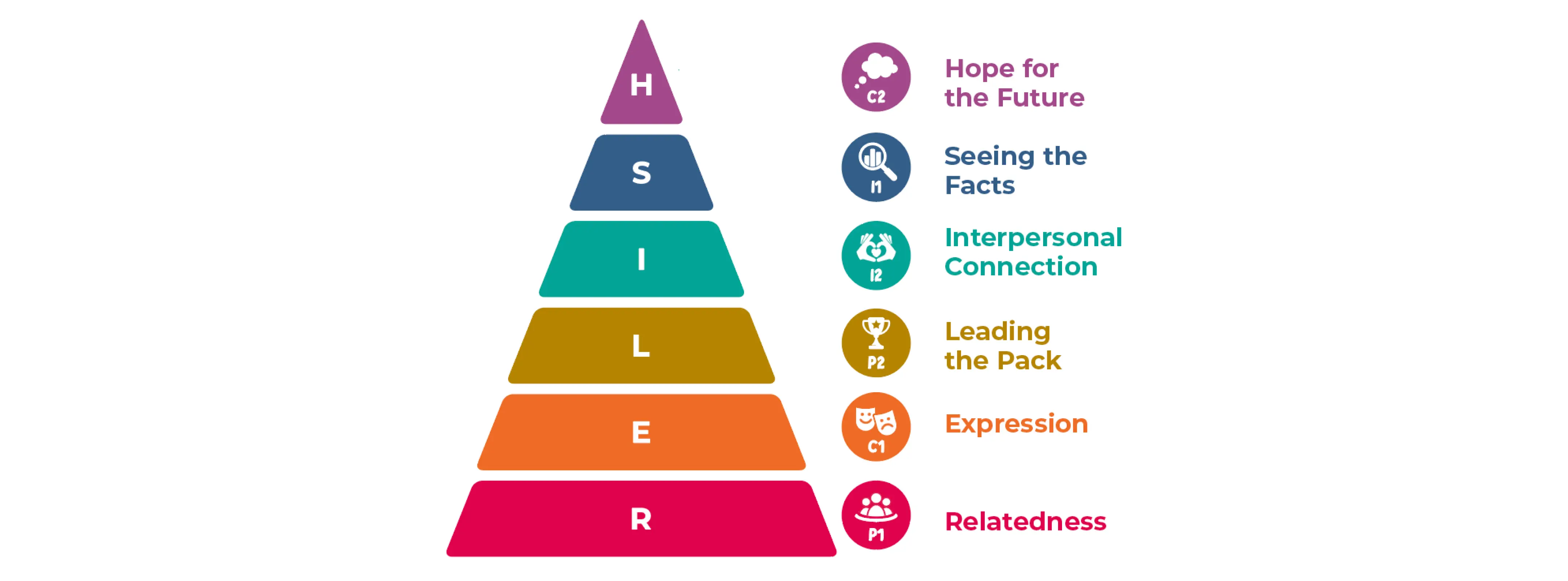
1. Relatedness
Our most foundational Social Cognitive Need is to relate. Relatedness is what ensures our belonging within tribes, teams and groups. If we belong to a group, we must add value to that group, otherwise we are merely consuming resources from the group (which is akin to being a virus). Belonging to groups is what ensures our survival – we can’t survive on our own.
Neuroscientists have discovered that similar regions in the brain light up when we experience social exclusion as when we experience physical pain. As such, we will do almost anything to safeguard against being socially excluded. The majority of human behaviour is driven by this overriding desire to belong. So much so, that it is far more effective to change human behaviour through social rules and norms than through individual willpower. We can constructively satisfy this need by defining how our role adds value to a team, how our team adds value to an organisation and how our organisation adds value to the world.
When teams do this, they have a clear purpose and are ready to perform.
Relatedness questions the brain is asking:
Who am I? Who are you?
How do we relate? Are we alike?
Is there value in us joining forces?
2. Expression
The second Social Cognitive Need that humans have is to express emotion. The brain can’t handle unexpressed emotion. Too often, we either give in to our emotions or we try to suppress them, which neuroscientists call ‘masking’. If we let our emotions take over, the blood in the brain moves from the rational system to the emotional system and we lose our ability to think in complex ways. If we try to suppress our emotions, it requires that we use the majority of the resources of the rational system in order to ‘control’ the emotional system.
Whether we are melodramatic or masking, a team that is highly emotional and unable to express it constructively is not thinking at the level they should be and are probably overpaid!
Expression questions the brain is asking:
How do I feel? How do you feel?
Is this pleasurable or painful?
Can we express how we feel
3. Leading the pack
The third Social Cognitive Need that humans have is to lead the pack. We all like to win. When we win, the brain releases dopamine and adrenalin which makes us feel great. How can we all think we’re winners? The answer is that we compete for different things. Really attractive people judge others by their looks and highly intelligent people judge others by the speed of their intellect.
Within a team, the task is to align personal objectives with team objectives and allow each person to win at something. Teams can help individuals to feel great rather than bring each other down. In order to motivate someone, to increase their discretionary effort, there must be something in it for them personally.
It is impossible to scare someone into being highly motivated, the best you can hope for is reluctant compliance. When looking to motivate people we often focus on material rewards like money and titles, however, social recognition and positive feedback has a much greater and more sustainable impact on team performance.
Leading the Pack questions the brain is asking:
What are our objectives?
What’s in it for me?
How will we know if we have succeeded?
4. Interpersonal connection
The fourth Social Cognitive Needs humans have is for interpersonal connection. When we feel connected to another person, our brain releases a neurochemical called oxytocin which increases forgiveness and reduces critical thought. This sense of empathy is crucial for effective teamwork.
Teams with a high degree of empathy tend to support each other more, focus on each other’s strengths not weaknesses and go above and beyond to achieve what is best for each other, rather than just focussing on themselves.
This sense of empathy transitions a team from a collection of individuals to an interdependent team. In practice, teams with higher interpersonal connection make more effective discussions, they build on each other’s ideas, they reduce conflict through mutual understanding and they solve problems that no one person could solve on their own.
Interpersonal Connection questions the brain is asking:
Do I understand you?
Do you understand me
Do we care for each other?
How are we going to work together
“We must be able to see a new future if we are to bring it into reality.”
5. Seeing the Facts
The fifth Social Cognitive Need humans have is to see the facts. The brain is a meaning-making machine that tries to predict the future based on the past, and is highly influenced by feedback.
Neuroscientists have discovered that the brain is capable of brightening TV screens, moving objects on the screen and even playing video games all on its own, when connected to neurofeedback technology! In many teams we have lost sight of the brain’s deep desire for regular, timely and relevant feedback.
Instead, we starve people of information and then wonder why they aren’t engaged in the right things in the right way at the right time.
Highly effective teams find ways to regularly share important information, accurately track their progress towards goals and learn from their experiences in order to continually improve.
Seeing the Facts questions the brain is asking:
What are the facts?
How are we tracking?
What am I learning?
6. Hope for the future
The sixth Social Cognitive Need humans have is Hope for the Future. We must be able to see a new future if we are to bring it into reality. Neuroscientists have conducted extensive studies that have linked effective visualisation with higher performance. In particular, professional athletes such as gymnasts and basketball players have been found to be more successful when using visualisation and practice over just practice alone. Teams that can hold the vision of a new or different future, therefore, have a much greater chance of achieving it. When teams align behind a shared vision and have the preceding five needs constructively satisfied, they have the essential foundations for being an exceptional team that has a positive impact.
Many scientists, philosophers, authors and consultants have dedicated their lives to developing frameworks and approaches to satisfy one or many of these needs in one way or another. Many ‘management tools’ that try to compete with each other, are often trying to achieve exactly the same thing. Rather than using neuroscience to prove ourselves right, we aim to use neuroscience to prove why everyone is right (in one way or another).
Hope for the Future questions the brain is asking:
What will the future look like (based on the past)?
Are things likely to get better or worse?
Many scientists, philosophers, authors and consultants have dedicated their lives to developing frameworks and approaches to satisfy one or many of these needs in one way or another. Many ‘management tools’ that try to compete with each other, are often trying to achieve exactly the same thing. Rather than using neuroscience to prove ourselves right, we aim to use neuroscience to prove why everyone is right (in one way or another).
The table overleaf outlines how some of our favourite frameworks and methodologies integrate with and satisfy different Social Cognitive Needs.
How contemporary frameworks address the six social cognitive needs (relish)
The six Social Cognitive Needs - Relatedness (P1), Expression (C1), Leading the Pack (P2), Interpersonal Connection (I2), Seeing the Facts (I1), and Hope for the Future (C2) - can be found across a wide range of established personality, leadership and process frameworks. Here is how each maps across the six needs.
Personality frameworks
Myers Briggs Type Indicator maps to Relatedness through Thinking, Expression through Extraversion, Leading the Pack through Feeling, Interpersonal Connection through Intuition, Seeing the Facts through Sensing, and Hope for the Future through Introversion.
Herman Brain Dominance Index (HBDI) maps to Relatedness through Quadrant B, Interpersonal Connection through Quadrant C, Seeing the Facts through Quadrant A, and Hope for the Future through Quadrant D.
Hogan Assessment System maps to Relatedness through Low Ambition and High Prudence, Expression through High Sociability, Leading the Pack through High Ambition and Low Prudence, Interpersonal Connection through High Interpersonal Sensitivity and Low Learning Approach, Seeing the Facts through Low Interpersonal Sensitivity and High Learning Approach, and Hope for the Future through Low Sociability.
Leadership frameworks
Five Dysfunctions of a Team (Lencioni) maps to Relatedness through Lack of Trust, Expression through Fear of Conflict, Leading the Pack through Lack of Commitment, Interpersonal Connection through Inattention to Results, and Seeing the Facts through Avoidance of Accountability.
Situational Leadership maps to Relatedness through Low Directive styles S3 and S4, Leading the Pack through High Directive styles S1 and S2, Interpersonal Connection through High Supportive styles S2 and S3, and Seeing the Facts through Low Supportive styles S1 and S4.
S.C.A.R.F (David Rock) maps to Relatedness through Certainty, Relatedness and Fairness, and Leading the Pack through Status and Autonomy.
C.O.R.E (Jan Hills) maps to Relatedness through Certainty and Equity, and Leading the Pack through Options and Reputation.
Engaged (Holbeche and Mathews) maps to Relatedness through Connection and Support, Expression through Voice, and Leading the Pack through Scope.
Process methodologies
Agile Principles maps to Relatedness through Value, Expression through Flexibility and Simplicity, Leading the Pack through Speed and Teamwork, Interpersonal Connection through Collaboration, and Seeing the Facts through Continuous Improvement.
Agile Practices maps to Relatedness through Social contract, Expression through Stand-ups, Leading the Pack through Sliders and Progress walls, Interpersonal Connection through Co-location and Showcase, Seeing the Facts through Planning poker and Retrospectives, and Hope for the Future through BVCs.
Lean Problem Solving maps to Relatedness through Define the Problem, Expression through Grasp the Situation, Leading the Pack through Plan and Do, Seeing the Facts through Check and Act, and Hope for the Future through Conclusions and Lessons Learned.
Product Management (e.g. Black Blot) maps to Relatedness through Value proposition and Unmet needs, Expression through Customer segmentation and Pain points, Leading the Pack through Competitor analysis, Interpersonal Connection through Customer personas, Seeing the Facts through Product features matrix, and Hope for the Future through Product roadmap.
Design Thinking (d school) maps to Relatedness through Focus on human values, Expression through Embrace experimentation, Leading the Pack through Bias towards action, Interpersonal Connection through Radical collaboration, Seeing the Facts through Show don't tell and craft clarity, and Hope for the Future through Be mindful of the process.
Development tools
4Q Integral (Ken Wilber) maps to Relatedness through Collective, Leading the Pack through Individual, Interpersonal Connection through Interior, and Seeing the Facts through Exterior.
Neuro-Linguistic Programming Techniques maps to Relatedness through anchoring, Expression through reframing and state management, Leading the Pack through goal-setting, Interpersonal Connection through matching and mirroring, Seeing the Facts through chunking down, chunking up and meta models, and Hope for the Future through shifting perceptual positions.
Demartini 7 Areas of Life maps to Relatedness through Physical, Family and Social, Expression through Physical, Leading the Pack through Physical and Vocational, Seeing the Facts through Financial and Mental, and Hope for the Future through Spiritual.
“Rather than using neuroscience to prove ourselves right, we aim to use neuroscience to prove why everyone is right.”
Building fluid organisations that can flex is no easy task. It requires a letting go of control while at the same time developing an ‘organisational appetite’ for taking shared responsibility beyonds one’s own ‘patch’. Often starting with the whole organisation is an incredible daunting task so we suggest that leaders start with their team – start small and demonstrate that it can be done in a different way.
Over the years we developed a Team Performance Standard which provides leaders with a simple outline of things they may like to implement with their teams to build the foundations for high performance in a complex world.
These elements help teams to form, self organise and regulate and spend less time ‘playing politics’ and more time doing the work because their basic social cognitive needs are satisfied.
We hope you have found some value in this article. We work with many high profile organisations around the world and coach a lot of terrific leaders in building high performance teams and organisations. When we ask them about the highlights of their careers, almost without fail that reflect on teams of people they have been a part of who worked differently and how being part of these teams had actually made them a better person.
It is our hope that everyone gets to experience a team like this at least once!
To get a copy of the Team Performance Standard, email us at hello@neuro.group