
It’s 3 o’clock in the morning, you’re lying in bed restless, you can’t sleep and all that seems to be on repeat in your mind is the question, what should I do?
The problems you struggle to solve, provide the seeds to your leadership effectiveness:
Is it something at work that’s causing a sense of dissonance or maybe something has happened that you disagree with? So… should you say something? Should you draft up an email? Should you contact the person directly? Or, should you take a big breath and just let it go?
What’s most critical about these early morning wake-up calls is that they’re actually highly influential in defining our approach as leaders. In essence, they’re decision-making conundrums. Whether these conundrums come from business-as-usual interactions or are the product of a crisis (e.g. the COVID-19 pandemic), we find that in the process of deciphering our next steps we’re caught in a tug-of-war between speed of decision-making and the risks associated with it.
While both the speed and risks of decision-making show up in a number of ways, we roughly cluster them in three core zones:
Zone 1 Business-as-usual decision-making
Zone 2 Engagement and dialogue decision-making
Zone 3 Guided empowerment
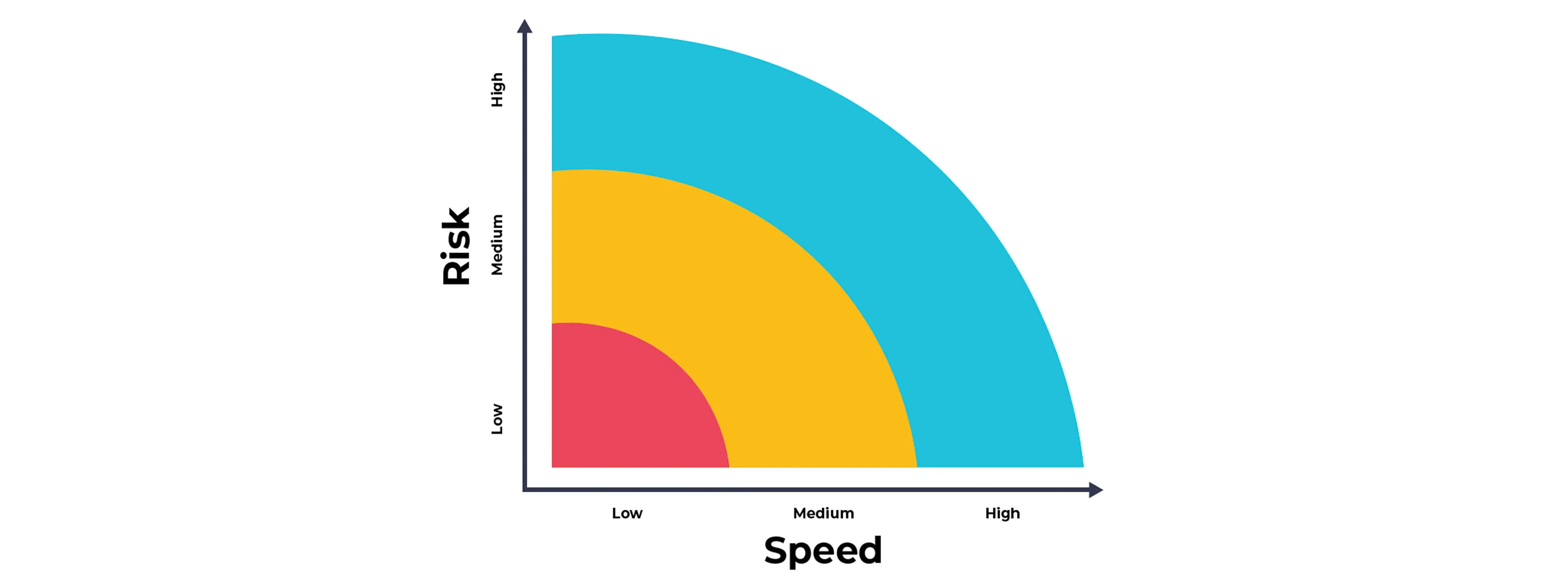
Zone 1
is a participative style that we often see as business-as-usual where a wide range of perspectives are gathered to inform decision-making. This approach is a common engagement strategy where both speed and risks are low.
Zone 2
narrows down the scope of decision-making as risks increase and pressure for speed escalates. This zone is, therefore, most commonly focused at the team level and leverages the specialised and collective insight, knowledge and experience from team members.
Zone 3
elevates decision-making again to be almost centrally accountable to leaders (e.g. CEOs, Executive Directors etc.). This is because at this level of decision-making both risks and speed are high in pressure and intensity – therefore the consultative approach adopted in previous zones is rendered almost ineffective (see Table 1 for more information).
Decision-making: when do I use what zone?
Zone 1
Decision-making focus: Decision-making as business-as-usual with wide participation.
Target level: Network.
Engagement type: Wide involvement that uses decision-making as an engagement strategy.
Zone strengths: Participative approach. Useful with low risk decisions. Works best when there is time to consult widely.
Zone 2
Decision-making focus: Decision-making through the group to define the complexity of the system.
Target level: Team.
Engagement type: Team level engagement to gather multiple eyeballs and perspectives.
Zone strengths: Consultative team approach. Useful when decisions are of moderate risk. Works best when decisions are needed relatively quickly.
Zone 3
Decision-making focus: Leader-led decision-making underpinned by first-principles that align with organisational values.
Target level: Hub and spoke.
Engagement type: Engagement as a means to cascade first-principle decisions and get immediate traction.
Zone strengths: Centralised approach. Useful when decisions have high associated risk. Works best when trade-off decisions need to be made and actioned as soon as possible.
As you could imagine, during times of crisis, decision-making almost instantaneously escalates to Zone 3. What’s most interesting however, is that many leaders are tempted to continue making decisions in Zones 1 or 2.
Now, I’d like to say that simply making the leap from Zone 2 to Zone 3 is enough to put a stop to the early morning conundrums – however, the journey to shift between these zones is much more nuanced and involves a great deal of introspection and consideration.
In our experience, there are two fundamental realisations that leaders need to make before they’re effectively ready to lead in Zone 3 (and to shift swiftly between other zones).
The first is through the recognition that, as a leader, they can no longer be defined by their social self and, secondly, that without tried and true guiding principles they won’t have the conviction to make the necessary decisions when it counts.
Realisation one
My socialised self and how others see me is only part of who I am as a leader
In Kegan’s research on adult cognitive development, he highlighted that adults also develop through different stages (much like in childhood development) and that through each stage they master an element of cognitive advancement¹.
These stages involve a progression from impulsivity (Stage 1: childhood and adolescence), to self-sovereign or imperial thinking (Stage 2: focus on the self), to socialised thinking (Stage 3: focus on others), to self-authorship (Stage 4: focus on principles) and, finally, to interconnected thinking (Stage 5: focus on the system – see Figure 1).
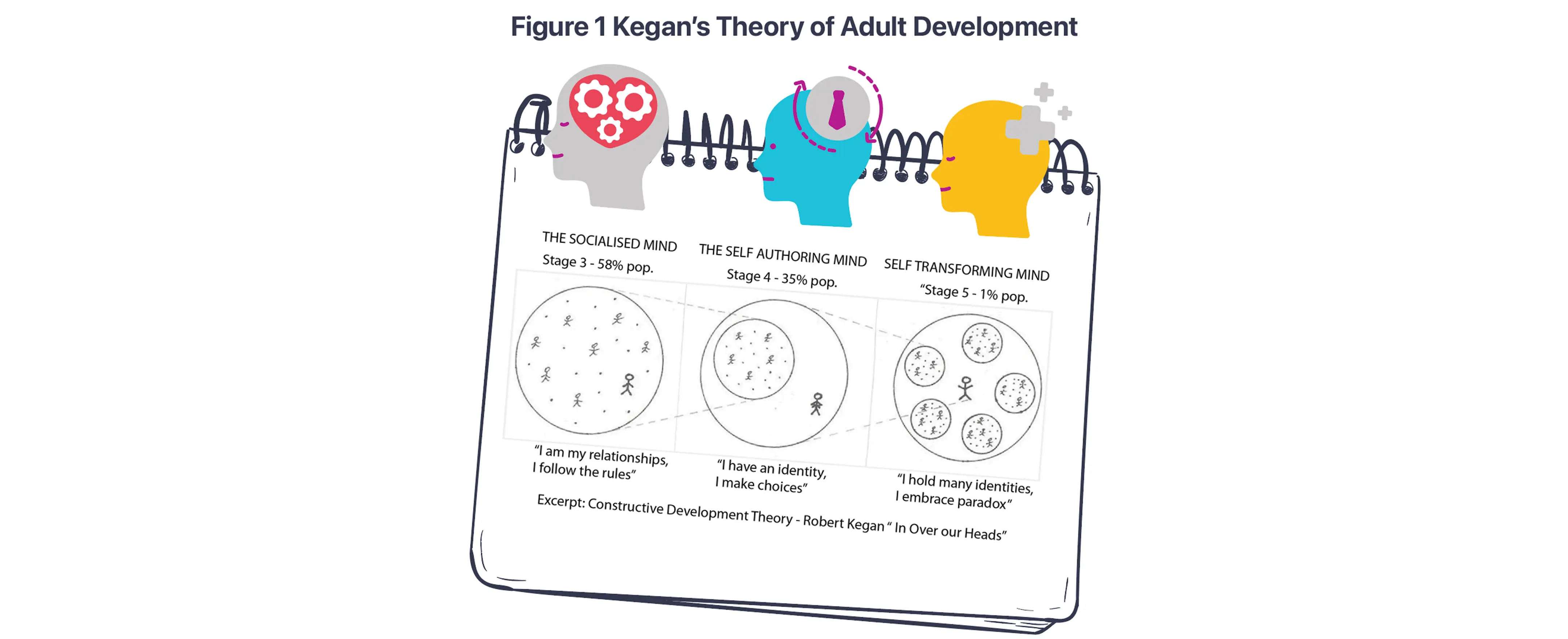
The transition between Stage 3 to Stage 4 is the critical milestone that enables leaders to move comfortably into Zone 3 decision-making and to subsequently shift between all three zones as needed².
Stage 3 leaders are torn between the people and the self and, according to Kegan, often define themselves and their success by those around them (e.g. I’m only as successful as my people think I am)³. As you can see this is difficult in Zone 3 decision-making as it places them in an uncomfortable tension between making the best decision possible and having it potentially isolating them from their people.
If leaders operate in Zones 1 and 2 during a crisis or any other high-pressure situation, they’re compromising risk at the cost of speed and in the case of the recent pandemic, it could even mean risking lives.
¹ Kegan, R. (1994). In Over Our Heads: The Mental Demands of Modern Life. Cambridge, MA: Harvard University Press
² Morad, N. (September, 2017). Part 1: How to be an adult – Kegan’s theory of adult development. Medium: https://medium.com/@NataliMorad/how-to-be-an-adult-kegans-theory-of-adult-development-d63f4311b553
³ Morad, N. (November, 2017). Part 2: How To Be An Adult – Kegan’s Theory of Adult Development. Medium: https://medium.com/@NataliMorad/part-2-how-to-be-an-adult-kegans-theory-of-adult-development-ddf057b4517b
We find that leaders who are still grounded in Stage 3 thinking are more likely to use Zones 1 and 2 decision-making during a crisis as they’re grappling with the element of discernment that is typically resolved by Stage 4.
It’s also often during the transition between Stage 3 and Stage 4 that leaders are confronted with the prospect that they may not be skilled or experienced enough to make the decisions required of Zone 3 (which is also why they rely on strategies more aligned with Zones 1 and 2).
Now, we’ve all experienced the ‘heaviness’ of imposter syndrome at some point in our careers but, as leaders making the shift, their experience of imposter syndrome can be make-or-break from this perspective3.
What can I do to help make the transition?
Making the transition is all about finding, nurturing and developing your internal voice so that the decisions needed in Zone 3 encompass more streamlined logic, reasoning and understanding3. Cultivating your internal voice can be achieved by approaching situations with curiosity, engaging in critical reflection and practicing openness3. Some questions that can help to grow your internal voice include – What do I think? What do I want? What are my motivations?
However, it’s important to note that these types of questions are not to be confused with Stage 2 thinking.
Realisation two
To make the tough calls I need to know my ‘non-negotiables’
Some people say, ‘You can’t just jump in and make decisions without doing some form of consulting’ but, when there is no time to consult, the role of a leader is to make the call.
For leaders in Stage 4, when situations present an abundance of information, they integrate perspectives and use discernment to carve out the next course of action. However, some situations, like crisis situations, present little (if any) information and, as such, leaders need to rely on experience, knowledge, data and their first principles to be able to make the tough calls.
In the process of transitioning between Stage 3 to 4 thinking, individuals often grapple with career or life defining moments in which experience or tension points can be distilled into core principles of being or ‘non-negotiables’. It’s these moments of tension that are also often responsible for those early morning wake up calls – they’re conundrums that are either yet to be converted to first principles (e.g. wisdom) or are first principles being precariously thrown into a potential trade-off scenario.
When we work towards distilling experience into principles we’re negotiating the emotional ties to situations and absorbing the lesson(s) they’re trying to teach us – after all, wisdom is just experience minus emotion.
Stage 4 thinkers use these questions to analyse the self as an object to be integrated with other perspectives/data (e.g. Where does my perspective fit in all of this?) whereas Stage 2 thinkers are more focused on using this type of thinking to assert themselves in the world (e.g. This is what I think and people need to listen or leave).
Finding your internal voice gives rise to a higher level of cognitive complexity and enables more systems-level integration of ideas. The reason that internal voice is critical for leaders (beyond the ability of discernment), is because your internal voice becomes the trigger for when a core non-negotiable is in potential conflict, i.e. your principles for being (Realisation two).
This distilling process is also why the transition between Stage 3 to Stage 4 cognitive development can be tricky (there’s a good reason only a third of the population will make the leap).
In part, the transition sees a shift in our limbic and prefrontal cortex activations where we see more executive functioning as we progress into Stage 4 and 5 thinking; e.g. impulse control, modulation, problem-solving and decision-making⁴. While Stage 3 thinking has substantially less limbic activation than Stage 2, the socialised component of Stage 3 still fosters more emotional reactions than Stage 4 or 5.
Now that’s not to say the latter stages don’t experience limbic activation (of course we all do!), it simply means that through cognitive development they have created pathways and habits that channel those reactions into productive synergistic behaviours.
Essentially, principles are the guardrails that enable these behaviours and leaders in Stage 4 thinking to make principle-based decisions.
In his book, Principles, Ray Dalio suggests that because humans naturally find it difficult to face reality, progress can only be made when we confront painful situations and be able to truly reflect on what they mean to us. In fact, painful truths are the seeds of wisdom and the cornerstone in which ego and blindspots are overcome to create the foundations of our core principles⁵.
⁴ Fuster, J, M. (2002). Frontal lobe and cognitive development. Journal of Neurocytology, 31(3-5). 373-385. doi: 10.1023/a:1024190429920
⁵ Chen, A. (September, 2019). Principles by Ray Dalio – Summary and application. Medium, https://medium.com/@alexchen_60904/principles-by-ray-dalio-summary-and-application-841e76f3eb9
So how do you begin to distill experience into principles?
In developing your non-negotiables or first principles, Dalio suggests diving back through your experiences to identify patterns in your decision-making that amplify the cause-effect relationship6. Ultimately, it’s in these moments that we can tease out our emotional ties and experiences to form principles.
Write down every kind of encounter you’ve experienced that involved intensity of decision-making (e.g. could be job loss, a personal disagreement or being late for something)
Write down how you actually handled it and how you should have handled it
Identify patterns or themes (sometimes, by this step, people will have hundreds of experiences but only a select few will be unique to you)
Update these as you get more data and stress-test your assumptions
Record why you made certain decisions, then check in on that reasoning later
Summary
Whether you’re awoken by early morning conundrums or are tussling with them in your day-to-day life, this article has highlighted several important factors to take into consideration to be able to streamline decision-making.
Firstly, consider what type of decision is most appropriate for the situation. You need to think about the urgency of the decision being made and the weight of the risk associated with it. In Zones 1-3 of decision-making, Zones 1 and 2 are most frequently dabbled in because as part of engagement strategies, teaming and daily operational planning, it’s important to involve the wider system.
However, when Zone 3 decision-making is needed (like in crises, emergencies or high-pressure situations), leaders need to be able to make the tough calls when it counts.
Secondly, leaders need to realise that the socialised self cannot support Zone 3 decision-making. Based on Kegan’s work on adult cognitive development, what leaders develop in Stage 4 thinking is an element of discernment that enables the individual to integrate multiple perspectives while simultaneously not being tied to popular opinion or the socialised perspective.
The internal voice leaders nurture, creates the clarity and conviction they need to make the tough calls associated with Zone 3 decision-making and, therefore, the decisions that need to be made to secure and stabilise organisations or even save lives and livelihoods.
Lastly, one of the core attributes that allows a leader’s internal voice to cut through the noise in Zone 3 decision-making is first principles. Principles are the essence of how leaders can make the tough calls as their life and work experiences have been distilled into non-negotiable truths that act as decision-making guardrails. If a leader is thrown into a situation that creates dissonance or requires a trade-off decision, their fundamental principles help guide their next course of action.
Overall, while we would like to say that ending those early morning wake-ups may be as simple as aligning the most appropriate decision-making zone, asking yourself what you think and establishing some life rules, this process is, in fact, a highly introspective and nuanced approach that can be the culmination of a life’s work.
However, there are ways to accelerate the process and elevate your thinking to Stage 4/5. Remembering that principles are powerful insights established through wisdom, there’s no better way to enhance your leadership approach than reflecting on what you believe in.
As Winston Churchill once said, “Never let a good crisis go to waste.” – so what has COVID-19 taught you as a leader? What decisions have you made that have defined who you are?