
Complex environments can feel like a daily battle against the clock. We are often conditioned early in our careers to respond to what is directly in front of us. We manage the immediate, we execute the deliverables, and we take pride in clearing the day's hurdles.
As we each transition into more senior leadership roles – moving from an individual contributor (IC) to a Director or Senior Director – the very tools that made us successful can start to hold us back. Your mandate shifts. You are no longer responsible for just turning the gears; your job is to step back and shape the entire machine.
To do this, it can be helpful to shift our view on prioritisation; moving from managing our own daily time to managing the team's strategic horizons. Expanding your suite of frameworks for prioritisation, and recognising which tool is of most use in different situations, allows you to manage that transition of responsibility more effectively.
The operational lens: the Eisenhower matrix
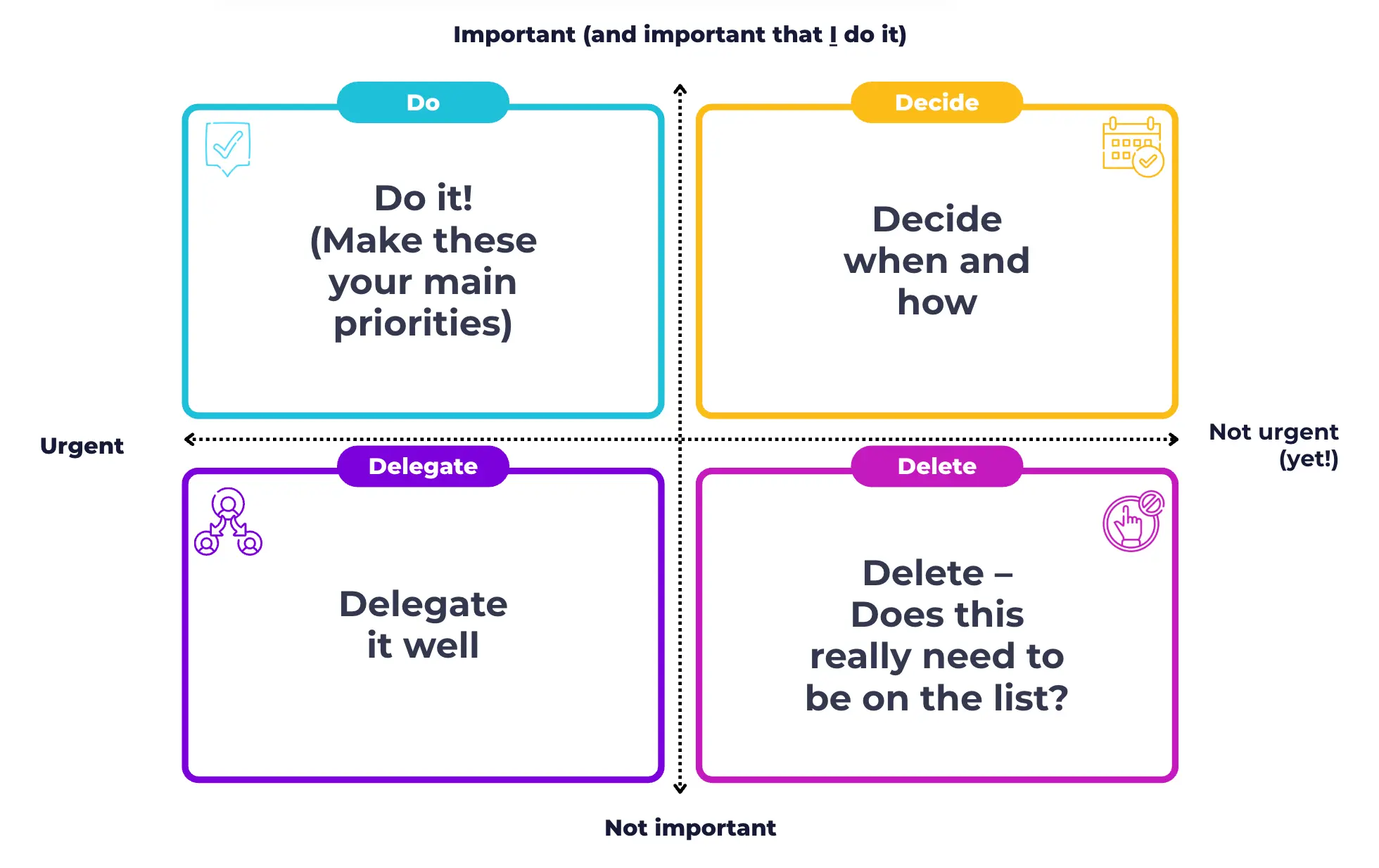
For individual contributors and frontline managers, the Eisenhower matrix (urgent vs. important) feels like an essential survival tool. It is hard-wired into how we manage our day-to-day lives.
This lens helps us filter the noise of daily operations. It forces us to ask: Does this need to be done right now, or can it wait? It is highly effective for managing personal bandwidth, responding to immediate stakeholder needs, and ensuring that critical operational tasks don't fall through the cracks.
However, the Eisenhower matrix has a limitation; it inherently biases us toward the present. When a senior leader relies solely on urgent vs. important, they risk getting trapped in a reactive cycle, constantly fighting fires rather than preventing them.
Eisenhower matrix: urgent vs. important
Strengths and advantages
Great for operating in chaotic environments
Helps with prioritising personal deliverables
Cautions and limitations
Biases leaders towards firefighting
Encourages downstream thinking
Minimises the multiple benefits of good delegation
Source: Covey, S. R. (1989). The 7 Habits of Highly Effective People. Free Press.
The strategic lens: impact vs. effort
When your role requires translating broad organisational strategy into actionable reality, you must operate on a longer time horizon. You are responsible for deciding which cross-functional projects to fund, which initiatives to staff, and which systemic problems to solve so they never happen again.

In this context, the impact vs. effort matrix becomes an exponentially more valuable tool.
Instead of asking when something needs to be done, this model asks what value an initiative creates, relative to the organisational energy required to achieve it. It also highlights where you might be over-investing for marginal return, and brings into focus the wider-reaching influence of your team's activity on others' priorities.
It pushes you to judge work by its wider, system-level impact, not just its immediate value, and to think beyond your own lane into how your choices shape the organisation around you.
Impact vs. effort matrix
A 2x2 matrix plotting low vs. high impact against low vs. high effort:
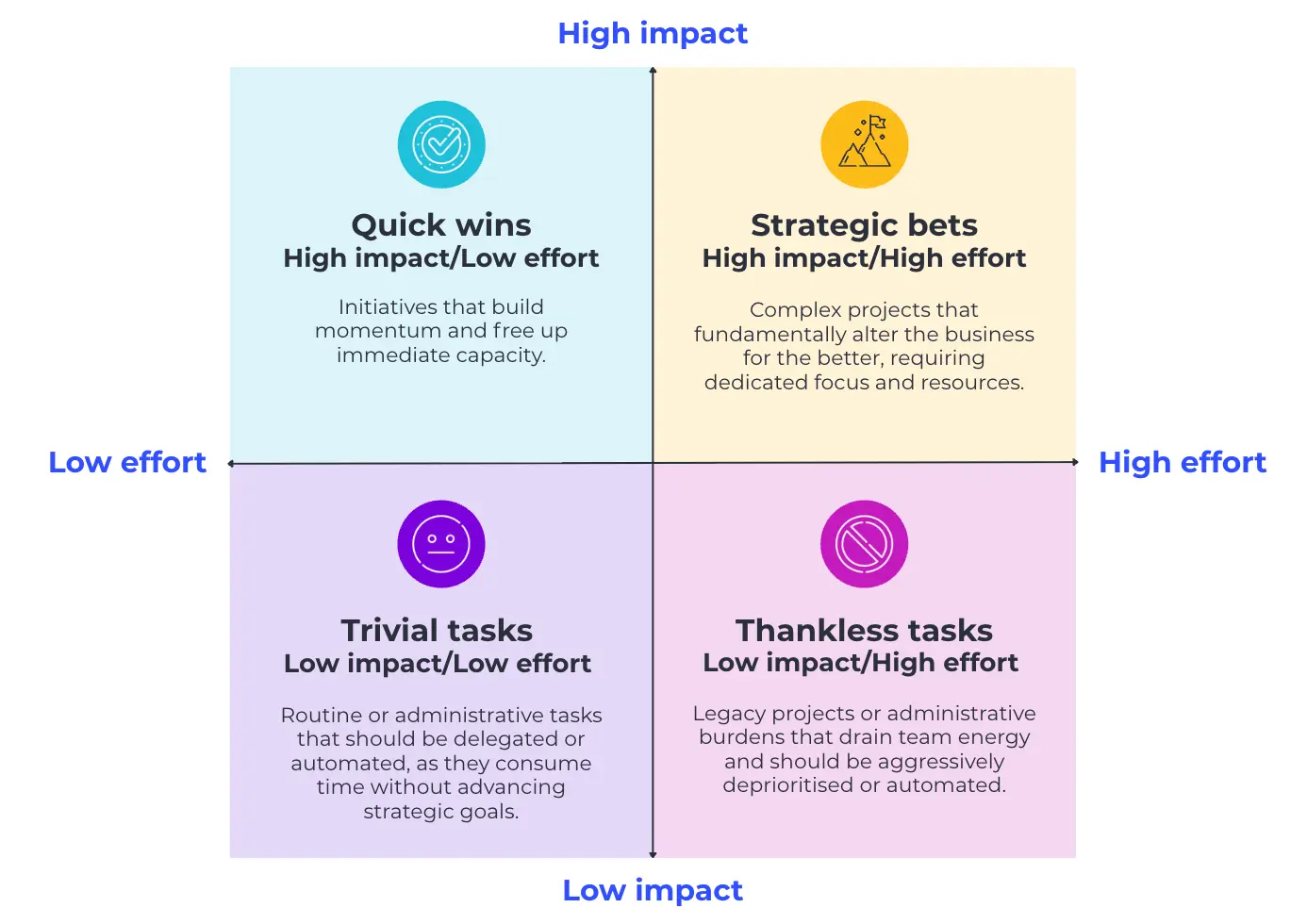
By viewing your portfolio of projects through this lens, you stop measuring success by how fast your team is running and start measuring it by how far they are actually going.
Where are you leading?
Our organisations need both lenses to function effectively. We need ICs to master the daily flow, and we need senior leaders to plot the strategic course. The challenge arises when senior leaders apply the wrong lens to their role.

Comparing the two lenses
Feature | Urgent vs. important (Eisenhower) | Impact vs. effort |
|---|---|---|
Primary user | Individual contributors / frontline managers | Directors / senior leaders |
Use it when… | You're overloaded and need clarity fast; you're managing personal execution; you need to delegate, defer, or drop | You're deciding what should exist; you're prioritising across teams; you're aligning on trade-offs |
Core purpose | Managing personal time and daily tasks | Allocating resources and prioritising projects |
Time horizon | Short-term (hours, days, weeks) | Long-term (months, quarters, years) |
Focus | Efficiency (doing things right) | Effectiveness (doing the right things) |
Action | Do, defer, delegate, drop | Invest, plan, automate, discard |
Signs you are using the wrong prioritisation lens
If you are a senior leader relying too heavily on urgent vs. important, you might be staying too far down in the operational weeds. Ask yourself if these symptoms resonate.
Your team is constantly busy, but major strategic milestones keep slipping to the next quarter.
You feel you have little control over your calendar, reacting to a barrage of 'urgent' emails rather than carving out time for deep, strategic planning.
You are solving the same operational problems today that you were solving six months ago.
You evaluate projects based on who is asking for them (urgency/politics) rather than the systemic value they create.
Your team initiates high-effort projects without first clearly defining the measurable impact.
To allocate initiatives successfully…
Use this checklist once you have allocated initiatives into a quadrant to sense check it's in the right place and all elements have been explored:
Impact Confidence
What specifically will change if we do this? What is the measurable outcome?
Who benefits, and how broadly across the business?
Are we solving a root issue or improving a symptom?
If the answers to these questions are 'fuzzy' it might not yet be truly high impact.
Effort Reality Check
What would this actually take in time, people, and coordination?
What might we have underestimated (dependencies, approvals, rework)?
Are we confusing "we know how to do this" with "this is easy"?
If effort feels "low" but involves multiple teams, it probably isn't.
Bias Check
Are we overvaluing this because it's visible or politically safe?
Are we undervaluing this because it's complex or uncomfortable?
Would we start this today if it didn't already exist?
Have we defaulted to calling too many things "high impact"?
Are we being honest about what is actually low impact?
After this reflection
Confirm placement
OR reclassify
OR pause until you have more information
Now what?
Once you're comfortable that everything is in the right place, moving forward with deliberate purpose is next. To help you (and your team) define what your next steps are, you can use these prompts:
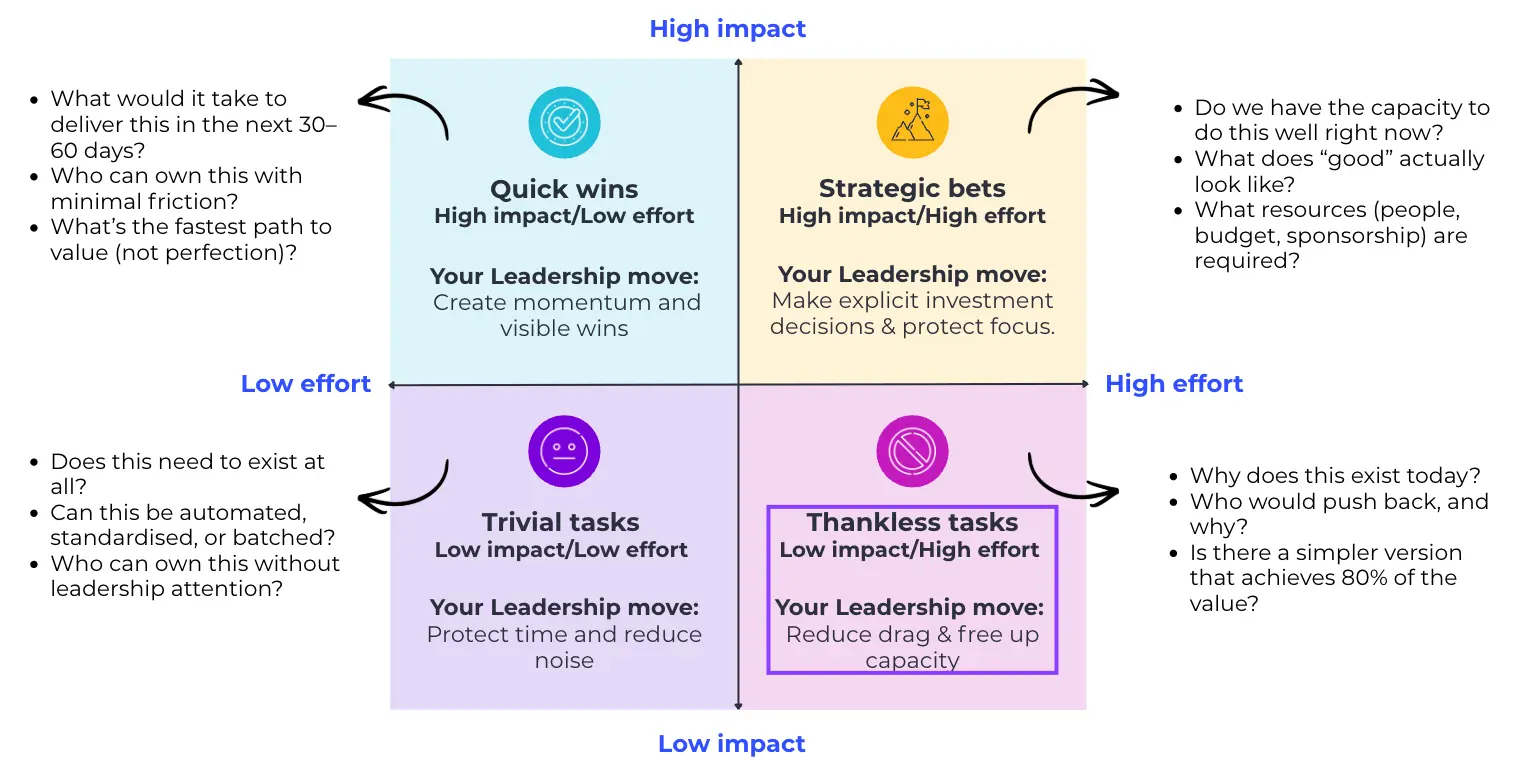
Moving upstream: questions to shift your focus
Changing how you prioritise means actively fighting the psychological reward of solving immediate, urgent problems.
To pull yourself out of the daily current and start shaping the machine, use these questions to guide your next planning session.
If we could only resource three initiatives this year, which ones would fundamentally make everything else we do easier?
Are we confusing 'hard work' (high effort) with 'valuable work' (high impact)?
What 'urgent' tasks am I managing today that could be eliminated entirely if we invested in a high-impact / high-effort systemic fix?
How can I empower my team to own the urgent/important matrix, so I can create the space to own the impact/effort matrix?
Are we balancing the portfolio (to avoid a bias towards 'quick wins')? Is there anything we're avoiding (e.g. if it's 'too hard' or 'too political')?
Your investment in the right strategic lens is what will ultimately build a resilient, future-ready organisation.