
In this article we explore how organisational cultures follow definable levels of maturity in functional lines of development.
Leaders who understand and work with these maturity levels seem to implement strategy with ease, while those who don't have a tendency to stall or are met with resistance.
Peter Drucker once said "Culture eats strategy for breakfast"
But how does culture have such a huge impact on our ability as leaders to get things done?
When navigating the intricate tapestry of organisational culture, leaders often grapple with the enigma of aligning strategic initiatives with the multifaceted values and behaviours embedded within their teams and broader entities.
The profound words of Peter Drucker, "culture eats strategy for breakfast", underscore a pivotal challenge: The formidable impact of culture on the execution of strategic endeavours.
While leaders meticulously craft strategies to propel healthcare systems forward, the underlying cultural currents, characterised by varying levels of maturity and divergent functional developments, can either buoy these initiatives or submerge them into an abyss of unfulfilled objectives.
This article delves into the profound realms of cultural maturity, exploring its pivotal role in healthcare settings and unravelling how the nuanced understanding of developmental lines can illuminate the path towards a more integrative, patient-centric model, adeptly navigating the complexities and resistances embedded within organisational cultures.
Cultural proficiency in healthcare contexts
The cultural maturity framework enhances healthcare systems by offering insights into varied perspectives among patients and professionals, applicable to personalised care, collaboration, education and policy-making.
It also aids in understanding resistance to change in complex settings and helps leaders transition towards a more integrative, patient-centric model, addressing the diverse needs of all stakeholders.
Exploring culture through the lens of developmental lines
The idea behind developmental lines is that an individual or cultural environment may grow and develop at different rates in different functional areas. For example, a culture may show advanced development in cybersecurity, yet lag in accounting practices.
The degree of maturity in the way the work is done is intrinsically entwined with its culture.
The concept of 'line development' is most often applied to an individual's personal development. Author Ken Wilber identifies a number of key universal lines; these include cognitive intelligence, moral development, artistic skills, interpersonal relationships, emotional responses, kinesthetic abilities and spiritual awareness.
He argues these various lines of development interplay to shape a person's overall state of being, understanding of the world and interaction with others.
In leadership, each performance standard in the leadership pipeline represents a different line of development. You can be highly skilled in one and a novice at another.
We would argue this same principle holds true for organisational culture – an organisation's culture is made up of multiple lines of functional maturity. This explains why different parts of the organisation, at different levels of cultural maturity (completing different tasks), often conflict about priorities and processes even at a leadership level.
Fortunately, these lines are not seen as fixed traits but rather as ongoing growth potentialities that can be nurtured and developed through life experiences, education and personal exploration.
All cultural lines in an organisation traverse the same fundamental stages of maturity. While these developmental lines may be disparate in terms of skill sets or aptitudes, they underpin similar stages of complexity.
These fundamental stages exhibit striking resemblances across various models, including Ken Wilber's spiral dynamics, Robert Kegan's levels of adult maturity and Drotter and Burow's stages of cultural maturity, indicating a common pattern.
A deep dive on the stages of cultural maturity
The cultural maturity model serves as a valuable tool for comprehending the value systems and driving forces that shape leaders' ambitions and their organisation's direction.
By examining the current maturity level of specific cultural lines in an organisation, and exploring the factors influencing its values, practices, and processes, the model offers a comprehensive understanding of how leaders can ensure the changes they need to make aren't 'eaten for breakfast' by the organisation's culture.
To enhance our understanding of cultural maturity, we will also refer to Frederic Laloux's influential 2015 book, Reinventing Organizations. Laloux's work helpfully showcases real-world examples of organisations operating from different levels of maturity.
Background of the evolution of the cultural maturity model
In the ever-evolving world of transpersonal psychology and integral theory, one prominent American writer, Ken Wilber, stands out for his application and promotion of a maturity model known as spiral dynamics.
An innovative brainchild of Don E. Beck and Christopher Cowan, spiral dynamics was conceptualised based on the pioneering endeavours of developmental psychologist Clare W. Graves. A mosaic of model and language, spiral dynamics conveys the intricate metamorphosis of individuals, organisations and societies.

The true brilliance of spiral dynamics lies in its ability to unravel the web of value systems – ambitious driving forces that dictate what individuals and organisations treasure and what stirs them into action.
By navigating the distinct rungs of development through which these value systems evolve, spiral dynamics offers a novel perspective of understanding these entities.
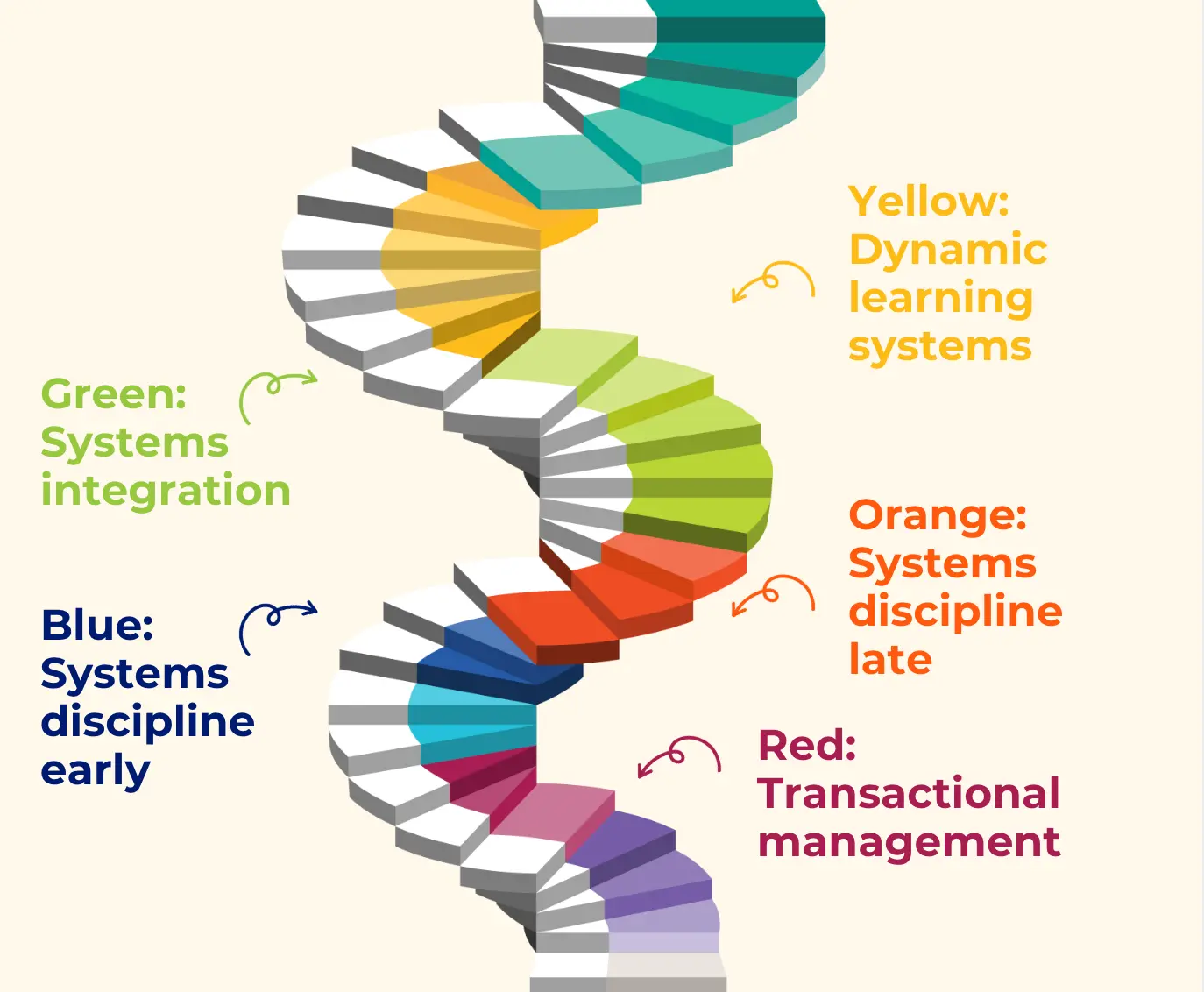
A visual representation of spiral dynamics provides a description of each developmental stage, including an exploration of the associated value system. It serves as a theoretical framework for understanding the constant evolution of human cultures.
It becomes a potent tool, therefore, for dissecting the interplay between individuals and their professional settings, painting a comprehensive picture of cognitive influences and behavioural drivers.
Figure 1 · Cultural maturity map
The map plots five stages of cultural maturity against two axes (managing the complicated → managing the complex; rider in charge → elephant in charge):

Muddling through (Kegan stage 1)
Transactions management (Kegan stage 2)
Systems discipline – 3A (Early) and 3B (Late)
Systems integrations (Kegan stage 4)
Dynamic learning system (Kegan stage 5) – with translational mechanisms
In this model, no stage is superior to another
Each harbours its own unique value system, effectively serving its function within its suited environment. The model is employed to decipher the underlying drivers of individuals' thoughts and behaviours.
The overarching objective is for leaders to best guess the level of maturity in the line of cultural development they wish to focus on, and check it will support the implementation of their desired initiative.
If leaders find that initiatives are being stalled, it could be due to multiple reasons including a lack of skill, a lack of clarity, perceived lack of resources or, if the issue is cultural, leaders are asking individuals to action things requiring a level of cultural maturity that they don't have.
If the task is mismatched with the level of cultural maturity around that line, it will stall and the initiative will be 'eaten for breakfast'.
This model, like all models, simplifies the complex realities it represents – serving as a tool for our understanding rather than an absolute solution.Remarkably, individuals and cultures do not exist solely within one level.
As we advance through each stage, we absorb and integrate all previous levels. The insight by Laloux encapsulates this idea lucidly: "In a specific moment a person operates from one type of paradigm".
Often, progress comes by facing adversity; when our existing worldview falters as it meets the challenges at hand, prompting us to embrace a higher level of cognition through learning and development.
As we grow together, our awareness around that line of development expands, giving rise to a more complex world view.
Unlike a curriculum that can be instilled, coerced or implemented, the evolution of cultural development requires leaders to create an environment that promotes and catalyses the necessary triggers for development.
Broadly, cultural maturity is broken into two tiers
The shift shows up not in strategy decks or new operating rhythms but in the texture of how the team works together.
First tier consciousness
Views the world through a lens of scarcity, and perceives its worldview as the ultimate truth.
Second tier consciousness
Is when fear drops away and is replaced by a more holistic and sustainable worldview.
The five stages of cultural maturity
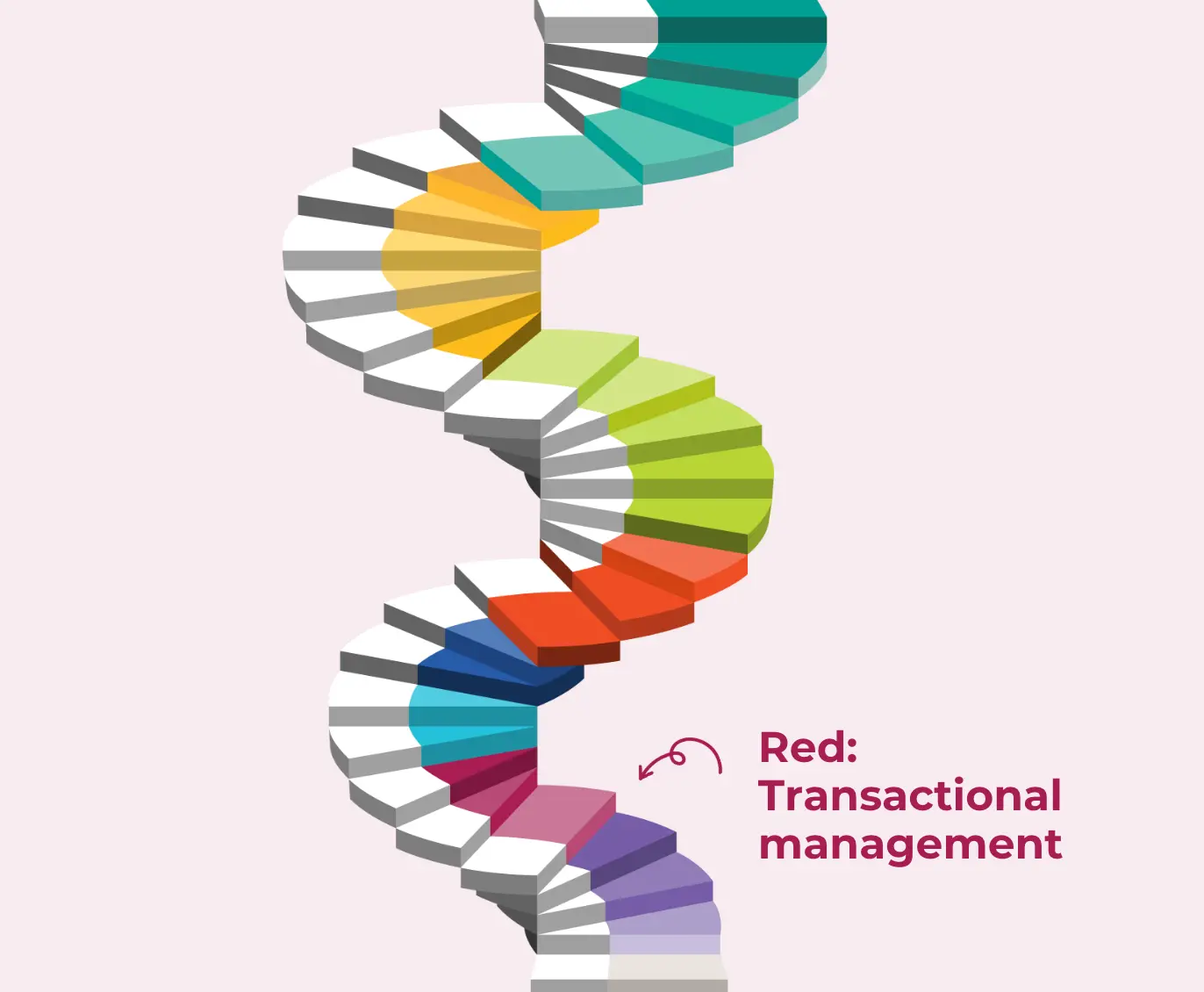
1. Transactional management
(referred to as 'red' in spiral dynamics and 'impulsive' by Laloux)
Venturing into known history, social development researchers argue that approximately 10,000 years ago, the first forms of organisational life – dubbed 'red' organisations (impulsive by Laloux) – emerged. Rooted in tribalism, these entities had an opportunistic value system focused heavily on exerting power or submission to a more formidable entity to fulfil their needs: Egocentric – fixated on personal needs and gains.
In these structures, a dominant leader at the helm led through fear, exerting their power routinely. Designed to succeed amid chaos, they prove effective in unstable circumstances like war zones. However, their fragility is exposed in more stable environments warranting strategic planning, where their short-sightedness and reactive modus operandi are revealed. Modern equivalents of such 'red' organisations can be seen in street gangs and mafia groups.
When a line of development is first introduced it moves from muddling through* to transaction management, when a strong leader takes the helm and drives compliance to a new approach.
*Muddling through phase refers to an organisation in start-up or crisis mode. If you were to start a bike shop under your house, you'd muddle through for the first few months. Where there's a field hospital set up after an initial disaster, teams muddle through until they start to get order into the systems; in this situation everybody leans in and 'makes it up as they go along'.
To move teams to transactions management
Establish yourself as a strong leader who can protect them
Link benefits with supporting the direction you provide and create negative consequences for challenging the leader
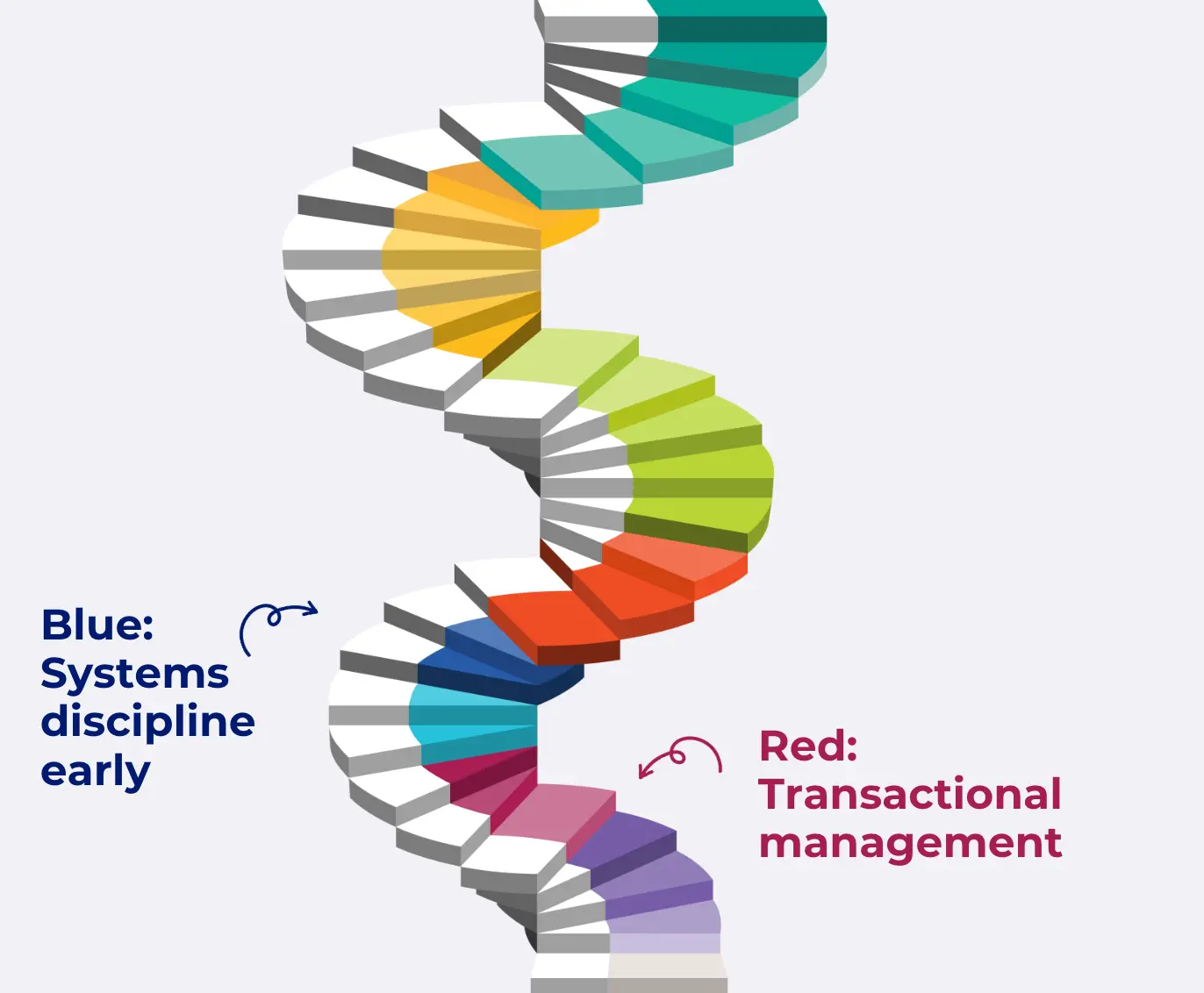
2. Systems discipline early
(referred to as 'blue' in spiral dynamics and 'order' by Laloux)
Many lines of development in today's populace (including our metropolitan public health systems) are believed to operate at the 'blue' (order driven) stage of development; they're characterised by an understanding of causality, forward planning, and heightened empathic connection. Self-esteem in this stage is often externally derived, with acceptance, recognition and belonging being coveted.
Individual focus transitions from a transactions management 'egocentric' zone to a systems discipline 'ethnocentric' perspective, where concern extends to encompass one's functional area but seldom beyond.
Authority, instead of being person-centric, becomes role-centric. The systems discipline phase values stability, predictability, strict hierarchies and rigid pyramidal structures for maintaining order.
For instance, many lines of development in the Catholic Church epitomise a systems discipline level of maturity in the western context, similar to government agencies, public schools and the military. This level of development provides the foundation for stability and certainty in groups and society.
Power dynamics at the systems discipline level of maturity are typically tumultuous, causing frequent rearrangements in the existing hierarchies. Adherence to an extensive set of rules and morals is prized, and deviations are met with punitive actions. Hence, cultivating rule-abiding tendencies is pivotal in assisting the transactions management to systems discipline transition, restraining the pursuit of immediate gratification.
Resistance to change is another hallmark of systems discipline organisations, often viewing employees through the McGregor's theory X lens – slothful, deceitful and necessitating strict supervision. Employee development is usually secondary and workplaces foster siloed operations, leaving interdepartmental communication minimal. McGregor's theory X a recurring issue often encountered in large-scale business process management.
To move teams to systems discipline (early)
Make the processes required very clear (document them and ensure everyone knows them)
Clarify the system
Provide standardised training for the system
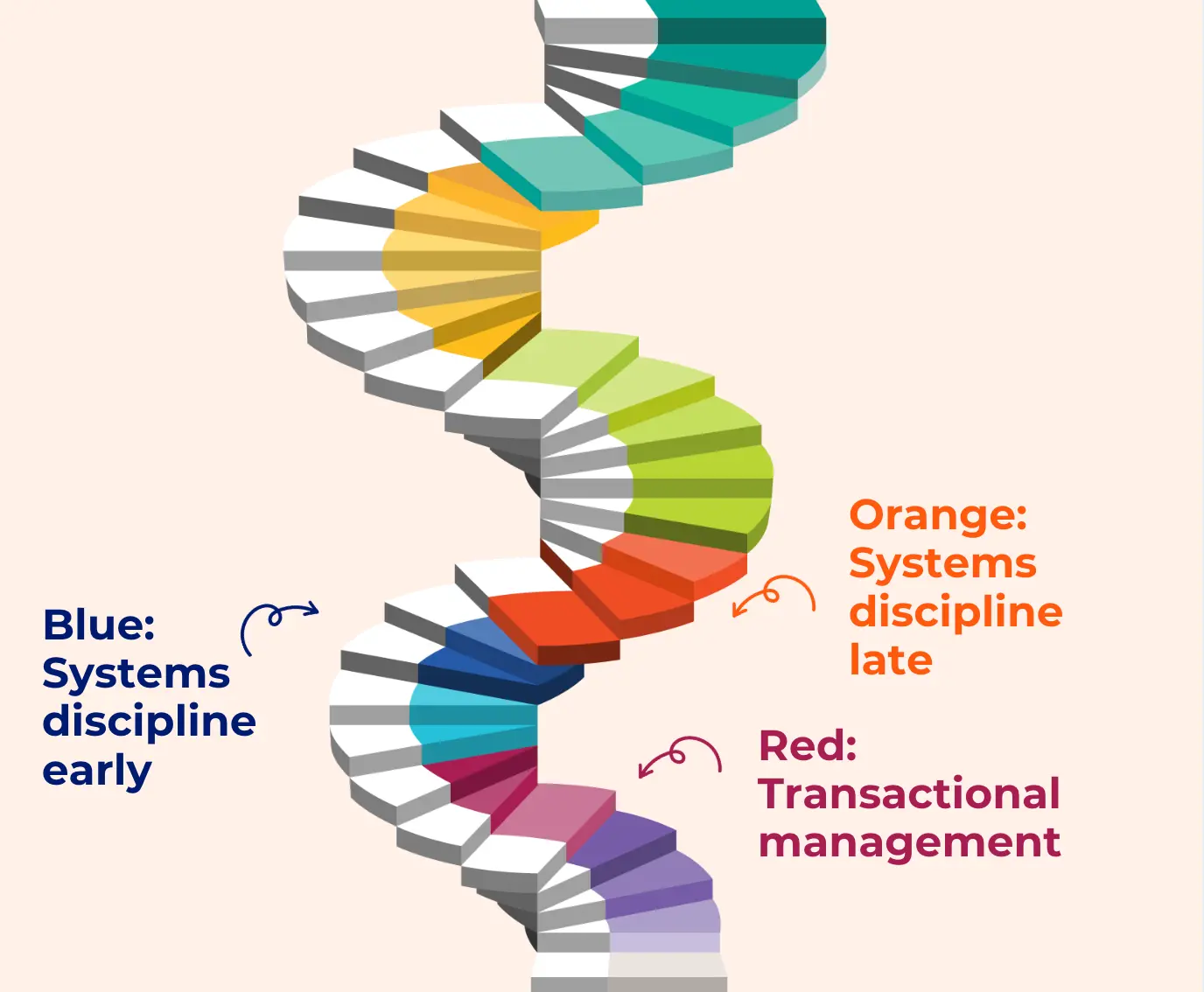
3. Systems discipline late
(referred to as 'orange' in spiral dynamics and 'achievement' in Laloux)
The majority of today's leaders in business and politics, according to Laloux, have their leadership line at this 'achievement' level of maturity, imbuing most global commercial organisations with this value system.
There is a tension at the achieving phase, ethics with short-cuts that improve chances of success.
In this landscape, individuals and cultural lines persistently strive for optimal outcomes, even if it means challenging authority and traditional methods. The pursuit of the 'right' answer fuels ambition for upward mobility – science ascends as the new religion, overshadowing dogmatic beliefs.
The systems discipline late 'achievement' level of cultural maturity ushers in innovation, accountability and meritocracy, though the hierarchical pyramid remains, subtly modernised with the emergence of project groups, cross-functional teams and expertise-based roles.
While an attempt to empower employees with management by objectives exists, it often falters due to the prevalent fear of failure. Leadership, caught in the grips of control, defaults to mistrust, refraining from delegating decision-making powers.
The achievement value system, however, casts a shadow of negative impacts such as greed, materialism, short-term outlooks, overconsumption and exploitation of earth and its ecosystems.
Leadership dominated by achievement tends to revolve around extrinsic motivation, favouring goal achievement over community building. Individualism trumps collective efforts; rationality supersedes emotions. A disregard for deeper meaning or purpose often leaves individuals feeling hollow.
In the achievement perspective, organisations are viewed as machines, reducing employees to mere cogs – often resulting in a soulless corporate culture.
To move teams to systems discipline (late)
Move focus from activity based to results orientated
Be accountable for following process and for the degree to which the process achieves the objectives
Have a system for people to upgrade the approach so it's more efficient/effective
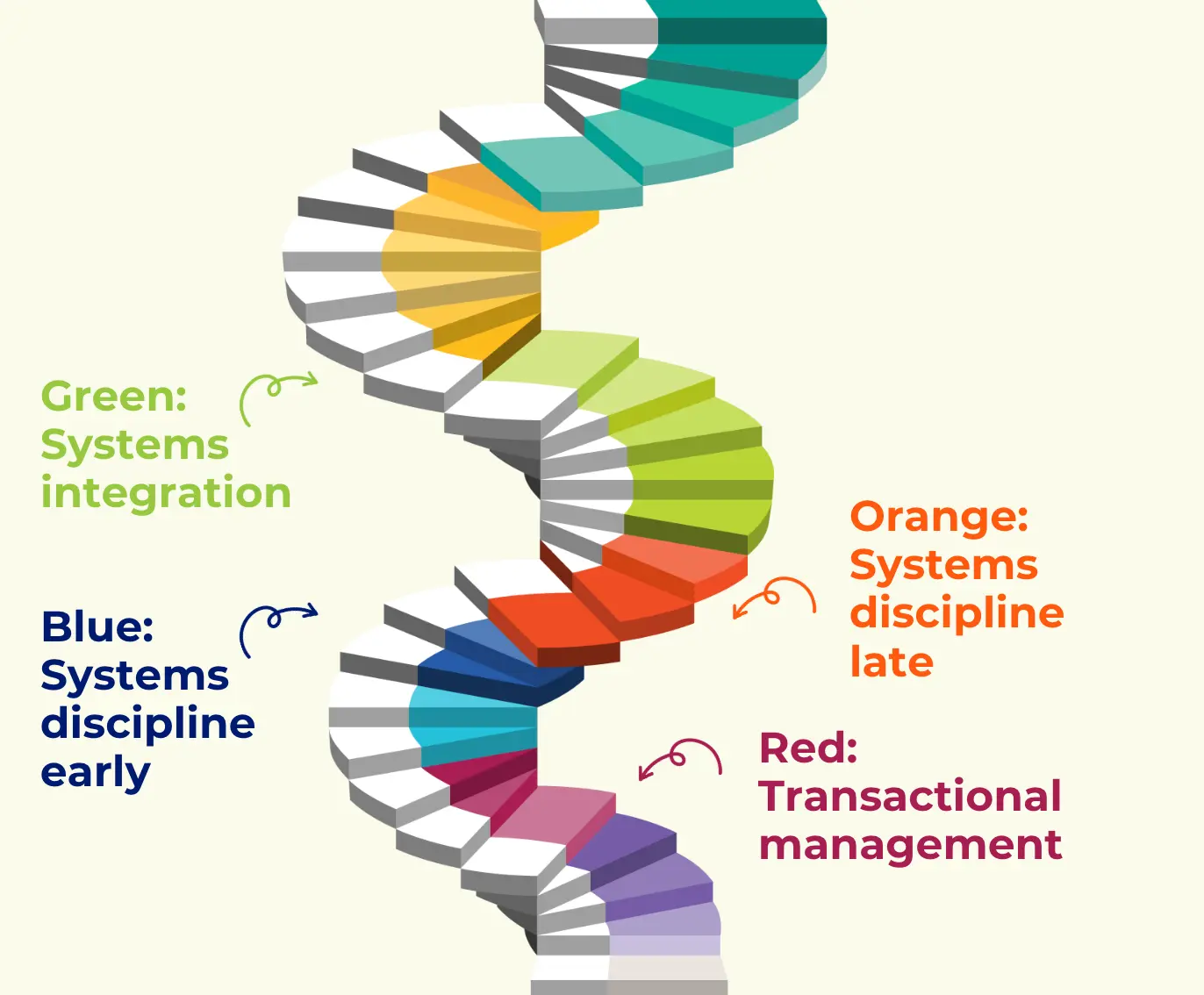
4. Systems integration
(referred to as 'green' in spiral dynamics and 'pluralistic' in Laloux)
Beyond the binary fixation on success or failure lies the worldview of systems integration (pluralistic), valuing more than mere shareholder value realisation, dominant in the for-profit achievement maturity level.
Systems integration submits to sensitivity, valuing respect, equality, community, cooperation and prioritising relationships above all else.
This level of leadership maturity upholds service to employees who, in turn, serve customers; instances of systems integration practices can be spotted not just in non-profits, social workers, and activists, but also in corporations like Southwest Airlines, Ben & Jerry's, Starbucks and Zappos.
Fostering systems integration maturity in a specific activity line in an organisation requires decentralisation and meritocratic hierarchies akin to the previous phase of maturity, though more power is vested in employees.
Leaders transition from problem-solvers to servant leaders who foster empowerment, belonging and motivation within employees. This necessitates the development of such leaders, grading performance through a 360 review, with leaders accountable for their subordinates.
Organisations with the majority of the lines sitting at systems integration thrive on shared cultural values and purpose. These aren't temporary fads, but deeply ingrained values, with leaders demonstrating them through actions, superseding extensive policymaking typical to earlier phases of maturity.
Stakeholders aren't confined to shareholders but extend to employees, customers, society at large and the environment, with an inherent sense of social responsibility. At this level of maturity, organisations strive to enhance corporate citizenship and create a familial workspace.
To move people working in a line of culture from achievement to systems integration, leadership strategies need to focus on structural, processual and cultural revamps, fostering employee development and collective enhancement over individual performance. It's often argued that core attraction factors for Millennials align with this value system.
To move teams to systems integration
Refine the process to deliver better and more efficient outcomes
Trial new processes, approaches and mindsets in one area of the organisation and share learnings
Highlight and reward improved outcomes, not just the activity
5. Dynamic learning systems
(referred to as 'yellow' in spiral dynamics and 'evolutionary' in Laloux)
Second tier consciousness
Embracing second tier consciousness, individuals adopt an abundance-oriented perspective, understanding their worldview is not exclusively correct. This realisation fosters respect for others' value systems, recognising their legitimacy parallel to one's own.
This stage signifies a pivotal shift from fear to trust, scarcity to abundance, diminishing the need for control. It heralds growth, transforming adversity into opportunities for innovation. Consequently, a meaningful, contributory life becomes the new driving force. Emphasising self-reflection, 'yellow' enables the manifestation of personal values and strengths.
A dynamic learning systems level of maturity fosters holistic decision-making, integrating rationality with real-time data. It builds leaders with intuitive insights based on a deep understanding of the complex system in which they live. It proposes seeing organisations such as Patagonia and Buurtzorg as purpose-driven entities that prioritise value provision over bottom-line profits.
In this strategy, decision-making powers are decentralised; the guidelines emphasise seeking advice from stakeholders and experts. Furthermore, the focus shifts from staff functions to self-organised, multi-functional teams.
Cultural lines at this level of maturity are characterised by a lean meeting culture, augmented transparency and straightforward conflict management.
Transitioning from systems integration to dynamic learning systems cultivates teams with a better understanding of ego-driven fears and desires and replacing them with effective self-management. Ultimately, this provides an environment nurturing productivity, trust and self-governance.
To move teams to dynamic learning systems
Create cross-functional teams to solve system-wide problems
Unify platforms so that data can be shared across the organisation
Consider restructuring from functional excellence to customer/patient/consumer experience
Spend time understanding or working in each other's portfolios
Tips for leaders: Navigating cultural maturity in organisations
1. Understand the cultural maturity model
Understand the cultural maturity model and its stages. Recognise that each stage has its own values, priorities and ways of working.
2. Identify your organisation's cultural maturity level
Assess the current cultural maturity level of your organisation. Identify the various developmental lines within your organisation and their respective maturity levels.
3. Align strategy with cultural maturity
Ensure that your strategic initiatives are in alignment with your organisation's cultural maturity. Be mindful that strategies requiring a higher level of cultural maturity than what is present may face resistance or failure.
4. Develop leadership across all levels
Cultivate leadership skills that are adaptable to various cultural maturity levels. Engage in leadership development that enhances your ability to navigate and influence different cultural stages.
5. Monitor and evaluate regularly
Assess the effectiveness of strategies in relation to the cultural maturity of the organisation. Be prepared to pivot and adapt strategies in response to evolving cultural maturity and organisational needs.
Cultural maturity summary table
The table maps five maturity levels (from low to high complexity) against five dimensions: Culture, People, Process, Governance, and Leadership.
Level 5: Dynamic learning systems
High complexity
People – How our people behave at this stage:
Increased focus on understanding and improving how the 'whole system' works
Last remnants of blaming others for problems drop away; 'we can't because…' thinking is replaced by 'what if…' thinking
Appreciation for complexity, constraints and interdependencies
Focus on partnership, social benefits and multidisciplinary, community-focused action
Process – What does the culture focus on at this stage?
Using lag indicators to shape the system quickly
Moving from creative engagement to real-time, data-informed activity
Governance – Emergent structure at this stage:
Systemic flow (synthesis oriented)
Leadership – Supporting leaders to shift to the next level:
Building from here
Simplify the number of data-points that inform the system and performance ('What are our most valuable indicators?')
Educate key decision-makers in the complex system on why this data is important and enable decision-making as close to the frontline as possible
Increase the pace of data informing the organisation
Level 4: Systems integration
People – How our people behave at this stage:
Socratic approach to decision-making with detailed engagement and discussion to consider all viewpoints
Bottom-up change informed by feedback from the frontline
Group-based decision-making
Consensus seen as truth
Process – What does the culture focus on at this stage?
Integration and co-creation
Moving from isolated activities to an integrated platform
Governance – Emergent structure at this stage:
Social network (people driven)
Leadership – Supporting leaders to shift to the next level:
To move teams from here to dynamic learning systems
Create cross-functional teams to solve system-wide problems
Unify platforms so that processes can be integrated and data can be shared across the organisation
Consider restructuring to decision-making from a focus on functional excellence to a focus on customer/consumer experience
Spend time understanding or working within each other's portfolios
Level 3B: Systems discipline (late)
People – How our people behave at this stage:
Increasing focus on outcomes over process
Iterative refinement of inefficient processes (early stage) gives way to an interest in 'cuttable corners' and new, more radical ways to deliver comparable outcomes with less effort
Recognised by the industry, leading best practice and discussion
Process – What does the culture focus on at this stage?
Outcomes rather than process driven
A focus on how activity can shift the dial in particular areas
A race to see who can deliver the best outcome
Governance – Emergent structure at this stage:
Strategic enterprise (success driven)
Leadership – Supporting leaders to shift to the next level:
To move teams from here to systems integration
Refine the process to deliver better and more efficient outcomes
Trial new processes, approaches and mindsets in one area of the organisation and share learnings
Highlight and reward improved outcomes, not just the activity
Level 3A: Systems discipline (early)
Underlying philosophy: Consistency
People – How our people behave at this stage:
Compliance and process-focused, with everyone keeping each other accountable
Governance to support consistency and safety becomes a key concern
Following the rules wins over personal gain and organisational outcomes
Process – What does the culture focus on at this stage?
Standardised processes
80% of all work in this area is documented to be completed by following a standardised process
Corporate approval that ensures people are trained in the process
Governance – Emergent structure at this stage:
Authority structure (order driven)
Leadership – Supporting leaders to shift to the next level:
To move teams from here to systems discipline (late)
Move focus from activity-based to results-orientated
Be accountable for both following process AND ensuring the process achieves the objectives
Establish a system for people to upgrade the approach so it's more efficient/effective
Level 2: Transactions management
People – How our people behave at this stage:
The loudest and most powerful (i.e. those who can give the biggest rewards or impose the most punishment) rule the roost – so if those voices do not support something it won't get done
Short-termism: immediate consequences (whether +ve or –ve) dominate attention
"How things impact me" are given just as much weight as impacts/benefits to consumers
At its most extreme: overt power plays/shows of strength, fiefdoms, threats/demands and 'gaming the system' to achieve personal ends
Process – What does the culture focus on at this stage?
Driven by transaction 'owners'
Specific processes exist to solve specific problems (but not linked, consistent or comprehensive)
Leaders own particular micro-functions and their preferred approach is enforced
Governance – Emergent structure at this stage:
Local empires (power driven)
Leadership – Supporting leaders to shift to the next level:
To move teams from here to systems discipline (early)
Clarify what 'our machine' needs/requires to operate effectively and sustainably
Make core processes very clear (document and make sure everyone knows them)
Standardise training for key systems/processes
Use each emerging pain point to motivate change – use the pains to drive conversations about a consistent shared picture or purpose and build towards it
Encourage individuals to use a portion of their time and energy to build shared ways of working, shared values and a shared vision of how a 'team before self' will make the culture better for all
Shift the performance focus away from 'big personalities' and what they like/want/believe towards objective roles, processes and enabling structures
Level 1: Muddling through
Low complexity
People – How our people behave at this stage:
If leaders give clear directives, directions are implemented compliantly and without contextual adaptation
'Gods' in the organisation (most powerful, most wise, longest tenure) are defaulted to
Cultural 'bibles' dictate unquestioned behaviours and reactions
Process – What does the culture focus on at this stage?
Driven by urgency
No process
Make it up as we go along
Do what needs to be done (urgent trumps important)
Governance – Emergent structure at this stage:
Tribal order (safety driven)
Leadership – Supporting leaders to shift to the next level:
To move teams from here to transactions management
Establish yourself as a strong leader who can protect them
Link benefits with supporting the direction you provide and create negative consequences for challenging the leader
Summary
As we deepen our understanding of individual and organisational development patterns, we gain insight into the motivations for human behaviour; we improve our ability to engage effectively with diverse organisational environments and enable more targeted solutions to meet individual and organisational needs.
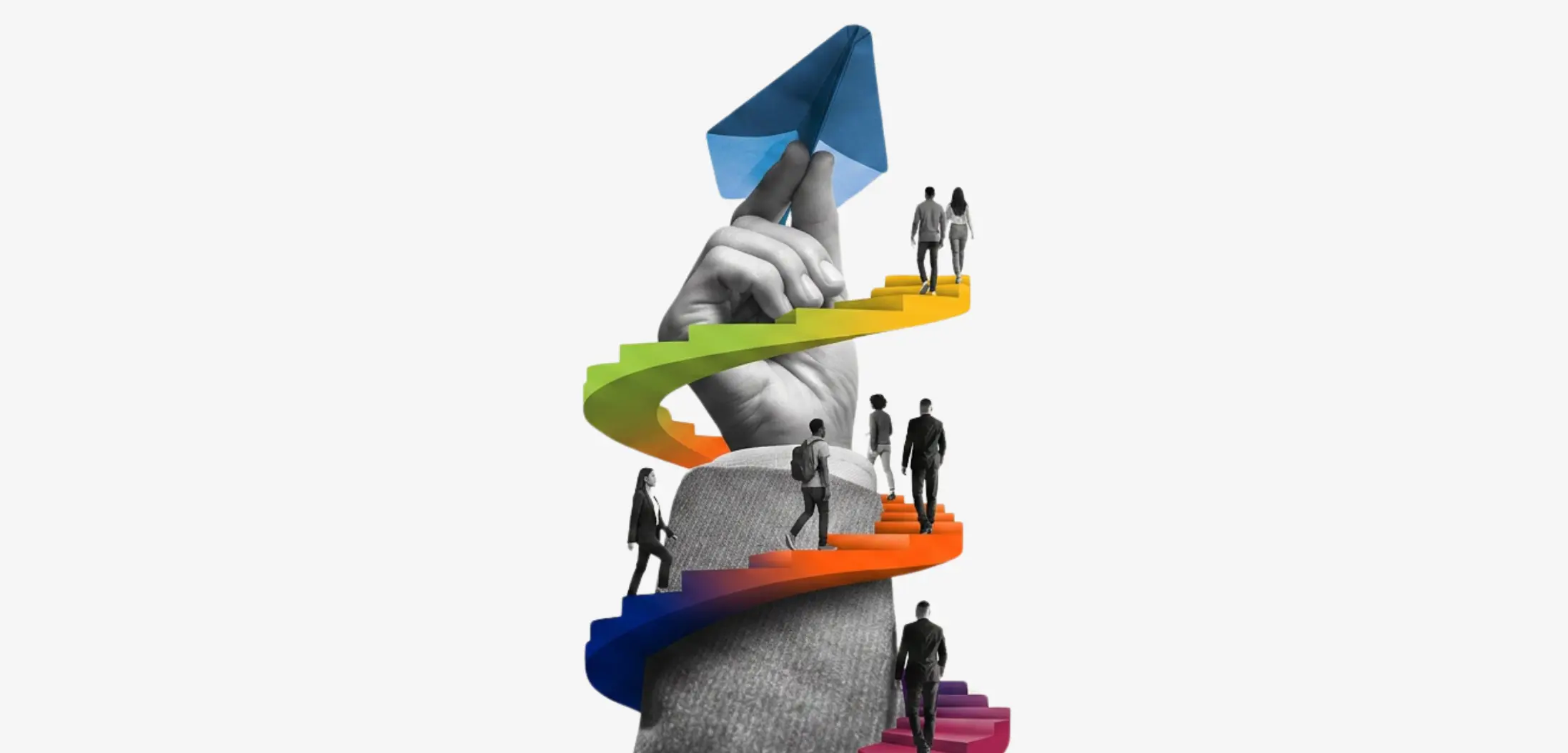
Cultural maturity offers a valuable framework for decoding the development necessary for leaders to cultivate high-performance environments where employees are able to implement strategically aligned initiatives that promote innovative organisational performance.
Each stage within this model should not be viewed hierarchically; the progression is not synonymous with improvement – businesses at the systems discipline (achievement) stage, for example, have inflicted unparalleled environmental damage.
The stages are context-dependent. In a warfare situation, the transaction management stage would be optimal, whereas in a tranquil, stable context, systems integration or dynamic learning systems level of maturity would be preferred.
Individual responses also vary according to the stage of life and unique circumstances. Job loss might trigger behaviours attributed to the earlier stages, while receiving genuine, supportive feedback from a manager could elevate us into the systems integration stage.
Cultural maturity remains a conceptual model but can augment our comprehension of complex realities, enabling greater achievement of significant goals.