
The market is changing, driven by a tidal shift in consumer behaviour. Customers are no longer ‘hunting and pecking’ their way through a long, considered purchase process. Instead, they’re tapping, typing and buying, sometimes barely knowing what they’ve bought.
The ability for a marketer to attract (with positioning and ‘sizzle’) and then persuade (with ‘the steak’ of features/benefits) has been eroded and replaced by a faster, more impulsive cycle. And as marketers’ classic 1-2-punch fails, it’s the masters of brain science and behavioural economics whose efforts are rising to the top.
Steve Jobs changed everything
Whereas in the ‘50s the Mad Men executives focused on creating needs and promoting features and benefits, Steve Jobs changed the world and it will never go back.
His relentless drive for ‘focus and simplicity’ gave rise to a whole new generation of user-focused experiences. His paradigm gave rise to a way of thinking, where adding more features and benefits and selling the USP (be it at a rational or emotional level) gave way to buzzwords like ‘ecosystems’, ‘platforms’, ‘stickyness’, ‘customer experience’, ‘cycle timesʼ and ‘gamificationʼ.
Thanks to Steve, from the customer’s perspective, complicated hand-wringing purchases have now become fast and intuitive, driven by ‘automatic need satisfaction’ that barely hits the brain’s conscious radar. And, most surprisingly, this is true not only for small habitual purchases, but also, increasingly, for the major ones like banking, insurance, health and legal services.
In 2016, we’re still at the beginning of the transition. The winners will be those who can turn their products into platforms, and whose economic value directly reflects the strength of the habits they create in their consumers.
They’ve grown accustomed to your Facebook
The trick in this massive transformation is to embed your offering into habit-forming products and services that link to the daily routines and emotions of your customers.
Some products and services that people access daily (such as news sites, Facebook, Twitter and Instagram) are standouts in this area. For example, industry figures suggest that in 2016, the average user spent 57 minutes per day on Facebook.
Their consumers come back many times a day, principally because the app or website’s primary behaviour is simple enough to quickly satisfy an internal emotional trigger.
For example, when someone feels lonely, within seconds and with just two taps, they can see what their friends are doing, feel reassured about their network, and be distracted by the novelty of social content. These habit-forming, addictive products have fundamentally changed customer expectations of the products they buy.
‘Hooked’ on motivation
In Hooked: How to Build Habit-Forming Products, Nir Eyal explores at length the emerging field of gamification: motivating customers to the habits that help your business.
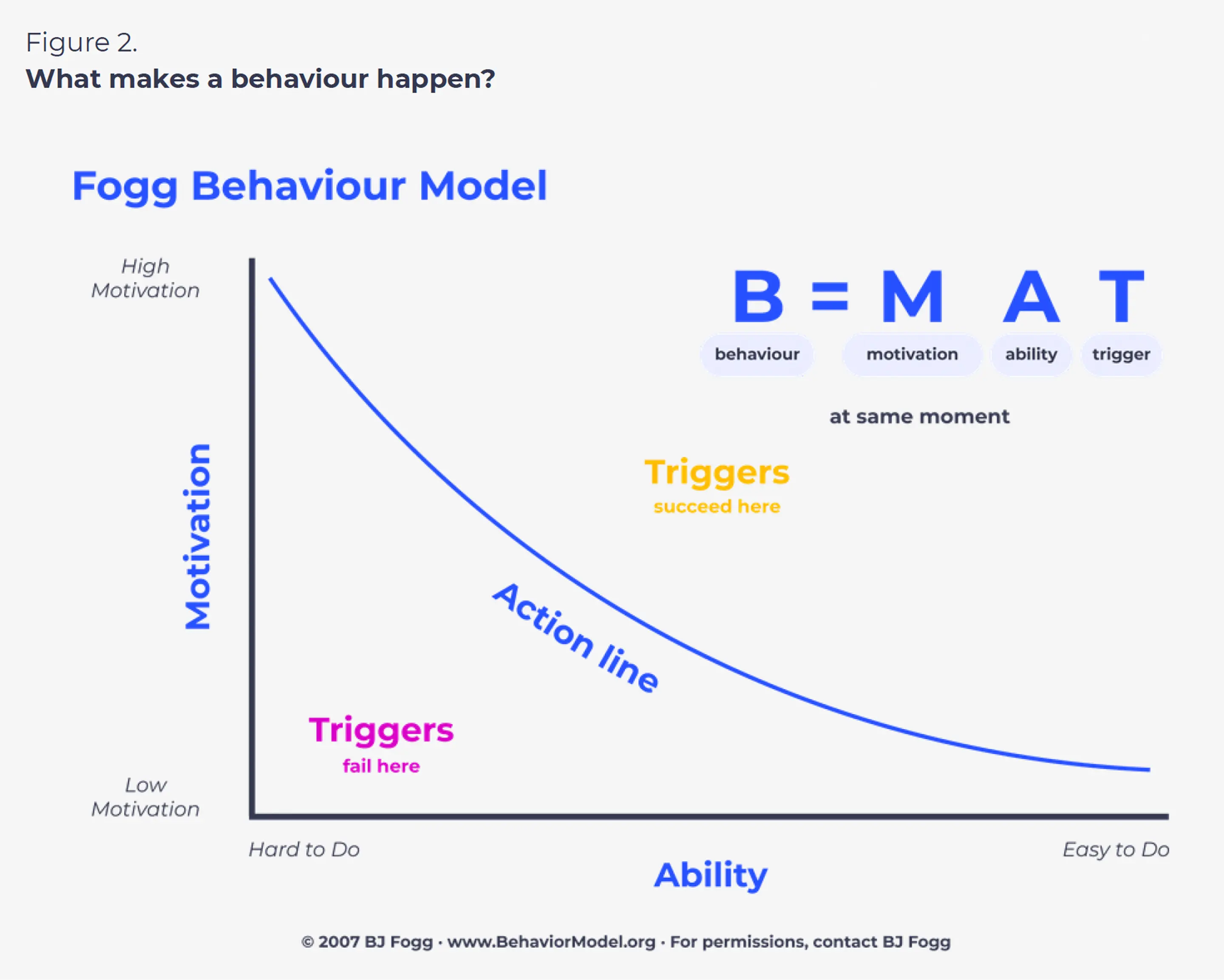
Not surprisingly, in explaining the winners and losers in a Web 2.0 world, Eyal stands on the shoulders of decades of behavioural science research. Notable amongst these is the work of Prof BJ Fogg (Director of the Persuasive Technology Lab at Stanford University), whose ‘MATʼ model helps define what drives our actions and provides product strategists with practical insight into how to design products, platforms, and ultimately ecosystems.
To get a ‘behaviourʼ, you need a Motivation to do it, the Ability to do it and a Trigger. Foggʼs first insight is to challenge every marketer to be incredibly clear on the behaviour weʼre looking for from our customers and then, importantly, to be equally clear on what motivates the behaviour (be it the motivation to: 1) seek pleasure and avoid pain, 2) seek hope and avoid fear, or 3) seek social acceptance and avoid rejection.
Far from the utilitarian world of features and pragmatic benefits, these motivations (drawn directly from Foggʼs research) are primarily emotional in nature.
From ‘innovation pain-points’ to baseline expectations
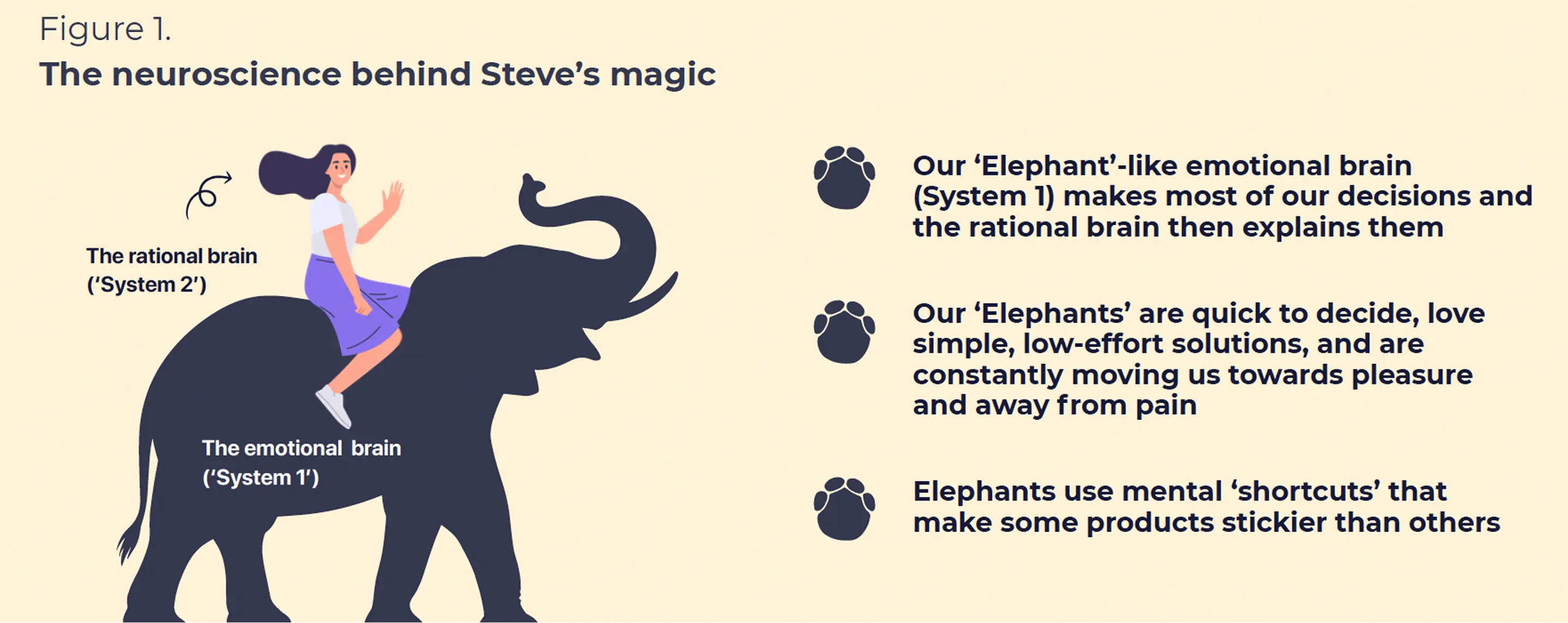
As outlined in Figure 1, Foggʼs research brought a science to something that we all intuitively know: the harder something is to do, the more you have to want it. Digging down, neuroscience can give us physiological insights into the six consistent elements of simple, habit-forming products and behaviours that, when missing, act as barriers to becoming ‘hookedʼ.
The brain is energy hungry – even hungrier than the body, in fact. So the brain is constantly on the lookout for ways to reduce energy by making this habitual and unconscious. This means new products have to actively overcome the ‘energy barrierʼ in the brain required to use them.
Even traditional marketers know that time and money represent two barriers to purchase. This, of course, is amplified online, where the incremental cost of delivering services is low and many providers have now moved to zero-cost, single-click sign-ups.
But emerging insights highlight four more ‘brain barriersʼ that will also scare your customerʼs Elephant away.
Anything out of the normal routine
Physical effort
Anything that could cause conflict with their tribe (social deviance)
Cognitive load (making Elephants think too hard)
But the important shift in mindset is that, while traditional marketing viewed these areas as pain points for innovation and competitive advantage, today they each represent an active battleground for consumer purchases and loyalty.
Put simply, itʼs not enough to be solving one or even a handful of these pain points. You need to solve all of them and do it well, because market leaders across a range of product categories have rapidly set a baseline expectation that things can be done in just one click, on demand, at a marginal upfront cost. These arenʼt differentiators anymore; theyʼre part of your right to play.
Painkillers and vitamins
In the world of Design Thinking and human-centred design, we always start with the problem or ‘pain pointʼ to be solved.
But not every pain point will give rise to a sticky, successful product. What makes the difference between a product that flops and one that succeeds?
Here, the venture capitalists have a useful yardstick: Invest in the ‘pain killersʼ, not the ‘vitaminsʼ. The reason, they argue, is that consumers rarely reach out and involuntarily buy a vitamin at 7am when theyʼre on the way to work and anxious about a headache brewing. They reach for the painkiller.
Whereas a vitamin is linked to an aspiration (being ‘healthyʼ) and solves a poorly defined need (How do you know if your vitamin was effective after you took it?), with a painkiller, you know exactly why youʼre taking it, and youʼll know pretty quickly if itʼs worked. Habit-forming ‘pain-killersʼ tend to sell themselves.
The brain on pain
Leaders around the world face the daunting challenge of selecting winning ideas for their organisations to pursue in the race to innovate. As Tesla disrupts the private car industry, for example, itʼs no secret that Germanyʼs leading institutions are racing to deliver not just an enhanced product but also a stickier, more engaging experience for their customers.
By seeing itself as a technology company first and a manufacturer second, Tesla has been fundamentally changing the industry's underlying assumptions.
For example, when Teslaʼs customers reported their frustration that the new Model S wouldnʼt ‘creepʼ at a stop sign when they took their foot off the brake (making for a jerkier start from standing, quite unlike the experience they were used to in their old car), Tesla responded quickly. How? With a software update patched through a built-in Wi-Fi chip.
Deployed in a fraction of the time it takes most automakers to run, Teslaʼs users woke up one morning to find that the software had been installed and that the new ‘creepʼ mode option could be turned on with a couple of taps.
Novelty? Sure, but also a powerful response to make sure that every frustration for the customerʼs Elephant was removed. The jarring of the customersʼ expectations at every stop sign (set up through a lifetime of driving traditional vehicles) could have rapidly eroded Teslaʼs delight factor. So they removed it.
We were exploring this case study with 300 German leaders at the YOTX Digital Disruption conference in Munich, all of whom were embedded within traditional ‘institutionalʼ organisations and struggling to get the buy-in from their colleagues to start the transition to a digital world. One of their leaders posed an interesting question: “If itʼs all about removing pain points, why is it that Facebook and Snapchat are so successful? Thereʼs no obvious ‘painkiller problemʼ. What exactly are they solving? Isnʼt Facebook the vitamin of online platforms?”
This is where neuroscience has powerful things to say. For example, Matt Lieberman at UCLA discovered that social exclusion has the same impact on the brain as physical pain (ramping up activity in a part of the brain called the ‘anterior cingulate cortexʼ). In many instances, Facebook has the same impact on the brain in resolving social exclusion as paracetamol has on the physical body. (In fact, Lieberman et al. later looked at the impact of taking aspirin for people suffering the pain of social exclusion and found it had the exact same impacts as CBT and other therapies.)
The point here is that emotional pain, including anxiety, social exclusion and loneliness, depression, future pain (just to name a few) are just as real, just as impactful and, importantly, a lot more prevalent in everyoneʼs lives.
And if buying vitamins in some way addresses these emotional pains, it sells in exactly the same way. It turns out vitamins and painkillers both sell by addressing exactly the same part of the brain, just in very different ways.
From purchase to habit creating embedded
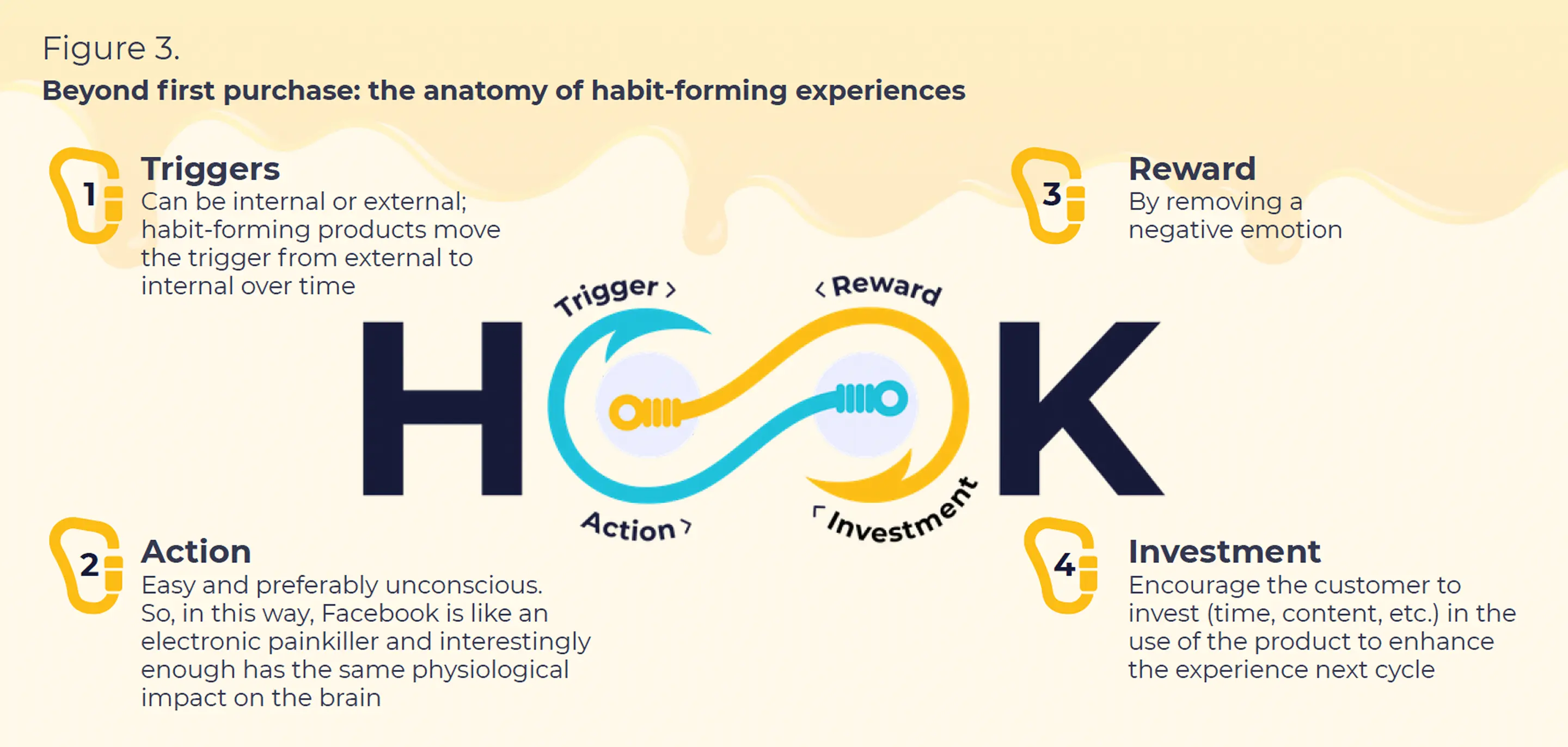
So we know that purchase behaviours need to be quick and easy, and that motivation needs to be clearly defined before our chosen trigger can kick-start our target behaviour. But how do we get from once-off behaviours to embedded, sticky customers?
As outlined in Figure 3, Nir Eyalʼs Hooked cycle has powerful insight for marketers. From the kinds of triggers to the qualities of rewards that are most successful. (Hint: the economic rewards usually wonʼt get you there!)
Tracking the trends
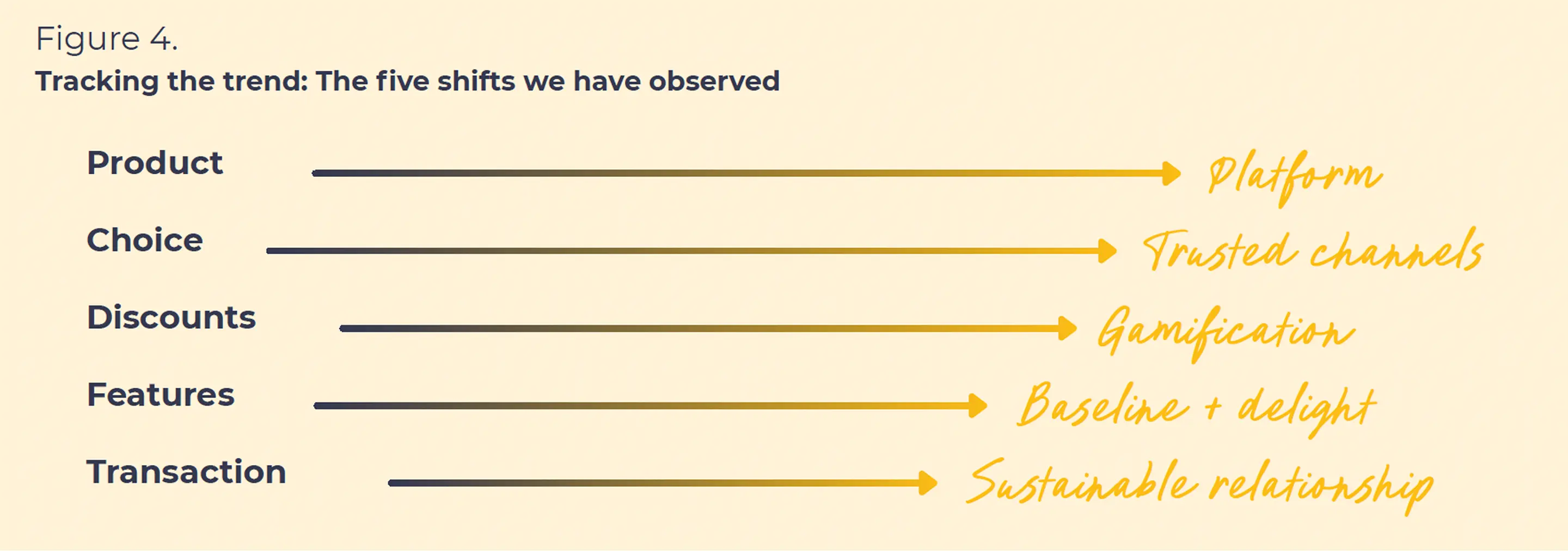
So what does all this mean for a modern marketer? As outlined in Figure 4, these shifts can be summed up into five major transitions.
1. From product to platform
Habits form over time through repetition, so not every product lends itself easily to a Hooked approach on its own. Itʼs hard, for example, for most of us to get into the ‘habitʼ of buying a house! But what about the purchases we make intermittently? And what about vendors with more than one product?
How can you hook customers? It starts with the shift from selling products to creating sticky ‘platformsʼ where customers come, engage and interact.
Facebook, Twitter, Amazon, iTunes – each of these platforms brings its customers back again and again by applying habit-forming, sticky features.
1 Making it work
How can you build valuable, sticky platforms that integrate your product into the daily life of your customers?
2. From choice to trust
The second move is from creating options and variety to focusing on building trust and credibility with customers.
Amazon, for example, measures its success by traffic rather than sales. It even goes so far as to advertise offers from other sellers on its pages. Madness? Not at all. Sure, they might lose the odd sale to a competitor, but in providing data on whatʼs around on the web, they emphasise their role as the ‘go-toʼ place for finding the best deals. This approach highlights their transparency and says they have nothing to hide.
2 Making it work
As a business, what can you do to build greater trust through demonstrated proof points of transparency, values alignment and integrity?
3. From features to experience (baseline + delight)
The third move is to shift from selling features to focusing on the customer experience. A relentless drive to simplify online experiences using Fogg's six dimensions (page 2) can go a long way toward removing frustrations and improving conversion rates. But beyond this, understanding the customer lifecycle is critical to dropping churn rates and giving your product or service the runway it needs to form habits.
Here, the critical thing is to understand the difference between a client's baseline expectations and what will delight them.
Satisfying baseline needs and being 'delighted' show up differently in the brain and have very different impacts on customer behaviour.
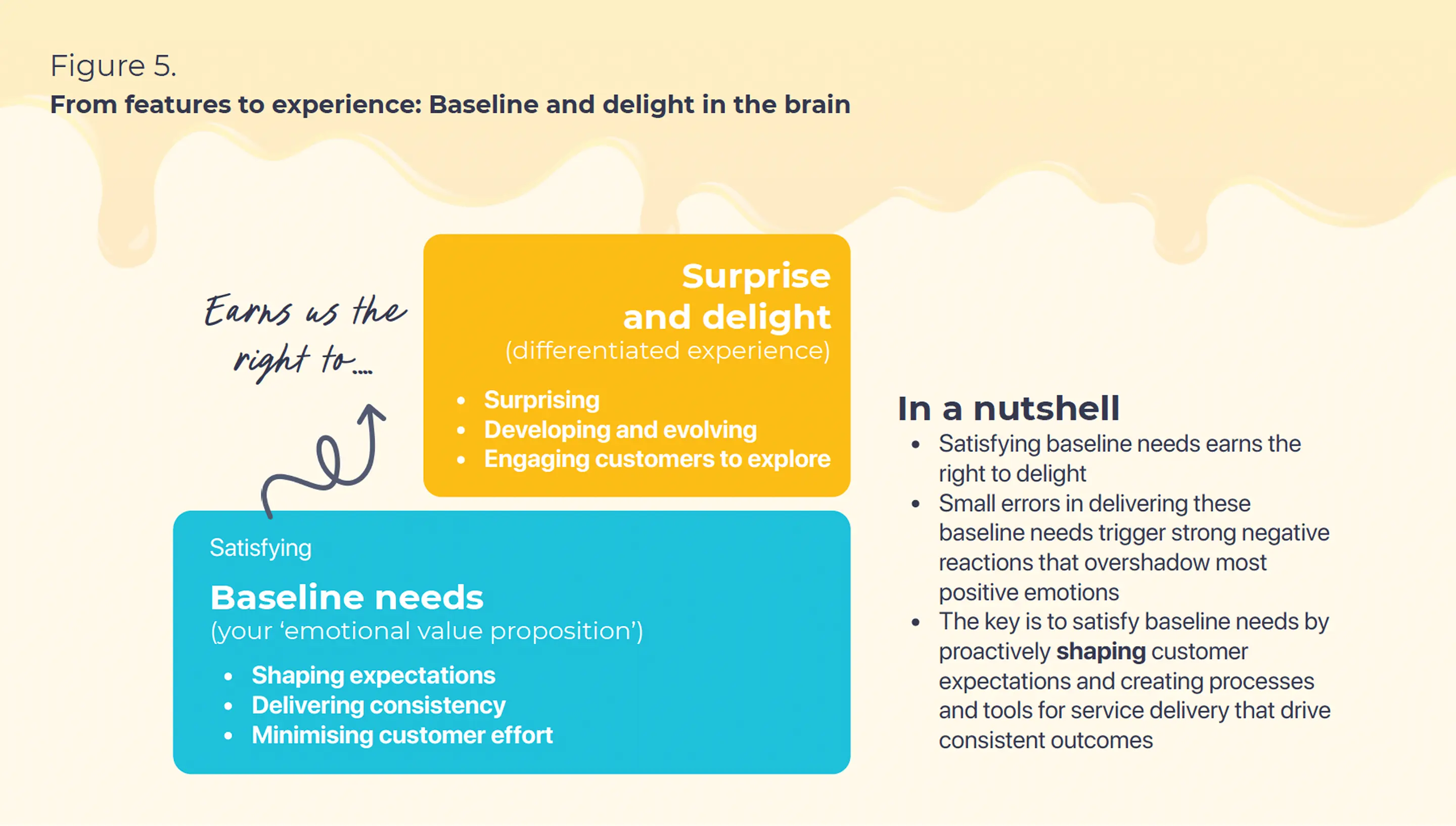
An expectation that's unmet loses you much more goodwill (and costs you far more in NPS and loyalty) than you can gain from exceeding and delighting. In fact, from the brain's perspective, you only earn the right to delight a customer when their baseline expectations have been fully met!
Deep customer research to tease out whatʼs baseline and real-time EEG tracking to spot moments of frustration and delight are powerful emerging tools in this space to help deepen our insights and drive better product and platform preference.
3 Making it work
How well does our current customer journey insight draw out what’s ‘baseline’ for our customers vs. ‘delight’? How have we engineered our systems and processes to deliver a faultless baseline experience, every time?
4. From discounts to gamified behaviour
Thereʼs now enough research evidence and enough real-world proof points to know that money really doesnʼt drive everything. And whereas the early web spurred a wave of price wars as traditional business models were disrupted and prices removed, as the web matures, weʼre seeing an alternative battleground for repeat customer purchases: gamification.
Once youʼre clear on the behaviour you want, how can you incentivise that behaviour for the customer?
4 Making it work
How can you change your motivators from being purely ‘rational’ (linked to features and benefits) to addressing one or more of the three underlying motivators to seek: pleasure and avoid pain, hope and avoid fear; and social acceptance and avoid rejection
5. From transactions to sustainable relationships
Interestingly, although you can use techniques like these to migrate people into repeated, ‘habitualʼ purchases that are nowhere near as price sensitive, and where people are nowhere near as analytical, itʼs important to remember that nothingʼs lost on the internet.
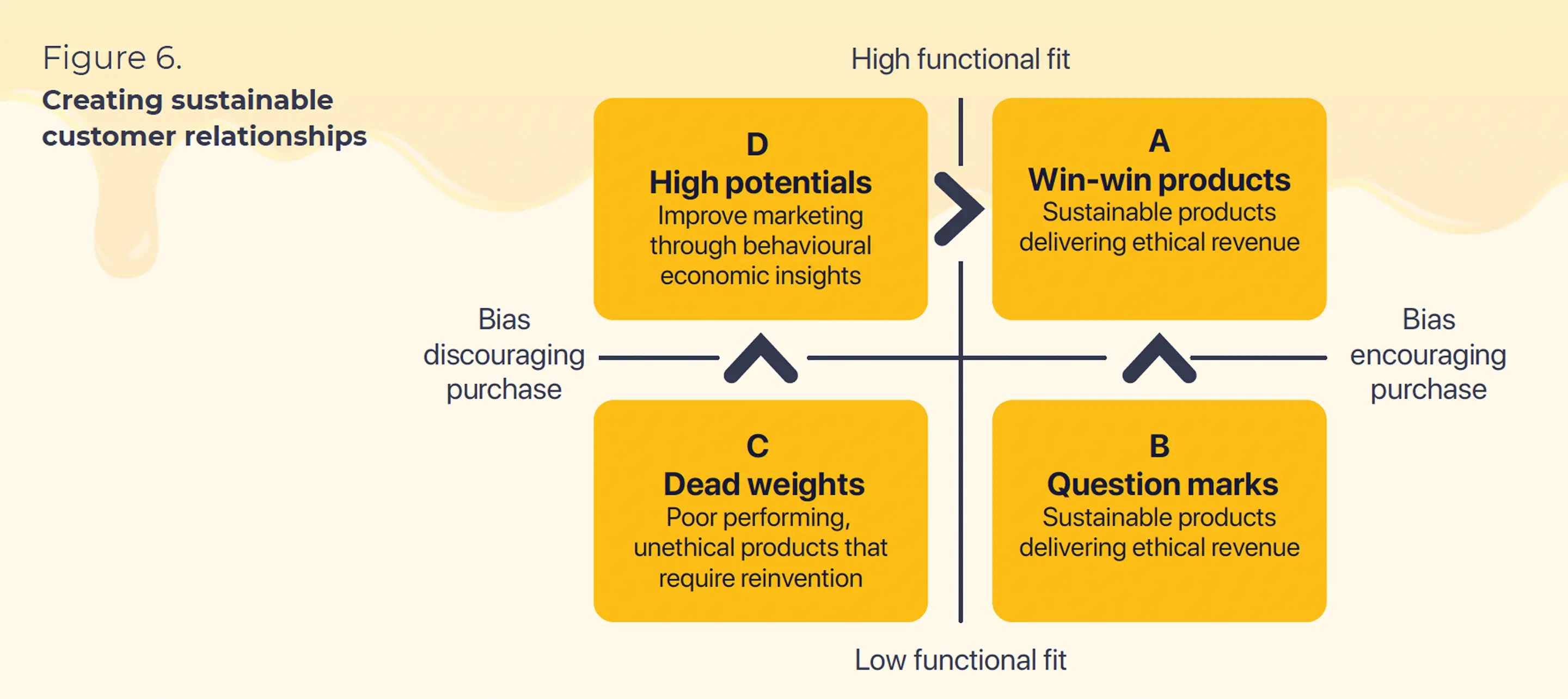
The system has a habit of keeping itself honest, with transparency at higher levels than ever before. Social media sites and dedicated forums are giving customers very public channels to vent exactly how they feel when what they think theyʼre buying and what they get donʼt line up.
This means that a strong ethical framework is needed, and companies need to be equally committed to ensuring that their products are delivering real value to their customers in both the short and longer term.
5 Making it work
How clear are we on the value our products add to our customers when they actually use them? What could we do to tangibly increase the value we deliver as a proof point for customers of our ongoing customer focus?
Getting started
1. Get beyond price and features
Identify your customerʼs deeper emotional needs and ideate ways you can satisfy these easily with a small online behaviour.
2. Build stickyness based on habit – your platform Emotional Value Proposition (EVP)
Identify the products/services/ideas that create platform stickyness. These create your ‘stickyness coreʼ or platform emotional value proposition.
3. Actively build platform trust
Help your customers build the habit of satiating their emotional needs, rather than focusing on the one-off sale. This may even mean promoting a competitor, having TripAdvisor-like feedback on products, or having a star rating.
4. Gamify
Invest in gaining deep insights into the dynamics of the ecosystem you have created. What are you incentivising? What behaviour do you want? How can you shape the reward environment to drive that behaviour?
5. Use ‘ethical marketing’ as a key lever of transitioning to a sustainable relationship
Conduct an ethical marketing audit, discover what your products look like through the eyes of your customers, and do what it takes to provide products that improve their quality of life in the long term.