
Human behaviour is a complex phenomenon that has been extensively studied by mystics, philosophers, social scientists, psychologists, neuroscientists and now, terrorism researchers.
Historically, each field has relied on its own frame of reference to explain what motivates humans to transform thoughts and beliefs into pro- and anti-social behaviours. As a result, each discipline has added layers of understanding and much needed tools to manage the risks associated with insider threat.¹
For the purposes of discussion, we define insider threat as, 'An individual who, having been granted privileged information and system access, intentionally and with malice, acts to use that information or access in a manner to harm the organisation and/or underlying entities'.² We would also like to add that insider threats are perceived to be just as dangerous (if not more dangerous) than frontal attacks as they often possess legitimate access and positions of trust within industries and infrastructure, thus, making them much harder to detect and subsequently intervene upon.³
In this article, we explore the insights from social cognitive neuroscience, social psychology, and terrorism studies, and aim to contribute to the discussion about terrorism prevention and insider threat with particular reference to the critical infrastructure sector.
Why is critical infrastructure a lightning rod for insider threats?
Critical infrastructure by definition is 'critical' for the functioning of society (e.g. water, food, transport, finance, services, power/energy etc.). These settings are of extreme interest to the most zealot radicals because, if damaged, they are seen as a punishment against the government or the associated power structures.
Furthermore, when terrorists successfully attack a piece of critical infrastructure, there is potential that the public will perceive their government as ineffective, unable to defend and protect critical services, and as such, incapable of protecting the average citizen.⁴
The loss of public trust is the worst possible outcome for any business or government and the 'gold prize' for terrorists, given the destabilisation and chaos it can cause.
With this in mind, it is essential that managers of critical infrastructure maintain constant vigilance to detect any infiltration or malicious utilisation of its environment, processes, and/or people. From this perspective, we refer to vigilance in a broader term and not in regards to just detecting weapons or explosives (granted that not all insider threats result in explosions and mass shootings). Instead, we refer to vigilance of behaviour, demeanour and social interactions.
So, how do we begin to elevate insider threat detection in critical industries?
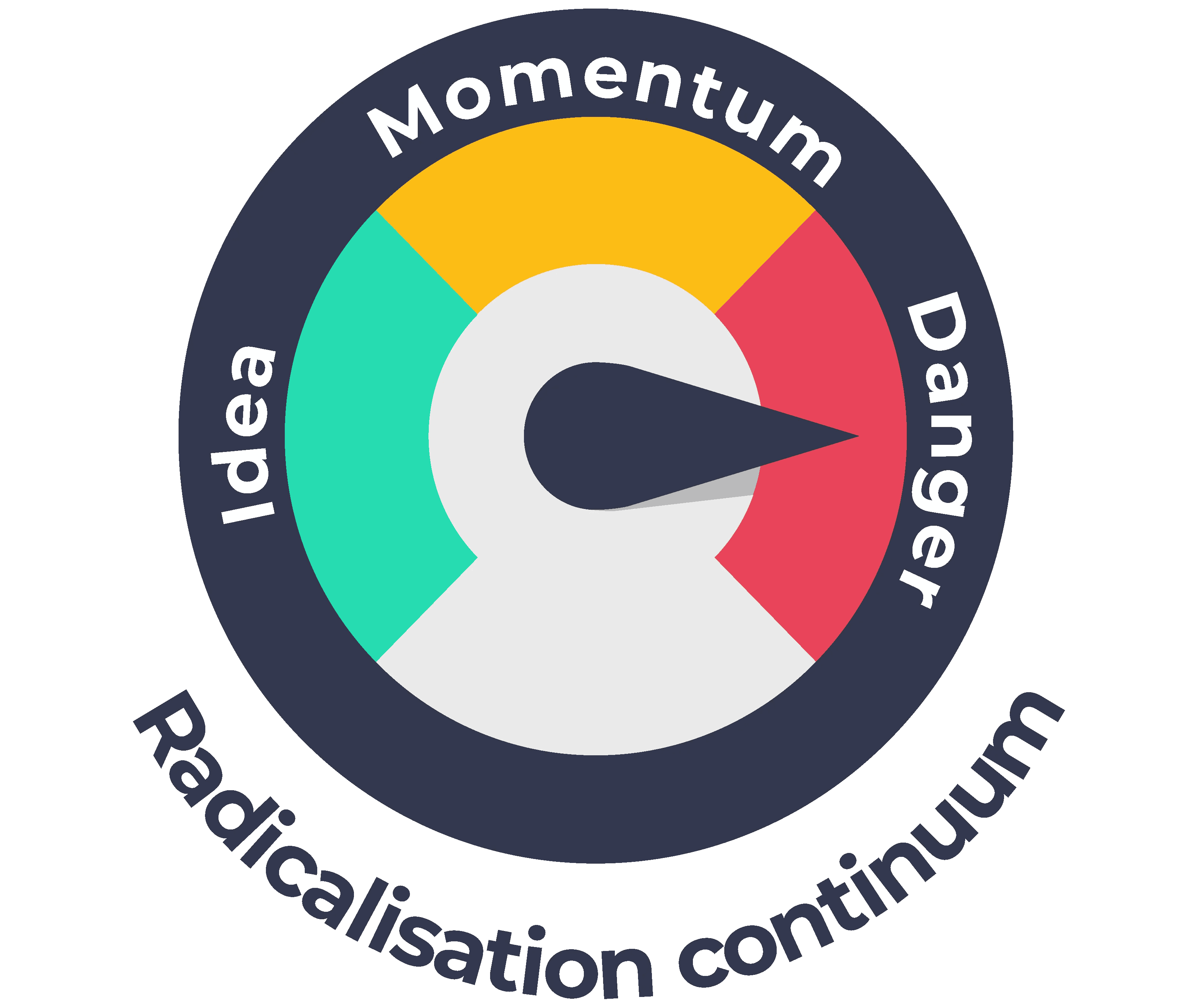
We first need to understand that acts of terrorism actually reflect the final stage of a radicalisation continuum
Humans are complex creatures; the human brain is endowed with greater complexity than the brain of many other animals. As a result, humans can reinvent themselves, their environment and their ideas just by imagining alternatives that can later be materialised.
Our lives are made up of objects and actions, that at one point originated from a faint chemical molecular and neuroelectric signal in someone's brain. Every good deed or a catastrophic terror attack was once just an idea.
The individual's cognitive landscape grows seedling thoughts that, if nurtured, give rise to behaviours in the real world. For ideas centred around malintent, there is not only a gap between ideation and action but a time which, fortunately, can be managed.
This can be done by deploying psycho-social assessment tools to track and assess employee sentiment on the continuum between ideation and action. We describe this position on the radicalisation continuum as 'momentum' or the point at which intervention and redirection is possible.

The radicalisation continuum: no single 'blueprint terrorist brain'
While many theories have been postulated about the biology, psychopathology and neurology of terrorism, evidence suggests that there is no 'one' blueprint terrorist brain.⁵,⁶,⁷ Instead, terrorist acts reflect the progression, 'nurturance' and final stage behaviour on the radicalisation continuum, to which the 'momentum' segment of the continuum provides the most opportune stage for identification and mediation to occur. For example, the culture of the immediate workplace for the individual is a mediating factor that can either accelerate or delay progress on the radicalisation continuum.
As such, it's natural that the workforce and workplace of the potential insider threat become a key focal point in breaking the progression and intended act given what we now understand from organisational psychology as being key organisational citizenship behaviours.⁸
At a conservative estimate, there is a small percentage of the critical infrastructure workforce that may be at the early stages of the continuum and therefore vulnerable to escalation. However, often their ideas are innocent or unintentional in nature (e.g. unintentionally transferring business information/data to a malicious third party).⁹ If the right triggers are in place (e.g. within the work environment or in regards to world events), they may move further along the continuum.
In some instances, particular individuals may already be on the path towards radical acts when they are hired (which existing selection tools can already flag based on the projected likelihood of theft and counterproductive behaviours).
However, if certain team dynamics and/or the work environment further fosters progression, they may become a lethal threat.¹⁰ It is also well known that lone actors use workplace environments as surrogate places to prepare, justify and conduct their attacks.¹¹
This is problematic not only from the perspective of an impending act, but also from an interpersonal perspective, as terrorists are known to use great ingenuity to persuade work colleagues (either through coercion or rewards) to share vital information that furthers their vision. Insiders with malicious intent can masterfully gather intelligence to secure their operation through social engineering and creative coercion which, when coupled with innocent team cooperation, can be a dangerous mix.
To prevent the progression further along the continuum, critical infrastructure organisations need to consider what amplifies and contains insider threat momentum in order to embed and deploy appropriate counter-measures.
What triggers radicalisation and progression through the continuum?
There is no single cause that drives people to resort to violence. Rather, it requires a culmination of inputs from both nature and nurture to transform a life-loving human being into a dangerous threat. So, what are the key inputs that may lead to weaponising a person's thinking and actions? What makes the seemingly average person choose destructive and sometimes lethal behaviours?
As early as 1974, Milgram's experiments demonstrated that people with the most innocent of intentions can be driven to act untoward if the right social 'storm' of ingredients were active, including willingly joining a hierarchy, being socialised through a hierarchy, being rewarded for obedience and having relevant authority figures present.¹²
Sound familiar? Some of these ingredients form the very core of many organisations across the world, and while these alone do not create insider threats, the work environment itself can prove conducive for individual predispositions to be triggered.
As humans, we have powerful inherent qualities that render us capable of endless creativity and persistence. We're able to envision alternative worlds and bring them to life, we discover new things every day and can innovate in the most extreme conditions. Yet, there are an exceedingly small number of us who apply this creativity and persistence in lethal and destructive ways.
So, what makes a human opt into violent pathways? Researchers affirm, 'Factors that predispose a person towards radicalisation are socio-cultural factors, such as perceived discrimination and [zealotry] religious involvement, and psychological factors, such as personality traits'.¹³
In fact, when positive and co-creative behaviours become radicalised and destructive, it's often fueled by the fusion of a chemical imbalance, a charismatic leader, particular ideologies/philosophies, past traumas and perceived injustices.¹⁴

One particular study that looked at the social determinants of radicalisation of Muslim youth in the Netherlands identified six compelling domains that have been shown to influence the process of radicalisation and terrorism.
These domains are inclusion, ostracism, agency, uncertainty, psycho-pathologies, and individual personality traits.
The six domains that drive radicalisation
1. Inclusion versus ostracism
Humans are inherently social creatures, designed to gravitate towards social groups to belong, survive and thrive. In fact, neuroscience research has shown that human beings experience considerable psychological distress if they perceive themselves to be ostracised.¹⁵ This takes the form of exclusion or rejection from a group. When someone experiences ostracism, their brain activates neural networks as if they are suffering physical pain.¹⁶ Studies have shown that ostracised individuals always favour more extreme options in support of their cause. Additionally, there is an increased willingness to destroy property.¹⁷
Ostracism is the opposite of inclusion and has a profound influence on how an individual relates to a society. Firstly, inclusion builds trust and loyalty among members of the same group. Secondly, when a person perceives they are members of a group, they decrease their compensatory behaviour aimed at earning membership. If group membership is still not afforded to them, individuals will seek other groups to belong to, even if the price is their lives.
Terrorists, gangs, and mafias know this, and capitalise on the overriding human need to belong at any cost. This is the 'we' part of the brain, the circuit that makes the individual strap themselves with explosives, to carry out the desires and aspirations of their 'in-group' to punish the 'out-group'. We can say that inclusion, which also means belonging, is one of the key domains to be strengthened in the terrorism prevention field.
2. Agency versus uncertainty
Although an individual will opt to act with violence to belong to a group, there is also another psychological and neurobiological force that pulls a person away from the group. This is the deep human need to be an individual, to personally achieve, to lead and create something of significance.¹⁸ Neuroscientists term this as the 'goal attainment' circuit, which is responsible for endowing the individual with a sense of self, achievement, control and willpower.
This self-oriented behaviour is a necessary rehearsal of agency and exertion of one's own willpower. If not developed, the child may grow unskilled in making choices and making decisions in the face of an uncertain world.
Further, if undeveloped, individuals may experience chronic low self-esteem (a term coined by psychologist Martin Seligman in 1967, as 'learned helplessness').¹⁹ It is a deep and debilitating self-belief that nothing can be done in life and that one is a victim at the mercy of an exploitative and cruel world.²⁰
If prolonged, this state of mind may lead to major mental and mood disorders. If untreated, it is likely that the individual will develop dependency. The need to feel that a person has agency, which gives a sense of control, is not only a neurobiological need; it is also a variable that we must monitor when dealing with radicalisation. Studies show that 'feelings of uncertainty are strong predictors for terrorism in response to ostracism'.²¹
Moreover, it is suggested that when the individual feels uncertain, there is a tendency to act antisocially, in pursuit of fortifying self-efficacy needs, using aggression to regain control.²¹ Lastly, it is also suggested that when individuals feel uncertain, their thinking style defaults to 'confirmation bias'.²² This limited cognition sees the individual only accept cognitive representations of the self and the world that agree with their own sense of knowing.²³
In this state of mind, the individual is unable to integrate fresh external information that contradicts their own version of truth. To create conditions that prevent individuals from falling into this downward spiral, it is essential to monitor the levels of agency and control perceived by each employee. In the context of insider threat, agency is the second aspect needing to be monitored if a bedrock of prevention is to be achieved.
3. Psychopathology
Although mental illness is not the cause of terrorism, it is recognised as being present in a significant number of terrorist actors, who have been documented and studied in the past. Specifically, researchers report the presence of schizophrenia and depression or mood disorders among jihadists.²⁴,²⁵ However, given the discrepancies in methodologies used to analyse each study, we will only discuss results that have undergone rigorously sound testing.
Firstly, we mentioned earlier that lone actors are a different profile from terrorists who are members of and operate as part of a cell. Systematic reviews about differences between the two have concluded that there is a 'higher prevalence of mental illness in lone actors'.²⁵ Moreover, the reviews show that this is accentuated when the radicalisation is about a single issue.²⁷
Considering these findings, we infer that cell-based terrorist leaders may realise the potential risks with such candidates and reject them as a measure of self-protection. These rejected players then go on to become a lone actor. Additionally, studies suggest that 'terrorists may not want to recruit individuals with mental illness because it could jeopardise their mission'.²⁸
After all, planning, resourcing and completing a terrorist operation requires complex thinking and carries considerable stress. If an individual is suffering a mental illness, this added pressure may lead to them taking reckless actions.
This may explain why lone-actor attacks are unpredictable and deadly. A lone actor has the ultimate freedom to choose timing, target and method of attack without others having a say. This is also a reason why lone actors are more difficult to detect, because in their preparation phase, they have little or no obvious discussions with anyone else. The introspective approach used by this type of terrorist makes it difficult for surveillance technology and law enforcement agents to detect. In the absence of reliable detection methods, co-workers are a valuable source of information that flag the potential lone wolf, through the identification of self-exclusion and anti-social attitudes displayed in the workplace.
4. Personality traits
Every human is unique and yet shares critical pro-social similarities with others by virtue of being human. If we were all completely different, there would be no common ground. Fortunately, we all share common traits. Humans are all pre-wired to be valued pro-social members of humanity. Each culture transmits to its members what is expected of them in terms of constructive behaviour, and to understand the punishment for transgressions.
Regardless of the cultural frame, everyone develops traits as we grow into adults. These traits define our character. We call these 'personality traits'. They give us a way of experiencing, perceiving and making meaning of our world. When we talk about terrorism, personality traits are not causal but may indicate 'proneness' towards radicalisation.²⁹
In some studies, they suggested 10 personality traits increased our proneness to radicalisation: (1) identity fusion, (2) the need for group identification, (3) low levels of empathy, (4) morbid transcendence, (5) feeling of being treated unjustly, (6) harbouring high levels of grievances, (7) rational decision-making, (8) dependent decision style, (9) cognitive complexity, and (10) uncertainty and analytical cognitive style.³⁰
We argue that instead of seeing these traits as steady state and causal, they are contextually determined and so can be mediated if detected and managed with the right intervention.
The Dark Tetrad
Unfortunately, another aspect related to personality that is far less easily managed is 'the Dark Tetrad' (DT).³¹ This is how researchers refer to the personality traits: Psychopathic³², Narcissistic³³, Machiavellianism³⁴, and Sadistic trait. Recent findings show that 'Narcissism contributed directly to radicalised cognition and behaviour'.³⁰ Similarly, Sadism was a direct contributor to radicalised cognition.³⁰ Also, they found that Machiavellianism directly contributed to radicalised cognition and indirectly to radicalisation through dogmatism.³⁰
Psychopathy was also found to contribute directly to radicalised dogmatism.³⁵ Together, these traits have the potential to form self-reinforcing clusters. If not contributors to terrorism themselves, these personalities have the potential to exacerbate the conditions in the workplace, precipitating an act by a radicalised person, who may be victimised by a person with DT personality traits. Knowing the flags that indicate employees fall within the DT is advisable because it enables you to put protocols in place to monitor and intervene as needed.³⁶
While these domains are important considerations and hold valid empirical and evidential support for monitoring insider threats, it is not to say that everyone who is ostracised or experiences psychopathologies may turn to destructive or radicalised behaviour. In fact, we want to make clear that radicalised behaviour often results from all of these factors.
As such, a number of contingencies contribute to radicalised behaviour when thrown in the mix with these particular domains.
Contingencies that influence radicalised behaviour
Contingency 1: The impact of stress on radicalisation (and progression on the continuum)
We know that stress levels lead to depletion of morale and self-control in individuals.³⁷ So, in addition to eliciting levels of workers' satisfaction and general wellness, sampling levels of workers' and workplace stress gives objective data to generate a heatmap, which highlights the most stressed individuals and teams within the facility. This helps identify the target interventions needed to mediate stress levels in the name of wellness. The right intervention can reduce the intensity and number of triggers felt by radicals towards their lethal goal. The goal here is to prevent the individual from approaching the later stages in the terrorism continuum.
From this perspective, terrorism prevention in the workplace is considered to be a workforce management and engagement role (co-management) that requires robust tools to prevent, identify, deter, deny, and respond to radicalised actors before they translate their ideas or visions into action. Terrorists and deviant ideas are similar to viruses and bacteria in that they quickly adapt and change to become resistant to known treatments. This adaptation is sometimes referred to as deviant creativity and can be countered through cultural development, which reduces momentum and equates to immunisation. In this way, a terrorism prevention plan can be seen as being similar to a vaccination schedule, in that it requires a systematic implementation of several doses to maintain the immune defences.
Contingency 2: Context is king
When an employee arrives at work, they bring their social and psychological selves. Every day, the employee's mind processes internal emotions and those elicited by events in the world around them. These include positive and negative material such as news, family issues, job-related issues, spiritual issues, economic issues and so forth. Some of these may stimulate pro-social behaviours, while others may ignite latent destructive emotions, triggering a possible acceleration towards revenge as retribution.
This is sometimes the case when a lone wolf acts in response to something that happens in the world at large. For instance, a radical young person of a minority living in Britain sees on television the invasion of their mother's homeland. As they see the images on the television, they feel humiliated, which is one of the most powerful accelerators in the terrorism and radicalisation continuum. If this is not mediated, it could result in lone-wolf violence against the closest target with affinity to the perceived enemy. This may include government buildings, officials, embassies and so forth.
With these contingencies in mind, along with the drivers of radicalisation, we believe that to detect and identify insider threats at the idea or momentum stage of the continuum, you need a holistic approach that integrates behavioural, social and organisational alignment.
How do we detect and identify insider threats (outliers) before escalation?
1. We need to embed a multi-focal lens that concentrates on a three-tiered system
As we've seen, personal tendencies can be exacerbated to drive a person to take deviant action. In conjunction with previous evidence, researchers have suggested that European youth are radicalised when there is a confluence of issues deriving from three domains.³⁸
The first is the macro-environment, which may include societal polarisation, religiosity, and geopolitics. Secondly, the micro-environment includes friendship with radical individuals and family dysfunctionality. Finally, their individual factors that may include personal uncertainty, psychiatric conditions, perceived injustice, experience of abandonment, adolescence, psychological vulnerability and trigger events. All three factors can be aggregated as interdependent ingredients to a human ecosystem that nurtures radicalisation.
One way of identifying the likely presence of outliers is by looking at the ecosystem and determining who and what the system currently rewards. If the ecosystem doesn't reward the right behaviours, seeds of discontent can grow into ideas, which can then propel individual progression along the radicalisation continuum.
We know that all life on Earth is the product of an ecosystem, all behaviours are mediated by both the internal sense of what is right and wrong, which, as mentioned earlier, comes from our internalised culture, as well as the external validation of what is expected, punished and rewarded.
So, in addition to surveillance technology, we must also sample individual self-reports (e.g. sentiment surveys) and the perception held by peers about their fellow workers.
Research shows that 'those best positioned to notice early signs of attitudes leading to terrorism or violence are friends of the radicalised person, and not families, school counsellors and clergy, as often thought'.³⁹
Tools designed to screen the workforce must go beyond the individual. They must triangulate human behaviour as a product sustained by the internal factors and the behaviours of those around, as well as the environment and processes in place.
The two profiles of terrorist actors
To find an active terrorist, one must travel to war zones, where they are in large numbers and engaged in armed struggle. Conversely, identifying those who are already radicalised or who are in the process of progressing through the continuum is not so straightforward or simple.
The search requires a holistic view of the ecosystem that nurtures the individual from extremist thinking to radical behaviours. It is this transition that completes their journey, culminating in an act of terrorism.
We know that acts of terror are conducted by two kinds of actors, the terrorist who carefully plans, recruits and attacks, and the other is more introspective. The first type is not alone in its quest to achieve the final act; instead, they rely on a cell or network of support. Support for a terrorist act may be in the form of ideas, access, money, materials, or moral or ideological support. This type of terrorist is supported and enabled by a group.
The other type of terrorist is the introspective actor who tells nobody, engages no one and acts by opportunistic chance. This terrorist is discreet, detached and does not signal their plans. We can infer that their personality is distrustful of others, perhaps socially withdrawn and lacking in social mores (when compared to peers within the work context).
These two approaches to terrorism are clearly from two different personality styles.
2. We need to elevate thinking beyond the immediacies of culture, ethnicity or religion
The first task, therefore, when identifying outliers, is identifying the correct cluster to which they belong. During this process, we must ensure that we do not demonise ethnic, cultural and religious attributes. There is no evidence that religious belief, cultural origin and ethnic origin cause terrorism.
This warning is warranted because there are instances in which Westerners have misinterpreted pious behaviour from other cultural norms, such as the need to pray during the day, as a fanatical practice.
This is not the case; this gross assumption stems from intercultural incompetence on the part of the judging individual. This type of incompetence further risks demonisation of legitimate cultural practices in the workplace, increases stress, decreases cohesion, and erodes the very culture we are advocating that prevents radicalisation.
Detecting an outlier is easy in an environment where everyone is known and comes from the same ethnic, cultural, religious, and linguistic background. In the global workforce, however, this does not exist because there is no single template of an overarching culture. In the natural setting, each culture reinforces what it deems to be 'normal' and what is not, giving rise to salient features about how people behave and how individuals should be compelled to stay within the expected cultural norm.
When searching for outliers, we must not examine only the oddities of people, but also consider the cultural bubble in which they operate. How well have members aligned their behaviours with the culture of the workplace? Is there a conflict of values, faith, ethnicity or politics? Have they been personally hijacked by grievances brought into the workplace by another member of the team? Has a new member awakened old-standing grievances due to racial, religious or political dynamics of the past? Not all findings need to be actioned. But they are critical pixels that bring greater clarity to the picture, so we can detect consistencies and inconsistencies and assess whether potential employees are on the continuum.
For instance, we would not expect a doctor or nurse working in a medical setting to undermine efforts towards vaccination and hygiene. Neither would we expect a person working on security and terrorism prevention to endorse and normalise the proselytisation of extremism within the team. Participation and abetting terrorism takes the form of active support, passive permissiveness and sheltering.
Any evolving extremist philosophy and behaviour in the workplace must be identified and dealt with. Toxic individuals and their ideas are like viruses; they grow if conditions permit.
Human nature is malleable, vulnerable, and constantly evolving. Whatever is occurring in the environment will have a lasting effect on the behaviour of the human cohort within that 'bubble'. A radical idea that is evolving may eventually transform into a powerful motivation capable of causing death and destruction.
This evolutionary progress and malleability are what enable an amateur to develop and master a sport to Olympic level (through practice, ongoing exposure and support). The continuum of radicalisation charts a similar, although more sinister, path. It evolves from ideas and experiences to an act of terror that, in the terrorist's mind, rights the wrongs.⁴⁰
Terrorism is a process that requires gradual preparation, resourcing and final action. An ungoverned, extremist ecosystem is critical to achieving this lethal goal. This being the case, we can implement early detection systems, prevention schemes and interdiction protocols that protect our people and our assets by identifying the presence of such ecosystems or the pre-existing conditions that enable them to flourish.
We have invested heavily in technology; now we must lift our game in the human part of the equation. Increased unpredictability in the workplace, with pandemics and unstable political leadership, may further deteriorate existing dynamics, creating chaotic, ungoverned spaces. This is further complicated by emerging threats posed by social media and fake news.
COVID-19 and new conditions for insider threat
It is worth noting that the current human threat posed by the pandemic of COVID-19 has created new conditions for terrorism, and so just as we're adapting to our new world, so too are radicals and insiders.
The challenges ahead, such as COVID-19, cannot be addressed solely with better technology; instead, we need human systems that subtly and ethically sample workforce sentiment to determine whether radicalisation precursors exist and preventive action is needed.
For example, as employees are laid off or sent home, they may, unintentionally, exchange work-related information with friends and peers, creating the risk of cyber interception known as 'man in the middle attack' or MITM.⁴¹ This is the unauthorised interception of data in the middle being exchanged between two parties.
Employees sent home to rest or work during COVID-19 lockdowns around the world have been using their own phones, tablets and laptops with inadequate cybersecurity. This temporary laxity in standard safeguards has significantly increased the vulnerability of critical infrastructure. Nobody knows how much data has been intercepted, where it may be warehoused, or how it may be used in the future. We can hypothesise that sensitive details of critical infrastructure have leaked out, intentionally or unintentionally. The problem here is that we won't know where it ended up until it's too late.
Terrorists are adaptive, passionate, resilient, persuasive, and committed. They use emerging threats to their advantage. The need for an appropriate tool to address emerging threats is paramount. Prior to the pandemic, the most serious insider threats were espionage, sabotage, terrorism, embezzlement, extortion, bribery and corruption. Malicious activities included an even broader range of exploits, such as negligent use of classified data, fraud, cybercrime, unauthorised access to sensitive information, and illicit communications with unauthorised recipients.⁴²
These will continue to be the case, with the added complexity of COVID-19's economic and political fallout. This period simply intensifies the terrorists' ability to further radicalise and weaponise people and systems against authorities who are increasingly being perceived as ineffective.
3. We need to focus on amplifying pro-social behaviours and promoting acts of inclusion and wellness
Humans are all endowed with creativity and the capability to imagine, conceptualize and then action behaviours in the physical world. If the ideas are noble and constructive, the world benefits from these actions. If the ideas are toxic, extreme and destructive, the world suffers. Fortunately, all cultures on the planet have a default bias towards pro-social behaviour.
This means that most humans will be nurtured by their cultural norms to become proficient in ethical and moral behaviours and be good members of society. Unfortunately, there are a small number of individuals in all cultures that, for many reasons, fail to internalize the culture's pro-social drivers. They fail to adopt the social norms and become extreme outliers.
Even though for the majority of the population, human neurobiology wires the brain to comply, follow and belong to a cultural human group,⁴³ for very few, this is not the case. Being wired to belong is evolution's way of ensuring we develop loyalty to the group that ensures survival.
This requires us to suppress our personal urges for the sake of others. For some, the evolutional need to be a valued part of the group is overridden by personal urges and self-interest.
These are the individuals who we need to identify, manage and support. Failure to do so, may result in the outliers resorting to destructive means to fulfill their needs, particularly because they perceive that their needs are above the needs of others.
Most dangerously, they can act to the detriment of society because they do not see themselves as part of it and normal social constraints do not affect them.
The insider threat journey
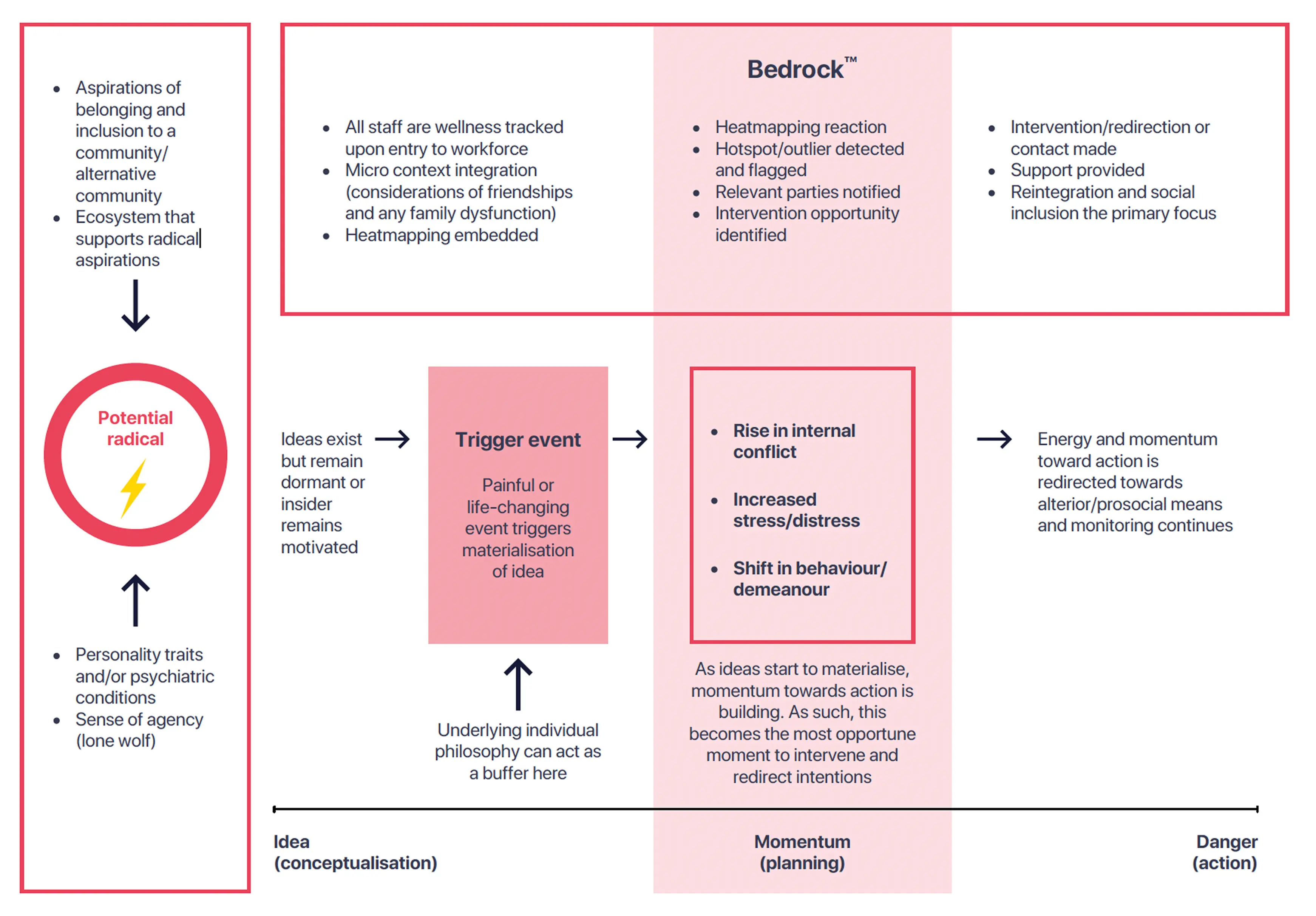
The journey from idea to action plotted across three stages of the continuum:
Idea (conceptualisation): Ideas exist but remain dormant or insider remains motivated. Underlying individual philosophy can act as a buffer here.
Trigger event: Painful or life-changing event triggers materialisation of idea.
Momentum (planning): Rise in internal conflict, increased stress/distress, shift in behaviour/demeanour. As ideas start to materialise, momentum towards action is building. As such, this becomes the most opportune moment to intervene and redirect intentions.
Danger (action): Energy and momentum toward action is redirected towards alterior/prosocial means and monitoring continues.
Potential radical inputs: aspirations of belonging and inclusion to a community/alternative community; ecosystem that supports radical aspirations; personality traits and/or psychiatric conditions; sense of agency (lone wolf).
Bedrock™ intervention layer: all staff are wellness tracked upon entry to workforce; micro context integration (considerations of friendships and any family dysfunction); heatmapping embedded; heatmapping reaction; hotspot/outlier detected and flagged; relevant parties notified; intervention opportunity identified; intervention/redirection or contact made; support provided; reintegration and social inclusion the primary focus.
The above model represents the many forces at play that drive radicalisation from ideation to action along the continuum.
While the individual is graphically shown to be embedded in the need to belong, their ecosystem, their need for agency and their own psychological traits, their path to radicalisation is often driven by a trigger event. This, in turn, is driven by the accompanying stress or distress from that event, the potential stress felt in their workplace, their micro environment and, most presciently, their philosophy.
From entry to exit from the workplace, various 'touch-points' are important to monitor when managing the stress experienced by the individual throughout their career lifespan.
This can be achieved through a number of existing occupational tools, to which Bedrock™ aims to align. Bedrock™ acts as a behavioural identification and social-cognitive intervention tool designed to redirect/halt the progression of the individual along the radicalisation continuum.

What is our proposed mechanism for detecting insider threats?
Bedrock™ is a tool designed to collect data at the three core ecosystem layers (macro, micro and individual) and subsequently triangulate it with psycho-social measures of stress and wellbeing.
Bedrock™ utilises existing employee intake data within critical infrastructure settings and takes a wellness approach by tracking occupational wellbeing as a mediating mechanism.
By taking this approach, we optimise the opportunity to prevent the development of a rogue element within the organisation and to ensure workers remain at the very early, nascent stages of the radicalisation continuum.
It is essential that, in teams working within critical infrastructure, we deploy Bedrock™ to evaluate the social and psychological dimensions that focus primarily on the overall levels of wellness, satisfaction and stability of individuals within the wider workforce. As such, this enables us to highlight individuals who fall outside the norm (outliers).
An effective preventive intervention may help these outliers reduce the intensity of their grievances, prevent their advancement to later stages of the radicalisation continuum, and ultimately prevent a terrorist act. As noted, Bedrock™ takes a strengths- and health-based approach to detecting insider threats.
We believe that by monitoring the healthy setpoints of these human dimensions, we can identify and ultimately negate conditions that may nurture radicalisation and terrorism within the critical infrastructure environment.
As an added benefit, Bedrock™ also complements existing recruiting and management tools in the workplace.⁴⁴

Conclusion
Humans are the bedrock of business and deserve just reward, care and trust. Emerging research in the field of terrorism and radicalisation has helped better understand the conditions that lead to terrorist acts. Utilising principles and insights from neuroscience, behavioural science, psychology, AVSEC, and terrorism studies, we can design and update tools to prevent, detect, deny and respond to insider threats.
References
BaMaung, David, David McIlhatton, Murdo MacDonald, and Rona Beattie. "The enemy within? The connection between insider threat and terrorism." Studies in Conflict & Terrorism 41, no. 2 (2018): 133-150.
Delosreyes, Garry C. Mitigating Insider Threat Risk. Utica College, ProQuest Dissertations Publishing, 2017. 10686094
Catrantzos, Nick. "Managing the insider threat: no dark corners". (2012; pg 4). CRC Press, Taylor & Francis Group: Florida, US.
National Academy Press and National Research Committee. "Making the nation safer: The role of science and technology in countering terrorism" (2002). National Academy of Science publication: Washington, D.C.
Victoroff, Jeff. "The mindset of the terrorist: A review and critique of psychological approaches". (2005). Journal of Conflict Resolution 49, no. 1, pages 3-42.
Borum, Randy. "The psychology of terrorism". (2004). The University of Florida, Tampa.
Bergen, Peter, Ford, Albert, Sims, Alyssa, & Sterman, David. "Part II: Who are the terrorists?". (2020). New America: International security in depth.
Yaakobi, Erez, & Weisberg, Jason. "Organisational citizenship behaviour predicts quality, creativity, and efficiency performance: The roles of occupational and collective efficacies". (2020). Frontiers in Psychology 11, 758.
Ali, Zehra. "Insider threats: 2018 statistics". (2018). U.S. Cyber threats landscape – the human factor.
Malthaner, Stefan, and Lasse Lindekilde. "Analyzing pathways of lone-actor radicalisation: A relational approach." Constructions of Terrorism (2017): 163-180.
Wright, Lance. "Reducing Workplace Violence." In People, Risk, and Security, pp. 171-186. Palgrave Macmillan, London, 2017.
Milgram, S. (1974). Obedience to authority: An experimental review. New York: Harper & Row.
McCauley, Clark, and Sophia Moskalenko. "Mechanisms of political radicalisation: Pathways toward terrorism." Terrorism and Political Violence 20, no. 3 (2008): 415-433.
Doosje, Bertjan, Annemarie Loseman, and Kees Van Den Bos. "Determinants of radicalisation of Islamic youth in the Netherlands: Personal uncertainty, perceived injustice, and perceived group threat." Journal of Social Issues 69, no. 3 (2013): 586-604.
Cacioppo, Stephanie, and John T. Cacioppo. "Research in social neuroscience: How perceived social isolation, ostracism, and romantic rejection affect our brain." In Social Exclusion, pp. 73-88. Springer, Cham, 2016.
Eisenberger, Naomi I., and Lieberman, Matthew D. "Why rejection hurts: a common neural alarm system for physical and social pain". Trends in Cognitive Sciences 8, no. 7 (2004): 294-300.
Cacioppo & Cacioppo (2016).
Burow, Peter. NeuroPower. Victoria, Australia: Copernicus Publishing Pty Ltd (2008).
Peterson, Christopher. "Learned helplessness." The Corsini Encyclopedia of Psychology (2010): 1-2.
Onoda, Keiichi, Yasumasa Okamoto, Ken'ichiro Nakashima, Hiroshi Nittono, Shinpei Yoshimura, Sigeto Yamawaki, Shuhei Yamaguchi, and Mitsuhiro Ura. "Does low self-esteem enhance social pain? The relationship between trait self-esteem and anterior cingulate cortex activation induced by ostracism." Social Cognitive and Affective Neuroscience 5, no. 4 (2010): 385-391.
Pfundmair, Michaela. "Ostracism promotes a terroristic mindset." Behavioural Sciences of Terrorism and Political Aggression 11, no. 2 (2019): 134-148.
Klayman, Joshua. "Varieties of confirmation bias." Psychology of Learning and Motivation 32 (1995): 385-418.
Kossowska, Małgorzata, Aneta Czernatowicz-Kukuczka, and Maciej Sekerdej. "Many faces of dogmatism: Prejudice as a way of protecting certainty against value violators among dogmatic believers and atheists." British Journal of Psychology 108, no. 1 (2017): 127-147.
Yakeley, Jessica, and Richard Taylor. "Terrorism and mental disorder, and the role of psychiatrists in counter-terrorism in the UK." Psychoanalytic Psychotherapy 31, no. 4 (2017): 378-392.
Mohamed, Yusuf H. "Using psychometrics to enhance HR management and insider threat detection". (2018). Dissertation.
Misiak, Błażej, Jerzy Samochowiec, Kamaldeep Bhui, Merryam Schouler-Ocak, Hella Demunter, Levent Kuey, Andrea Raballo, Philip Gorwood, Dorota Frydecka, and Geert Dom. "A systematic review on the relationship between mental health, radicalisation and mass violence." European Psychiatry 56, no. 1 (2019): 51-59.
Ibid.
Ibid, pg 55.
Ibid, pg 56.
Ibid, pg 57.
Chabrol, Henri, Jonathan Bronchain, Clara Isabel Morgades Bamba, and Patrick Raynal. "The Dark Tetrad and radicalisation: personality profiles in young women." Behavioural Sciences of Terrorism and Political Aggression 12, no. 2 (2020): 157-168.
Hamden, Raymond H. "Psychology of Terrorists: 4 types." In Based on a workshop presented at the September 2006 Conference American Board of Certification in Homeland Security. 2006.
Ruby, Charles L. "Are terrorists mentally deranged?" Analyses of Social Issues and Public Policy 2, no. 1 (2002): 15-26.
Pailing, Andrea, Julian Boon, and Vincent Egan. "Personality, the Dark Triad and violence." Personality and Individual Differences 67 (2014): 81-86.
Chabrol et al. (2020).
Noonan, Christine F. Spy the Lie: Detecting Malicious Insiders. No. PNNL-SA-122655. Pacific Northwest National Lab. (PNNL), Richland, WA (United States), 2018.
Kandias, Miltiadis, Alexios Mylonas, Nikos Virvilis, Marianthi Theoharidou, and Dimitris Gritzalis. "An insider threat prediction model." In International Conference on Trust, Privacy and Security in Digital Business, pp. 26-37. Springer, Berlin, Heidelberg, 2010.
Campelo, Nicolas, Alice Oppetit, Françoise Neau, David Cohen, and Guillaume Bronsard. "Who are the European youths willing to engage in radicalisation? A multidisciplinary review of their psychological and social profiles." European Psychiatry 52 (2018): 1-14.
Williams, Michael J., John G. Horgan, and William P. Evans. "The critical role of friends in networks for countering violent extremism: Toward a theory of vicarious help-seeking." Behavioural Sciences of Terrorism and Political Aggression 8, no. 1 (2016): 45-65.
Huesmann, L. Rowell. "How to grow a terrorist without really trying: The Psychological Development of Terrorists from Childhood to Adulthood." Cambridge Scholars Press, 2010.
Dan, Swinhoe. "8 Ways attackers are exploiting the COVID-19 crisis". CSO Australia, 15 May 2020. https://www.csoonline.com/article/3532825/6-ways-attackers-are-exploiting-the-covid-19-crisis.html
Noonan, Christine F. Spy the Lie: Detecting Malicious Insiders. No. PNNL-SA-122655. Pacific Northwest National Lab. (PNNL), Richland, WA (United States), 2018.
Over, Harriet. "The origins of belonging: social motivation in infants and young children." Philosophical Transactions of the Royal Society of London. Series B, Biological Sciences vol. 371, 1686 (2016): 20150072. doi:10.1098/rstb.2015.0072
Bedrock is designed to be an integrator, not a replacement. It is akin to the role played by imaging technology such as CT scans, ultrasonography, fMRI and X-rays in biomedicine. Each tool enables practitioners better assessment and proof of existing issues. It helps better location, diagnosis and prognosis.