
How well does your organisation develop strategic relationships with its key stakeholders, customers and partners? All too often, the development of strategic business relationships is left to chance and the personal skills of executives rather than being proactively negotiated and shaped to deliver the most value to both parties.
Over and over again, we have seen suppliers assume one type of relationship and clients assume a very different one. This often leads suppliers to over-invest in activities or advice that the client may not recognise or value. The key to all highly successful partnerships is that they must be negotiated and defined. The Strategic Relationship Management Framework allows you to do this.
What is Strategic Relationship Management?
Clear expectations are vital to managing relationships. This paper explores the fundamentals of relationships by identifying different relationship types as summarised in the Strategic Relationship Matrix. This matrix analyses relationships on two axes – complexity and interaction.
Businesses run better when key relationships are well managed. This type of interaction involves a client and a service provider. Building this 'social capital' means forming the most appropriate and highest quality type of relationship. In today's environments of constant change in organisational structure and staffing, building this 'social capital' requires strategic relationship management.

What are the benefits?
The service provider fully understands what the client values most from the relationship and can therefore deliver an improved service.
The client is able to communicate much clearer expectations to the service provider, thereby ensuring the highest possible value is delivered.
Both the client and the service provider benefit from clear processes to resolve misunderstandings in prioritisation and delivery standards.
Both the client and service provider enjoy higher staff morale within their teams as a result of clear objectives and regular feedback.
Where do you start?
Good relationships do not happen by chance. Whether we are aware of it or not, most good relationships are built on a process that defines, values, sets expectations and governs interactions.
There are fundamentally different types of relationships. Each type has very different expectations. Understanding this is vital to effective relationship management. When a client and a service provider have different concepts about what their relationship is based on, conflict and disappointment tend to follow.
This is because both parties need to agree on what the fundamentals of their relationship are before they can begin building the quality of this relationship.
What are the different types of relationships?
Vendor
A Vendor partnership is characterised by an infrequent transactional relationship whereby the service provider supplies the client with an on-demand product or service. In this type of relationship, speed and cost are most important.
Contributor
A Contributor partnership is characterised by infrequent specialist advice or support. In this type of relationship, technical expertise and flexibility are most important.
Preferred supplier
A Preferred supplier partnership is characterised by a frequent transactional relationship in which the service provider regularly provides the client with a product or service in return for loyalty from the client. In this type of relationship, reliability and product fit are most important.
Trusted advisor
A Trusted advisor partnership is characterised by frequent specialist advice, support and decision-making. In this type of relationship, context and expert knowledge in a broad area are most important.
How can I use the Strategic Relationship Matrix?
What is important is that both the service provider and client understand and agree on how the relationship is defined.
If the client and service provider have different understandings of the 'what' and 'how' of the relationship, it will lead to fundamental conflict where expectations are broken, causing deep-seated distrust and a breakdown in the relationship.
A common misalignment that occurs is when the service provider wants to be in a different quadrant of the matrix than the client. This means the service provider is providing a different type and therefore not valuing the same things as the client. This can cause the service provider to feel underappreciated or to charge the intrinsic value of the product or service they are providing. In this situation, both parties need to discuss where they are on the relationship matrix and negotiate the type of relationship they both want, and that will work best in the current situation.
Diagram 1 – Strategic Relationship Matrix
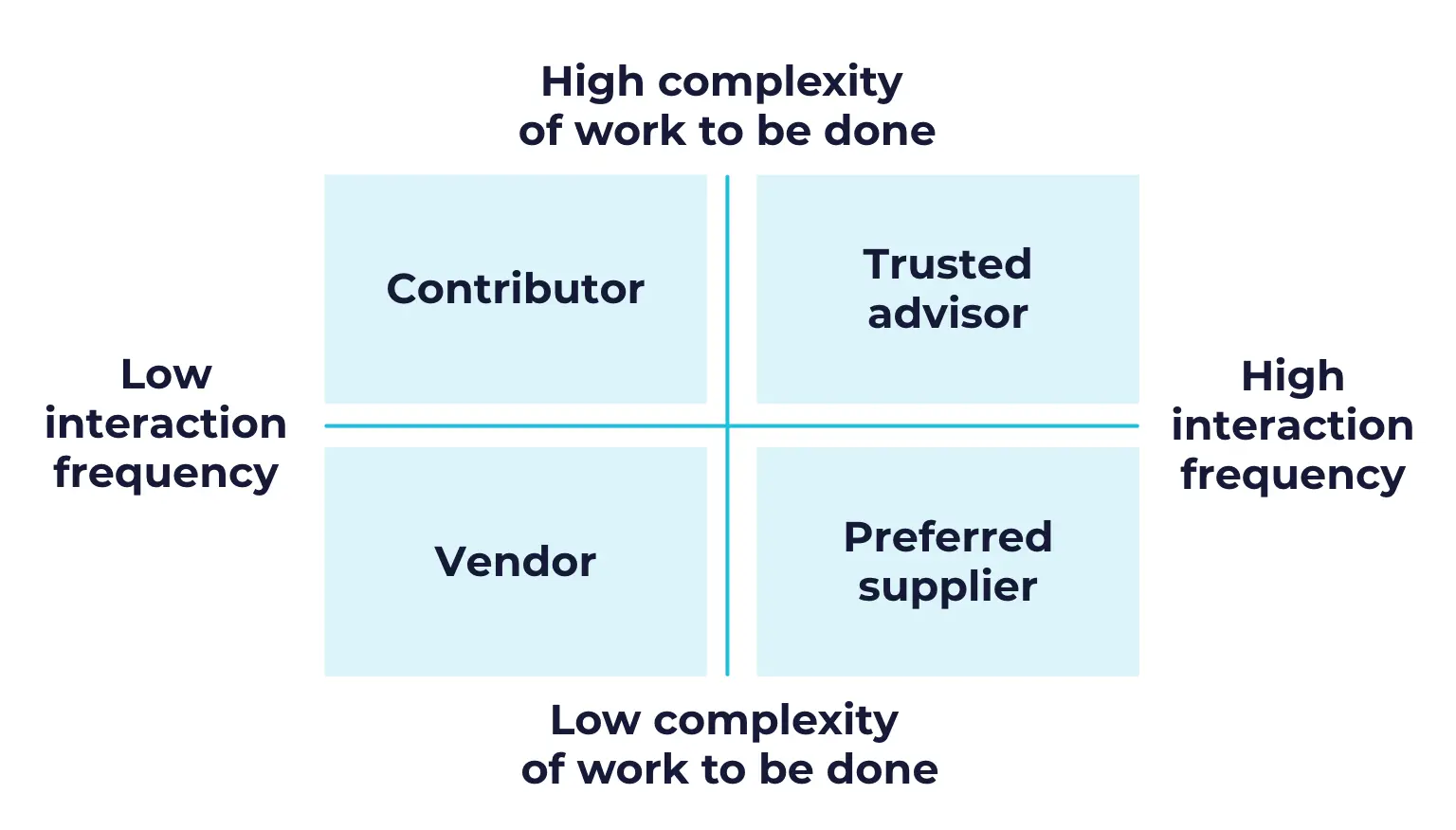
As the breadth of the service provider's type is negotiated, the quality of the relationship can only be changed through effective relationship management.
Once both parties understand and agree on how the relationship is defined, the quality of the relationship can be improved. This means ensuring the relationship foundations are strong, with a clear value proposition, and building relationship qualities such as trust, reliability, credibility and creative authenticity.
Can you build a quality relationship in any of the four quadrants?
Regardless of the form a relationship can take, its quality can also vary depending on the level of trust, credibility and reliability.
Improving the quality of a relationship brings into play the benefits discussed earlier, such as lower levels of stress, the benefit of the doubt and improved information sharing, which make it easier to deliver a quality service.
It also has a significant effect on your ability to negotiate and get things resolved when required.
Where to from here?
In this paper, we've focused on the Strategic Relationship Matrix as a lens to clarify some of the most important expectations of a professional relationship. We recommend you take the following steps to ensure the most productive business partnership possible.
Establish a clear value proposition for the relationship
Plot the relationship position on the Relationship Matrix
Develop strategies to align expectations between client and provider
Negotiate the breadth of the business issues to be addressed – scope
Manage the depth of the professional relationship
Establish internal processes that support the type of relationship selected – try not to under-invest or over-invest in processes and systems to support the relationship
This process enables long-term relationships to be formed on the basis of clear expectations, deliverables and value.